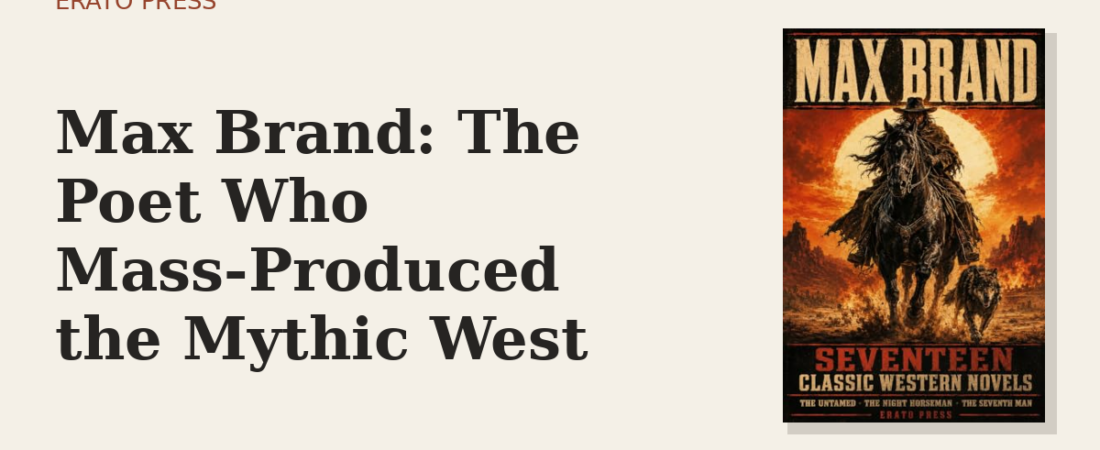
The man whose name was Max Brand did not exist, and the man who wrote under it wanted to be remembered for something else entirely. Frederick Schiller Faust — and the middle name is a clue, given by a father who loved the German poets — produced an estimated thirty million words of fiction across his working life, under some twenty pseudonyms, at a rate that beggars belief: Westerns, detective stories, historical romances, the Dr. Kildare series that became films and a radio show, spy thrillers, and pulp adventure of every description. He wrote so much that no one has ever made a complete count of it. And the whole time, the prolific, exhausted, magnificently overpaid machine of “Max Brand” believed his real work was the epic poetry he composed in private, in the manner of the ancients, and which almost no one read.
This is the central irony of Faust’s career, and it is also the key to why his Westerns are stranger and better than their disposable origins suggest. He brought to the pulp Western a sensibility formed entirely by classical epic — by Homer and the Arthurian romances and the Norse sagas — and the result was a body of work that took the cheapest, most formulaic genre in American publishing and infused it, almost in spite of itself, with the architecture of myth.

The machine: thirty million words and the contempt of the man who wrote them
Faust was born in Seattle in 1892, orphaned young, raised in poverty in California’s Central Valley, and put through a self-education ferocious enough to leave him fluent in the classics. He wrote at industrial speed because he needed industrial money — for a Florentine villa, for a lavish life, for the leisure to write the poetry he cared about. By the 1920s he was producing for the pulps, above all Western Story Magazine, at a pace of thousands of words a day, dictating and typing plots he could assemble in his sleep. He held the genre he was conquering in something close to contempt, regarding it as honest hackwork that subsidised his true vocation.
And yet contempt, in Faust’s case, was a kind of liberation. Because he did not respect the Western, he did not feel bound by its claims to authenticity. He had no interest in the texture of real ranch life, the price of cattle, the geography of actual trails. He treated the West as the Greeks treated the plain of Troy: a stage for archetypes. His heroes are not weathered cowhands but demigods — impossibly fast, impossibly skilled, marked out by fate. The very laziness of the genre freed him to write the only kind of story he genuinely knew how to write: the heroic legend.
The poet beneath the pulp: Destry, Dan Barry, and the mythic hero
Read Destry Rides Again (1930) — the source, loosely, of the famous James Stewart and Marlene Dietrich film, though the novel is darker and colder than the comedy Hollywood made of it — and you find a revenge plot built on a frame as old as the Odyssey: a man wronged, exiled, returning transformed to deal justice to those who betrayed him. The pleasures are not realistic; they are mythic, the satisfactions of a tale told around a fire.
The clearest case is Faust’s first great success, The Untamed (1919) and its sequels, built around Dan Barry, called “Whistling Dan” — a hero so close to a force of nature that he is barely human, attended by a wild stallion and a wolf-dog, drawn by the cry of wild geese toward a freedom that no human bond can hold. Barry is not a character in the realist sense; he is a Pan-figure, a wilderness spirit in a cowboy’s body, and the novels around him have the dreamlike inevitability of folktale rather than the contingency of social fiction. Faust’s prose, at its best, has a swing and an incantatory repetition that betrays the poet underneath — sentences built for the ear, the cadences of a man who spent his nights composing hexameters. He could not stop being a poet even when he was being paid by the word to be something cheaper.
The two Wests: Faust the mythmaker against Bower the realist
To see what Faust actually was, set him beside the other great popular Western writers, because the genre contained from the start two opposed impulses. There were the writers who wanted the West to be real — the ranch novelists who knew the work, the weather, the economics, who treated the cowboy as a labourer with dirt under his nails. And there were the mythmakers, for whom the West was a moral theatre, a place where the human story could be told in its largest, simplest, most archetypal form. Faust is the supreme example of the second kind, and the contrast is sharpest against a writer like B. M. Bower, whose Flying U stories are full of the real comedy and grind of ranch life, the practical texture of men actually doing a job. Place Faust’s demigod gunmen against that grounded, observed world — the contrast runs right through The Classic Western Novels Worth Reading — and you see two entirely different theories of what a Western is for. Bower shows you a world. Faust shows you a legend.
Neither is simply better, but they want different things, and Faust’s choice has proven the more influential. The mythic Western — the lone gunman of supernatural skill, the showdown as ritual combat, the West as a stage for elemental moral drama — is largely Faust’s bequest, refined and passed down through countless films and novels. When Hollywood reached for the Western as American myth rather than American history, it was reaching, knowingly or not, for the structure Faust had spent his career perfecting.
The end that was almost a poem
There is a final irony, and it is the kind Faust himself might have written. He spent his life wanting to be a serious artist, a poet of epic and heroism, and dismissing the popular fiction that made him rich. In 1944, at the age of fifty-one, too old for service and ill of heart, he insisted on going to the Italian front as a war correspondent — drawn, one suspects, by the same hunger for the heroic that drove his fiction — and was killed by shrapnel near Santa Maria Infante, among the soldiers he had gone to write about. He died, in a sense, inside one of his own plots: the man who longed for epic, seeking it out and finding it fatal. The hexameters were forgotten. The Westerns he despised are still read. Faust would have found the ending unbearable, and perfect.
Frequently asked questions
Why did Frederick Faust use so many pseudonyms?
Partly commercial necessity — a single magazine issue might carry several of his stories, and editors could hardly print the same name three times in one table of contents. But the pseudonyms also let him keep his identities separate: “Max Brand” was the brand, the product, the machine, while “Frederick Faust” remained, in his own mind, the poet he hoped posterity would honour. The split was psychological as much as practical, a way of protecting the self he valued from the self that paid the bills.
Are Max Brand’s Westerns actually worth reading, or just historically interesting?
Genuinely worth reading, if you come to them on their own terms. They are not realist fiction and will frustrate anyone looking for authenticity. But as pure narrative — fast, mythic, propulsive, with heroes drawn at the scale of legend — they are superb examples of storytelling craft, and the classical undertow gives the best of them a resonance the genre rarely achieved. Start with Destry Rides Again or The Untamed.
How is Max Brand different from Zane Grey?
Grey loved the Western landscape with a near-religious intensity and grounded his romances in real, lovingly described geography; his West is a place. Faust cared nothing for the actual country and built his Wests as abstract arenas for heroic action; his West is a stage. Grey gives you scenery and passion; Faust gives you velocity and myth.
The edition worth your shelf
Faust wrote to be consumed and forgotten, which is exactly why a careful edition does him a service he never expected — it lets you read the best of the work with the attention it quietly rewards, and to see the classical scaffolding beneath the pulp surface. The Erato Press edition presents Brand’s Western fiction in a clean, well-set text with an introduction that situates Faust the secret poet behind Max Brand the machine, so you can read these legends both for their headlong narrative pleasure and for the strange literary ambition smuggled inside them. Meet the man who mass-produced the mythic West, and read him knowing what he hoped he was.
Read the Erato Press edition →
Enjoyed this piece?
Get the next one — our essays on the classics and news of each new Erato Press edition — straight to your inbox.