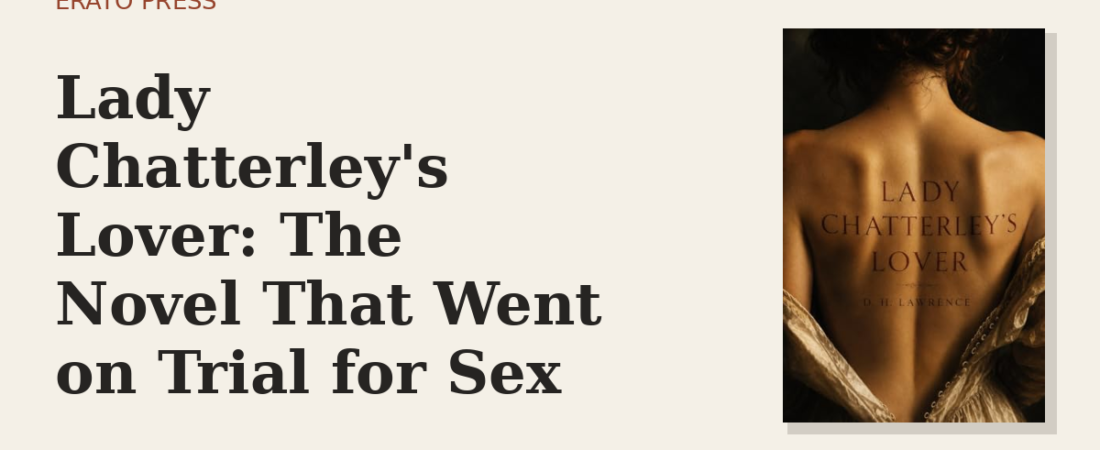
For over thirty years it could not be legally published in Britain or America. When Penguin Books finally printed the full text in 1960, the British state prosecuted it for obscenity, and the trial — in which the prosecutor famously asked the jury whether it was a book “you would wish your wife or servants to read” — became a turning point in the history of censorship and a symbol of the coming sexual revolution. But Lady Chatterley’s Lover (1928), D.H. Lawrence’s last novel, is far more than its scandal. Beneath the explicit sex that made it notorious lies one of Lawrence’s most passionate arguments: that a civilization gone cold, mechanical, and cerebral might be healed only by a recovery of tenderness — the honest, unashamed life of the body that the modern world had learned to despise.

The wound of the modern world
Lawrence loads his story with symbols. Constance Chatterley is married to Sir Clifford, a mine-owning aristocrat paralyzed from the waist down by the First World War — impotent, brilliant, cerebral, all talk and management and cold intellect, a man who has replaced life with machinery and mines. He is Lawrence’s image of a whole ruling class, a whole civilization, that has severed itself from the body, from feeling, from the earth, and gone bloodless and dead. Against him stands Mellors, the gamekeeper — a man of the woods, of the body, of tenderness and directness — and Connie’s turn from the paralyzed lord to the living keeper is Lawrence’s parable of what the modern world must do to save itself: come back down out of the head, into the body, the touch, the tenderness it had learned to be ashamed of.
Why the sex is serious
The explicit scenes that scandalized the courts are not there to titillate but to argue. Lawrence believed that the modern denial of the body — the treatment of sex as either dirty or trivial — was a spiritual sickness, and he set out to write physical love with a reverent, un-euphemistic seriousness no English novelist had dared, to insist that this was sacred rather than shameful ground. He wanted the words and the acts on the page precisely because their absence was the disease. Whether he succeeded — whether the writing is profound or embarrassing, liberating or absurd — has been argued ever since, and readers still divide. But the intent is unmistakably earnest: Lawrence was trying to heal what he saw as a civilization dying of its own repression and abstraction, and the tenderness between Connie and Mellors is offered as the cure.
The trial that changed the culture
The 1960 obscenity trial of Penguin Books is one of the great cultural watersheds. The defense called a parade of eminent writers and critics to testify to the book’s literary seriousness; the jury acquitted; and the verdict effectively ended the era in which the British state could suppress serious literature for sexual content. The floodgates of the 1960s opened partly here. So Lady Chatterley occupies a strange double place — a genuine work of a major, difficult, prophetic modernist, and a landmark in the long fight for freedom of expression, its scandal and its seriousness forever entangled. It belongs in any account of how the modernist revolution broke the old proprieties of the English novel.
Why read it now
Because it is both a landmark in the fight against censorship and a passionate, flawed, unforgettable argument about the cost of a life lived only in the head — and because Lawrence’s diagnosis of a mechanized, disembodied civilization starved of real tenderness has not lost its force in our own screen-lit, disembodied age. Read it past its notoriety, and you find a prophet raging, beautifully and sometimes absurdly, for the life of the body against the death of the machine.
Frequently asked questions
Why was it banned?
For its explicit descriptions of sex and its frank language, which the authorities deemed obscene. It could not be legally published unexpurgated in Britain until the Penguin edition of 1960, whose acquittal at trial was a landmark for free expression.
Is it just about sex?
No. The sex serves Lawrence’s larger argument: that a modern civilization gone cold, mechanical, and cerebral can be healed only by recovering the honest life of the body and tenderness. The paralyzed, industrial Sir Clifford and the vital gamekeeper embody the opposition.
Is Lawrence’s writing about sex good?
Famously divisive — some readers find it reverent and liberating, others earnest to the point of unintentional comedy. That very divisiveness is part of the novel’s interest, and of Lawrence’s high-risk seriousness about the body.
Read the Erato Press edition →
and read past the scandal to the prophet underneath.
Enjoyed this piece?
Get the next one — our essays on the classics and news of each new Erato Press edition — straight to your inbox.