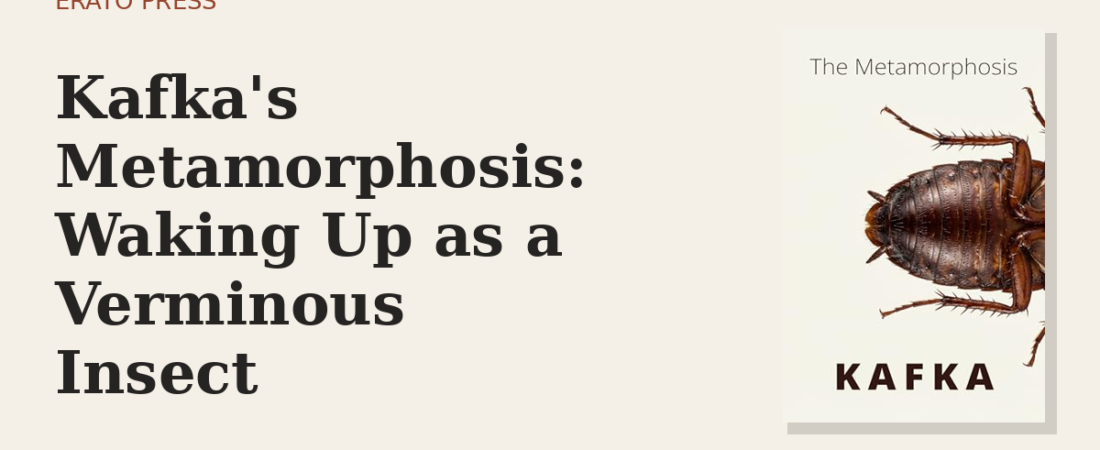
“As Gregor Samsa awoke one morning from uneasy dreams he found himself transformed in his bed into a monstrous vermin.” It is among the most famous opening sentences ever written, and almost everything that makes Kafka great is already in it. Notice what is not there. No explanation. No magic, no curse, no laboratory accident, no warning. The transformation has simply happened, in the night, off the page, and the story will never tell you why — because the why is not the point and Gregor himself barely asks it. What he worries about, lying on his armored back with his many thin legs waving helplessly in the air, is that he has overslept and will miss his train. The horror of The Metamorphosis is not that a man turns into an insect. It is that he turns into an insect and his first coherent thought is about his job.

The temptation to over-read
Almost everyone who teaches this novella reaches immediately for the allegory machine. The insect is alienation. The insect is capitalism. The insect is the artist rejected by bourgeois society, or Kafka’s tuberculosis, or his terror of his father, or the Jew in an anti-Semitic Europe, or the modern self crushed by bureaucracy. Each of these readings can be defended, and each of them, applied too confidently, kills the thing it touches. Kafka’s power lies precisely in his refusal to let the symbol resolve into a single meaning. He never tells us what Gregor “really” is, and the German word he chose — Ungeziefer, an old term for unclean vermin unfit for sacrifice — is deliberately vague, naming a category of disgust rather than a species. He even forbade his publisher to put a picture of the insect on the cover. The creature must remain unseen, unspecified, irreducible. The moment you decide the bug definitely means one thing, you have stopped reading Kafka and started reading yourself.
The better approach is to resist the allegory and stay with the surface, because the surface is where the genius lives. Read literally, sentence by sentence, the story is a masterpiece of deadpan logic: a fantastic premise treated with absolute, suffocating realism. Once you accept the impossible first sentence, everything that follows is meticulously plausible — how the new body moves, how it eats, what foods now revolt it and which it craves, how a giant insect might cling to a wall or hide under a sofa. Kafka spends his imaginative energy not on the marvel but on its consequences, and the consequences are almost entirely domestic. This is the comic terror that links him to the larger currents of literary modernism: the catastrophe is total, and the family’s main concern is the inconvenience.
The family economy
What the over-readers miss by reaching for the cosmic is the brutal economic engine driving the plot. Before his transformation, Gregor is the sole support of his family. His father’s business has failed; his mother is asthmatic and idle; his sister Grete is seventeen and, in everyone’s mind, decorative. Gregor’s joyless work as a traveling salesman pays for the apartment, the furniture, the maid, and a debt his father owes to Gregor’s employer — a debt Gregor is silently working off, which means he is not merely employed but indentured. The first half of the story makes painfully clear that the family’s affection for Gregor is inseparable from his usefulness. He is loved as a provider, which is to say he is loved as a function.
So the transformation is, before it is anything metaphysical, an economic catastrophe. The breadwinner can no longer earn. And here Kafka springs his cruelest irony: the family, deprived of Gregor’s income, turns out to be perfectly capable of supporting itself. The father, supposedly broken, takes a job as a bank messenger and stands straighter in his uniform than he has in years. The mother sews. Grete becomes a salesgirl. The very people whose helplessness justified Gregor’s slavery prove, the moment he is gone, to be ordinary working adults. The lesson is devastating and quietly stated: Gregor’s sacrifice was never necessary. He was consumed by a role that the others could have shouldered all along, and his disappearance, after the initial shock, is less a loss than a liberation — for them.
Shame, the body, and the closed door
If there is a single emotion that saturates The Metamorphosis, it is not fear but shame. Gregor is ashamed of his new body almost from the first moment — ashamed of how he looks, ashamed of the sounds he makes, ashamed of the food he now wants, ashamed above all of being seen. He hides under the sofa with a sheet over himself so that Grete will not have to look at him when she brings his food. He presses himself against doors to overhear the family he can no longer face. The story is structured around thresholds and the act of closing them: the locked bedroom door at the beginning that the family must break through, the doors Gregor is shut behind, the final door closed on him for good.
Kafka grasped something most writers about suffering never reach: that physical degradation produces not self-pity but self-disgust, and that the degraded person often experiences his own body as an offense against the people he loves. Gregor’s deepest wish is not to be cured but to spare his family the sight of him. When his father, in a fit of revulsion, pelts him with apples and one lodges in his back to fester, Gregor accepts the wound almost gratefully, as no more than his due. He is starving himself by the end, partly because nothing tastes right and partly because he has absorbed the family’s verdict that his continued existence is a burden. The body that shames him must be removed, and he comes to agree. This is the part of the book one cannot allegorize away, because anyone who has been ill, dependent, or unwanted in a household recognizes it from the inside. It is not a symbol of anything. It is simply true.
Grete, and the verdict
The most quietly terrible movement in the story belongs to the sister. Grete begins as Gregor’s only ally, the one who feeds him, learns which foods he can stand, and at least tries to imagine his comfort. She is the last warmth in his life. And it is Grete who delivers the death sentence. Worn down, ashamed before the lodgers the family has taken in to make ends meet, she announces that the creature is no longer her brother — that if it were Gregor it would have understood it must go — and that they must get rid of “it.” The shift in pronoun is the whole tragedy: he has become it. Gregor, overhearing this from his room, agrees with her. He withdraws into the dark, stops eating, and dies before morning, his last thoughts tender and without reproach.
What follows is the final stroke of Kafka’s genius. The family does not collapse into grief. They feel relief, and then a guarded, rising hope. They take the day off, ride the tram into the countryside, and notice — the mother and father both — that Grete has bloomed into a pretty young woman who ought soon to find a husband. The story ends not with mourning but with the renewal of the family’s prospects, the parents already imagining Grete’s marriage as the creature’s body is swept out by the charwoman. Gregor’s death is the soil his survivors flower in. It is one of the bleakest endings in literature, and Kafka delivers it in the mildest, most reasonable prose imaginable, which is exactly what makes it unbearable.
Frequently asked questions
What kind of insect does Gregor become?
Kafka never says, and the refusal is deliberate. The German Ungeziefer means unclean vermin, the kind of pest one exterminates, without specifying a creature. The text gives contradictory clues — a hard armored back, many small legs, a body large enough to fill a doorway — and Kafka explicitly insisted the insect never be depicted. Translators who reach for “cockroach” or “beetle” narrow what Kafka left open on purpose. The vagueness is the point: it is the unnameable, the thing you do not want to look at.
Is the transformation literal or a metaphor?
Within the story it is entirely literal — there is no dream-frame, no hint that Gregor is “really” still a man imagining things. That literalness is what makes the book modern rather than a fairy tale. Kafka’s method is to plant one impossible fact and then reason from it with perfect consistency. Readers are free to find metaphors in it, but the story itself never winks; it treats the insect as a fact to be managed, like a leak in the roof.
Why is it considered funny as well as horrifying?
Kafka reportedly laughed reading his work aloud to friends, and the comedy is real. It comes from the mismatch between the enormity of the situation and the pettiness of everyone’s responses — Gregor fretting about his train, the office manager scolding through the door, the family bickering about lodgers while a giant insect listens from the next room. It is the humor of total catastrophe met by total bureaucratic and domestic banality, and the laughter it produces is the kind that catches in the throat.
Kafka’s effects are built on the exact weight of words — that opening sentence, the slide from “he” to “it,” the deadpan plausibility that makes the impossible feel like a chore — which is why the translation and the framing matter so much. Our Erato Press edition gives you a faithful, unhurried rendering that preserves the deliberate vagueness of the vermin and the dry calm of Kafka’s voice, with an introduction that sets the novella where it belongs: among the founding works of modern literature, not the curiosities of horror. and meet Gregor Samsa on the morning everything is already over.
Enjoyed this piece?
Get the next one — our essays on the classics and news of each new Erato Press edition — straight to your inbox.