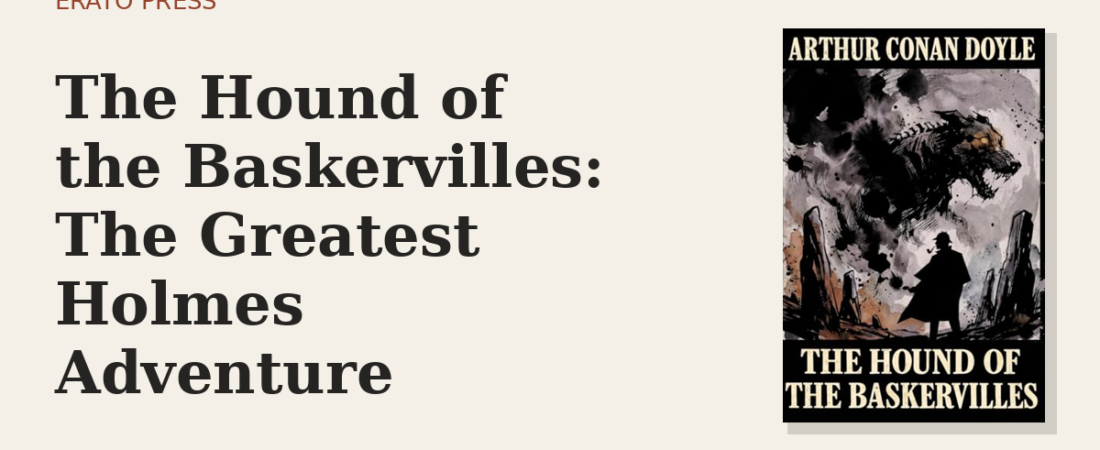
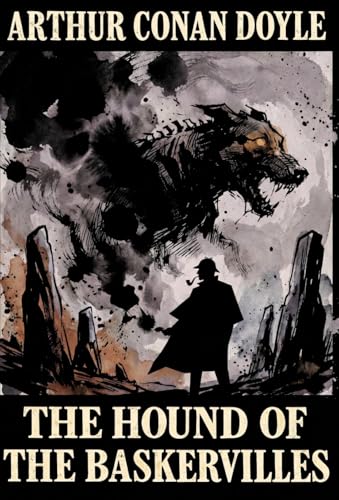
A legend of a monstrous, glowing hound that has stalked and killed the Baskerville family for generations; a fresh corpse on the misty moor, the face frozen in terror; and, beside it, the footprints — as the terrified doctor whispers to Sherlock Holmes — “of a gigantic hound.” The Hound of the Baskervilles (1902) is the most famous of the Sherlock Holmes stories and, by common consent, the best: a full-length novel in which Arthur Conan Doyle fused the gothic horror tale with the detective story and produced a masterpiece of atmosphere and suspense. It is the case where the supernatural seems, for once, to be real — and where Holmes’s cold reason must do battle with the oldest and darkest of human fears.
Reason against the supernatural
What makes the novel special is the tension Doyle sustains between two worlds. The moor is a place of ancient dread — the fog, the treacherous mire, the neolithic ruins, the family curse, the spectral hound out of hell — and for much of the book the horror feels genuinely uncanny, as if the rational universe Holmes represents might not hold. Against all of it stands Holmes’s absolute faith that every effect has a natural cause, that the demon hound is a problem to be solved and not a doom to be suffered. The whole book is a duel between superstition and science, between the terror the moor breeds and the daylight of deduction — and the pleasure is that Doyle makes the terror so real that we half-doubt reason can win. When Holmes finally explains the hound, the natural solution is more satisfying than any ghost, because we have been made to feel how much easier it would have been to believe in the curse.
Watson alone
Doyle plays a clever structural game: for much of the novel Holmes is absent, and Watson is sent to Baskerville Hall to investigate alone. It is a masterstroke, because it lets us feel the dread without the reassuring presence of the great detective, and because it lets us watch Watson — usually the admiring foil — try his own hand at detection, with results that are both creditable and a reminder of the difference between talent and genius. And it sets up one of the finest revelations in the canon, when the mysterious figure Watson has glimpsed on the moor turns out to be Holmes himself, secretly at work all along. The interplay of the two friends, the loyal doctor and the brilliant, unknowable detective, is the human warmth that has kept these stories alive, and it is at its best here.
Gothic and detective, fused
Doyle took the two most popular forms of Victorian storytelling — the gothic horror of the cursed house and the moor, and the new detective puzzle he had himself perfected — and welded them into something greater than either. The result is atmosphere thick enough to cut and a plot clean enough to satisfy, terror and logic held in perfect balance. It is the summit of the whole Holmes achievement that our reading guide to Sherlock Holmes maps, and one of the finest entries in the tradition of classic detective fiction — proof that the puzzle story could also be genuine literature, rich in mood and character.
Why read it now
Because it is the perfect gateway to Sherlock Holmes and one of the most purely enjoyable novels ever written — a horror story, a mystery, and a portrait of the great friendship, all in a couple of hundred gripping pages. Whether you know Holmes well or not at all, the hound of the Baskervilles is waiting on the moor, and the fog has not lifted in a hundred and twenty years.
Frequently asked questions
Do I need to have read other Holmes stories first?
No. The Hound of the Baskervilles stands completely on its own and is one of the best possible introductions to Holmes — a full novel with all the atmosphere and cleverness of the great short stories.
Is it actually scary?
Genuinely atmospheric and suspenseful — Doyle sustains a real sense of supernatural dread across the fog-bound moor before reason reasserts itself. It is as much a gothic thriller as a detective story.
Why is Holmes absent for much of it?
Doyle deliberately sends Watson to investigate alone, heightening the dread and letting us see the case through the loyal doctor’s eyes — before revealing that Holmes has been secretly at work on the moor all along, one of the canon’s best surprises.
Read the Erato Press edition →
and follow the footprints of a gigantic hound into the fog.
Enjoyed this piece?
Get the next one — our essays on the classics and news of each new Erato Press edition — straight to your inbox.