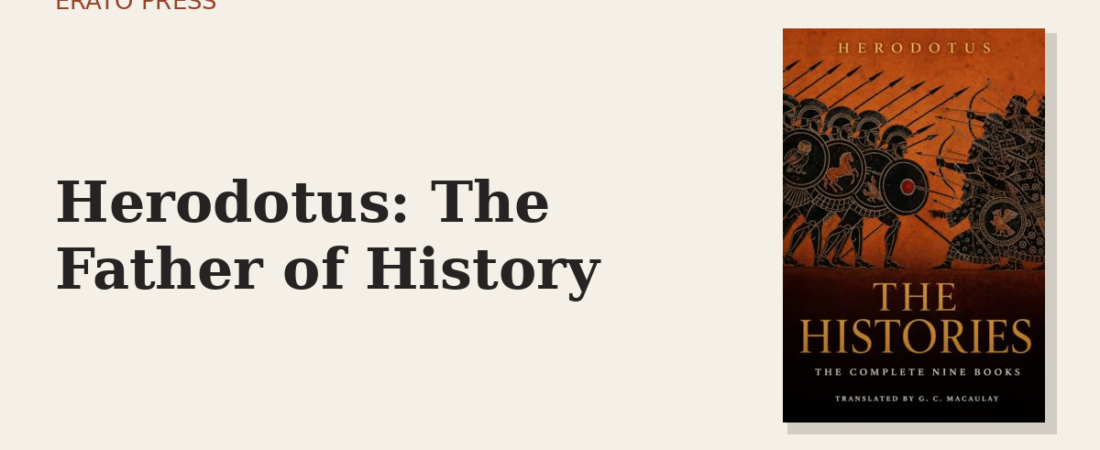

Cicero called him the Father of History. His critics, then and now, have preferred another title: the Father of Lies. Both are fair, and that is exactly what makes The Histories the strangest and most human of the great ancient books.
Herodotus set out, around 440 BC, to explain the greatest event of his age — the wars between Greece and the vast Persian Empire, the story of Marathon, Thermopylae, and Salamis. But he could not tell that story without telling every other story that brushed against it: how the Egyptians mummified their dead, why the Scythians blinded their slaves, what a giant gold-digging ant looks like. He is the first writer who wanted to know everything, and who assumed you would too.
That is his real invention. Before Herodotus, the past was myth or genealogy. He was the first to inquire — the Greek word is historia, inquiry — to gather rival accounts, weigh them, and say, in effect, ‘I am told this; I do not believe it, but I record it.’ He is the first sceptic and the first gossip in one, and the ancestor of everyone who has since tried to find out what really happened.
Read alongside our editions of the Greek storytellers — the poets who made the myths and the tragedians who staged them — Herodotus is where the Greek mind turns from imagining the world to investigating it. The wonders are still there; he just wants to check them first.
Read The Histories — the Erato Press edition →
Enjoyed this piece?
Get the next one — our essays on the classics and news of each new Erato Press edition — straight to your inbox.