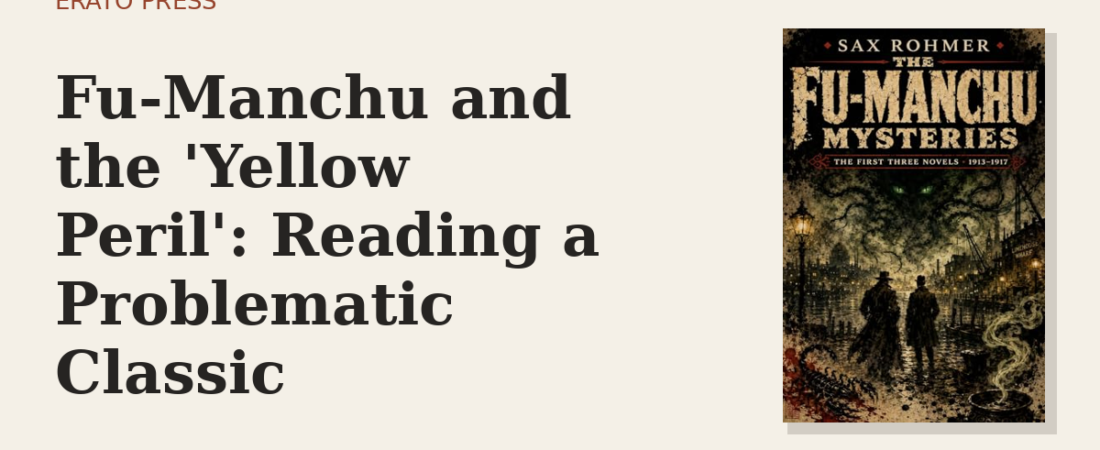
There is a particular kind of cowardice in pretending a book does not exist, and a different kind in pretending it is harmless. Sax Rohmer’s Fu-Manchu novels demand that we refuse both. Here is a series that sold in the millions, defined a villain archetype for a century of pulp and film, and is also, line by line, one of the most concentrated expressions of racial paranoia in popular English fiction. To read it honestly is to hold those two facts in the same hand without letting either drop. The interesting question is not whether the books are racist — they are, structurally and avowedly — but what they reveal about the imagination that produced and devoured them.

Arthur Henry Ward, writing as Sax Rohmer, introduced Dr. Fu-Manchu in 1913, the same year a far gentler book gave the language the word “Pollyanna.” The timing matters. The Edwardian world was at the height of its empire and at the height of its anxiety about that empire’s durability, and Rohmer gave the anxiety a face. My argument is that the Fu-Manchu novels are best read not as adventure stories that happen to be bigoted, but as bigotry organized into adventure — that the racism is not a stain on the plot but the engine of it, and that understanding the machine is more useful than either banning it or excusing it.
The “Yellow Peril” was a fantasy with a function
The phrase “Yellow Peril” predates Rohmer; it circulated through the late-nineteenth-century West as a name for the imagined threat that the populations of China and Japan posed to European civilization — through immigration, through economic competition, through a vaguely apocalyptic dread of being numerically overwhelmed. It was never a description of anything real. It was a projection: the West’s own appetite for conquest, turned around and attributed to the people it was conquering. Rohmer’s genius, if that is the word, was to compress this diffuse panic into a single body.
Fu-Manchu is described, in the famous passage, as having “a brow like Shakespeare and a face like Satan” — the entire cruelty of the conception is in that sentence. He is granted every intellectual gift, then those gifts are made monstrous precisely because they belong to him. He is “the yellow peril incarnate in one man,” the narrator tells us flatly. The villain is not a person but a personification, a way of making a continent’s worth of fear small enough to be shot at on the last page. That is the function the racism serves: it converts an unmanageable historical anxiety into a manageable plot, with a hero, a villain, and a reassuring sense that the threat can be contained by Englishmen of good character.
The craft is real, and that is the problem
It would be convenient if the books were also badly written, but they are not. Rohmer was a genuine craftsman of pace, atmosphere, and dread. The fog-bound London, the opium-scented dens, the locked rooms and exotic poisons and trap-doors, the relentless cliffhanger rhythm — he built a sensory machine that still pulls a reader forward against their better judgment. The narrator, Dr. Petrie, and his Holmesian counterpart Nayland Smith are competent vehicles for the dread, and the prose has a feverish momentum that explains the sales figures.
Consider how the threat is staged. Fu-Manchu rarely strikes in the open; his weapons are poisons, fungi, trained insects and reptiles, hypnosis, secret societies — an arsenal of the hidden and the contaminating. This is not accidental. The whole grammar of the “Yellow Peril” was one of infiltration rather than invasion, of a danger that seeps in through the back channels of a port city and works from inside the body politic. Rohmer’s plots literalize that anxiety into trap-doors and tainted wine, so that every chapter rehearses the same lesson: the enemy is already here, indistinguishable from the ordinary, and only ceaseless vigilance by the right sort of Englishman keeps the nation from being poisoned in its sleep. The pleasure of the suspense and the work of the propaganda are the same gesture.
This competence is exactly why the books are dangerous and why they are worth studying. Propaganda that bores no one persuades; the Fu-Manchu novels are persuasive because they are entertaining, and they smuggle their picture of the world inside genuine narrative pleasure. The reader who is gripped has, without quite noticing, accepted the premise — that the Asian intellect is a weapon, that the Asian presence in London is an infiltration, that whiteness is a fortress under siege. The skill is not separable from the harm. It is the delivery system for it.
How the West fictionalized “the East”
Rohmer did not invent the Oriental villain so much as perfect a long Western habit of using “the East” as a screen for whatever the West needed to externalize — cunning, sensuality, cruelty, the uncanny. The figure of the inscrutable Asian mastermind, surrounded by silent servants and unspeakable rituals, is a fantasy assembled almost entirely from European need and almost not at all from observation. Rohmer himself knew very little of China; the world of the novels is a stage set, dressed from secondhand exoticism and newspaper panic.
The contrast with an earlier and far more humane Victorian engagement with the same anxieties is instructive. Readers who know Wilkie Collins and The Moonstone: The First Great Detective Novel will remember that Collins, half a century before Rohmer, also built a sensation novel around an object stolen from India and the figure of pursuing Indians — but Collins complicated the Englishman’s guilt, gave the colonial crime back to the colonizers, and treated the “foreign” presence with a moral curiosity Rohmer never approaches. Set side by side, the two books measure how far the popular imagination could either interrogate empire or simply flatter its fears. Rohmer chose the flattery, and the market rewarded him for it.
Why keep reading it at all
The case for keeping Fu-Manchu in print and in the conversation is not nostalgia and certainly not endorsement. It is that a culture which forgets the shape of its own propaganda is more likely to fall for the next version of it. The “Yellow Peril” did not stay on the page; it underwrote real exclusion laws, real internments, real violence, and its grammar — the foreign genius, the demographic siege, the civilization under threat from within — recurs, lightly redressed, in every generation’s panics. To read Rohmer with your eyes open is to learn to recognize the machinery when it is wheeled out again.
An honest reader can hold the whole picture: that the books are skillful, that they are influential, and that they are an artifact of a poison the twentieth century would drink deeply of. The right response to a problematic classic is neither the bonfire nor the apology but the annotation — the steady marginal voice that says, here is what this is doing, and here is why it worked. That is how a dangerous book becomes a useful one.
Frequently asked questions
Is it acceptable to read Fu-Manchu today?
Reading is not endorsing. These novels are primary documents of how racial fear was manufactured and sold as entertainment, and that makes them worth confronting — with full awareness of what they are. The unacceptable thing is to read them uncritically, as innocent adventure.
How racist is the portrayal, really?
It is not incidental; it is foundational. Fu-Manchu is explicitly called “the yellow peril incarnate in one man,” and the entire premise depends on treating Asian intelligence and presence as inherently threatening. The bigotry is the plot’s organizing principle, not a regrettable detail.
Why is Fu-Manchu still culturally important?
He is the template for a century of evil-mastermind villains across pulp, film, and comics, and the “Yellow Peril” rhetoric he crystallized has had a long and damaging political afterlife. Understanding the original helps you see the pattern wherever it resurfaces.
A book like this needs an edition that neither sanitizes nor abandons it. The Erato Press edition presents Rohmer’s text with critical apparatus that names the racism plainly, traces the “Yellow Peril” myth to its historical roots, and explains the craft that made the propaganda so effective — giving readers the framework to study a problematic classic rather than simply stumble through it.
Read the Erato Press edition →
Enjoyed this piece?
Get the next one — our essays on the classics and news of each new Erato Press edition — straight to your inbox.