A young Englishwoman stands at her pension window in Florence and complains that her room looks onto a courtyard instead of the Arno. A stranger across the dinner table — an awkward, déclassé older man named Mr. Emerson — offers, with embarrassing directness, to swap: he and his son have the view; she may have it. The exchange scandalizes everyone, because in Edwardian England you do not simply say what you want to a stranger, and a view is never only a view. That is the entire novel in its first chapter. A Room with a View is E. M. Forster’s comedy of what it costs to want something honestly, and to admit it, in a culture engineered to prevent exactly that.

Forster published it in 1908, at thirty, and it is the sunniest of his major books — a romance that actually delivers its happy ending, which is rare in him. But the lightness is deceptive. Beneath the Baedeker-toting tourists and the social farce runs Forster’s lifelong subject: the war between the honest heart and the well-trained social self, between what people feel and what they are permitted to admit they feel. His famous epigraph from a later novel — “Only connect” — is already the secret motto here. The question of A Room with a View is whether Lucy Honeychurch will connect the two halves of herself before the machinery of respectability seals her into a beautiful, lifeless marriage.
Italy tells the truth; England keeps it
The novel is built on a geographical opposition that is really a moral one. The first half takes place in Italy, where the light is strong, the people are direct, and the social padding that protects English emotion has been stripped away. The pivotal event happens in the Piazza Signoria: Lucy witnesses a sudden, brutal murder — two Italian men quarrel, one is stabbed, blood runs — and she faints into the arms of George Emerson, the young man who has the view. Forster stages it precisely: Italy delivers the raw fact of death, sex, and passion with no buffer, and the shock cracks Lucy open. Moments later George kisses her among the violets on a hillside outside Florence, and the kiss is the truth her whole upbringing exists to suppress.
Then the novel returns to England — to the Honeychurch home, Windy Corner, in the Surrey hills — and the second half is the long, comic, agonizing process by which Lucy tries to deny what Italy told her. England is the country of the unsaid, of tea and tennis and tactful evasion, and into it Forster introduces Cecil Vyse, the man Lucy agrees to marry. Cecil is one of the great comic villains of English fiction precisely because he is not a villain at all: he is cultivated, intelligent, devoted, and utterly bloodless. Forster gives him a withering self-diagnosis — Lucy realizes Cecil thinks of her as a work of art, a Leonardo, something to be appreciated rather than loved, and that “he should know no one intimately, least of all a woman.” He is the medieval, the “drawing-room” man, all surface refinement and no contact. Marriage to Cecil would be a beautifully furnished tomb.
The “muddle,” Forster’s word for self-deception
Forster has a precise vocabulary for Lucy’s condition, and the key word is muddle. A muddle, in his usage, is not mere confusion; it is the specific moral disorder of refusing to know what you actually feel — the lies people tell themselves to stay comfortable inside their class and their conventions. Old Mr. Emerson, who functions as the novel’s plain-speaking conscience, names it directly near the end: “you are in a muddle,” he tells Lucy, and the whole book has been leading to the moment when someone says it aloud. Lucy has spent the second half lying — to her mother, to Cecil, to George, and above all to herself — pretending she does not love George, dressing the lie up as propriety, nearly fleeing to Greece to escape the truth.
What makes this more than a love triangle is Forster’s insistence that the muddle is a moral failing, not just a romantic mistake. To deny your own heart, in his ethic, is to “sin against passion and truth,” to commit a kind of treason against life itself. The Emersons — father and son, faintly absurd, socially impossible, given to quoting Samuel Butler and saying the unsayable at dinner — are the carriers of that ethic. They are radicals and freethinkers, slightly ridiculous and entirely right, and Forster loves them for the embarrassment they cause. George’s great argument to Lucy is not that he is a better match than Cecil but that Cecil will never let her be herself, will keep her as an object, while love means wanting another person to be wholly, freely alive. The novel’s happy ending is earned only when Lucy stops muddling and admits the simplest and hardest thing: that she wants the view, and the man who offered it.
The comedy that hides a serious argument
It would be easy to read A Room with a View as a charming period piece, and easy to miss how radical its claim is. Forster, a closeted gay man writing in the long shadow of the Oscar Wilde trials, had personal reasons to understand the violence a society does to the heart it forbids to speak. His argument that honesty about desire is a moral duty, that the “muddle” of respectability is a form of cowardice, that the body’s truth matters as much as the mind’s refinement — this is quietly subversive in 1908, and it places him at the hinge between the Victorian novel and what came after. He was a member of the Bloomsbury Group, friend to Virginia Woolf and the rest, and though his form stays conventional, his sensibility is reaching toward the inwardness and the candor about sex and self that the next generation would make central. You can see him standing in that doorway in our larger account of the period, our reader’s guide to modernism, where Forster sits as a transitional figure — one foot in the well-made Edwardian comedy, one foot in the modern preoccupation with the unspoken self.
The genius of the book is that it carries all this lightly. The social comedy is genuinely funny — the meddling chaperone Charlotte Bartlett, the gossiping novelist Miss Lavish who turns the Florence kiss into a scene in her potboiler, the vicar Mr. Beebe with his complicated reservations about marriage. Forster lets you laugh your way to a conclusion that is, underneath, a manifesto: that a life governed by what people will think is a kind of death, and that the only salvation is to connect what you feel with what you do. Lucy and George end the novel back in their Florence pension, in the room with the view, having chosen honesty over the muddle. The window that opened the book finally lets the light all the way in.
Frequently asked questions
What does the “room with a view” actually symbolize?
It is Forster’s controlling metaphor for an honest, open, unobstructed relation to life — love, beauty, desire, the truth of one’s own feelings. To want the view is to want reality directly; to settle for the courtyard is to accept the padded, secondhand existence that English convention prefers. The literal room-swap in chapter one quietly stages the moral choice the whole novel turns on.
Why is Cecil Vyse the obstacle if he is not a bad man?
Because Forster’s target is not villainy but bloodlessness. Cecil is cultured, faithful, and well-meaning, yet he treats Lucy as an aesthetic possession rather than a living equal — he wants to admire her, not know her. He embodies the refined, repressed England the novel critiques, which is far more dangerous than any obvious cad because it looks like a respectable, sensible match.
Is the novel really as light as it seems?
On the surface, yes — it is Forster’s most cheerful book and it grants its lovers a happy ending. But the comedy carries a serious ethic: that denying one’s true feelings is a moral failure, a “muddle” that amounts to a betrayal of life. Coming from a writer with intimate reasons to understand social repression, the gaiety is a delivery system for a quietly radical argument.
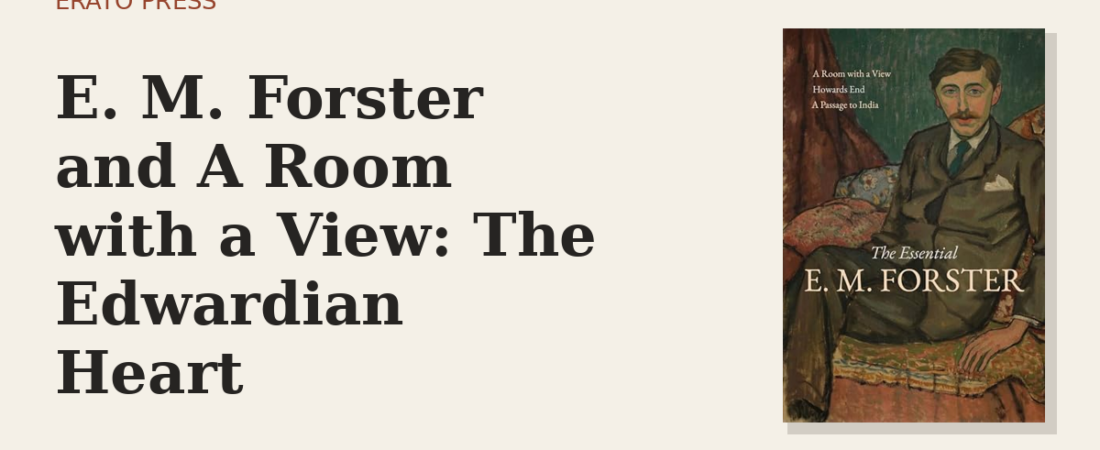
The Erato Press edition presents Forster’s text with critical material that opens up the Italy-versus-England structure, the ethic of the “muddle,” and the author’s pivotal place between the Edwardian novel and the modernism just over the horizon. It is the edition for readers who want to see how much weight this featherlight comedy is actually carrying.
Read the Erato Press edition →
and watch a young woman decide, against everything she was raised to want, to take the view.Enjoyed this piece?
Get the next one — our essays on the classics and news of each new Erato Press edition — straight to your inbox.