A middle-aged gentleman in a parched corner of La Mancha reads too many chivalric romances, decides the world is one, and rides out to make it so. That is the engine of the joke, and for three centuries readers laughed at it without quite noticing that the joke had teeth. Miguel de Cervantes published the first part of Don Quixote in 1605, the second in 1615, and somewhere in the gap between those two volumes the European novel learned to think about itself. The book is funny the way a hall of mirrors is funny: you start by laughing at the man inside it and end by checking your own reflection.

The claim that Don Quixote is the first modern novel gets repeated so often it has gone soft. It is worth saying exactly what is meant. Not that it is the first long prose fiction, nor the first comic one. What Cervantes did, and did first, was build an entire book on the gap between what a person reads and what is actually there — and then refuse to close that gap with a tidy moral. Out of that refusal come the three things we now take as the novel’s birthright: irony as a structural principle, the unreliability of any single account, and interiority that the reader can see but the character cannot.
The gap between the book and the windmill
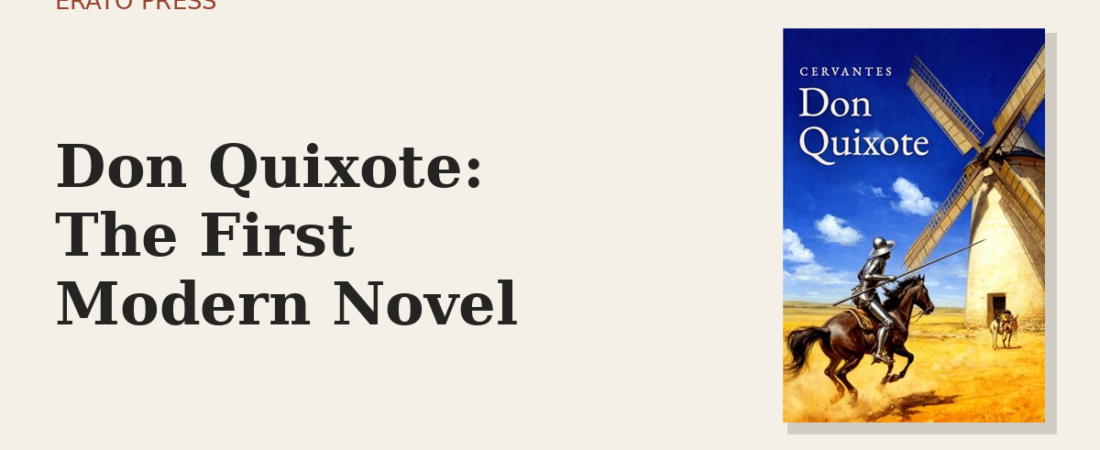
The famous windmills come early, in chapter eight of Part One, and they are usually quoted as a charming bit of madness: the knight charges what he takes for giants. But look at how the scene is actually built. Sancho Panza tells him plainly, “those over there are not giants but windmills.” Quixote does not fail to see the windmills. He sees them and overrides the evidence with a prior text — the romances in which giants are exactly what a knight-errant ought to find. When he is thrown from his horse, broken-lanced and humiliated, he does not abandon the interpretation. He decides a malicious enchanter has turned the giants into windmills to rob him of the glory. This is the decisive move, and it is not stupidity. It is the human mind defending a story against the world, and Cervantes understood, before anyone, that we all do it. The windmill is not a symbol of folly. It is a diagram of how belief survives contact with fact.
That diagram is what makes the book modern rather than merely medieval. The chivalric romances Quixote loves — Amadís of Gaul and its endless imitators — assumed a continuous world in which words and things matched: a knight was noble, a giant was a giant, a lady was either virtuous or a witch. Cervantes drives a wedge into that assumption and never removes it. Every encounter in the book is double: there is the world as Quixote’s reading composes it, and the world as the dusty roads of Castile actually are. The inns are not castles; the barber’s basin is not the golden helmet of Mambrino; Dulcinea is a coarse farm girl named Aldonza Lorenzo whom Quixote has barely met. The comedy is real, but the structure underneath it is the structure of all serious fiction that followed: reality is contested, and the contest happens inside a head.
Two voices, and the birth of irony
Cervantes could have written a satire — a simple takedown of bad books, mocking the deluded reader from a position of superiority. Plenty of his contemporaries did. What raises Don Quixote above satire is that the narrator refuses to stay superior. The text claims to be a translation of an Arabic manuscript by one Cide Hamete Benengeli, a fictional historian whose reliability Cervantes openly questions. We are told, with mock scholarly anxiety, where the account breaks off and where it resumes, which episodes may be invented, which the “translator” doubts. The author hides behind a translator who hides behind a historian who may be lying. No reader of Nabokov or Borges will find this unfamiliar; it was invented here.
And then there is Sancho. The genius of pairing the deluded knight with the literal-minded squire is that it gives the book two truths instead of one. Sancho sees windmills and inns and bruises; he wants food, wages, and the governorship he has been promised. He is the reality principle on a donkey. But as the two travel, something unprecedented happens — they begin to infect each other. Sancho grows imaginative, even quixotic; Quixote, especially in Part Two, grows lucid, melancholy, aware that he is being humored. By the time Sancho governs his “island” of Barataria and rules it with rough peasant wisdom, the hierarchy of sane and mad has dissolved. Neither man owns the truth. The reader has to hold both. That suspension — the inability to settle on one authoritative view — is irony in the modern, novelistic sense, and Cervantes is its first master.
A book that knows it is a book
Part Two, published ten years after Part One, performs a trick no earlier fiction had attempted. In the interval, a rival author had published a fraudulent sequel, and Cervantes responded not by ignoring it but by folding it into the story. The characters in Part Two have read Part One. People recognize Quixote on the road because his published exploits have made him famous. A duke and duchess, having enjoyed the first book, stage elaborate entertainments to make the real Quixote perform his fictional self for their amusement. Quixote even meets a man who has read the false sequel and gets him to swear, before a notary, that he has never met the impostor’s version of himself. The novel becomes a hall of mirrors in which fiction, the fiction’s reception, and a counterfeit of the fiction all collide inside the same plot.
This is not a postmodern gimmick avant la lettre, though it looks like one. It is Cervantes pursuing his one great subject to its limit. If we live inside the stories we consume, then a man whose story has been told and counterfeited lives inside a hall of competing texts about himself — which is, increasingly, the modern condition. The book that began by laughing at a reader who confused literature with life ends by trapping its hero in precisely that confusion at industrial scale, and treating the predicament with a tenderness that has curdled out of comedy into something close to grief.
The death that makes the meaning
The ending is the proof. After his final defeat — bested in combat by a neighbor disguised as the Knight of the White Moon, and bound by knightly honor to lay down his arms — Quixote goes home, falls ill, and recovers his sanity. On his deathbed he renounces the romances entirely. “I have judgment now, free and clear,” he says, and calls himself Alonso Quixano the Good. It should be a triumph: the madman is cured. Instead it is unbearable. Sancho, the realist, is the one who weeps and begs him to get up and ride out again. We do not want the cure. We grieve the loss of the man who could see giants, because the book has slowly taught us that a world drained of imagination — the windmill that is only a windmill — is poorer than we thought. Cervantes will not tell us which view to hold. He grants reality its victory and mourns it in the same breath.
That double movement is why Don Quixote repays the length that intimidates new readers. If you have wondered whether the long classics earn their bulk, this is the one to test it on — and our guide to whether long classic novels are worth reading places Cervantes first for a reason: its size is not padding but the slow accumulation of a friendship and a worldview, the only scale at which the ending could land.
Frequently asked questions
Do I need to read both parts?
Yes, and the second is the greater of the two. Part One is the brilliant comic premise; Part Two is where Cervantes turns the premise on its own readers, lets the characters age and deepen, and delivers an ending no first volume could have earned. Reading only Part One is like hearing the setup and leaving before the reversal.
Is the humor still funny, or just historically interesting?
It is genuinely funny — the slapstick of the early adventures, Sancho’s avalanche of mangled proverbs, the deadpan footnotes from the “historian.” But the comedy works on you. By the end you laugh less and feel more, which is exactly the effect Cervantes engineered.
Why does the translation matter so much?
Because the book’s whole texture is voice — the layered irony of narrator, translator, and historian, the play between Quixote’s high romance diction and Sancho’s earthy speech. A flat translation collapses those registers into one and the irony vanishes. The prose has to perform the gap between styles for the book to do its work.
The Erato Press edition is built for exactly that reading: a translation that keeps Cervantes’s layered voices distinct, with critical apparatus that tracks where Cide Hamete’s “history” is teasing you and why the false sequel of 1614 reshaped Part Two. It treats the novel not as a museum piece to be admired but as the living machine it is — the first book to ask how the stories we read make the selves we are. and meet the knight who invented the novel by mistaking himself for a hero.
Enjoyed this piece?
Get the next one — our essays on the classics and news of each new Erato Press edition — straight to your inbox.