At the close of Sons and Lovers, a young man walks at dusk toward the lights of a town, away from the house where his mother lies dead, and the novel’s last words are not a triumph but a strange double negative: he would not go back. It is a refusal dressed as a fact, and inside the refusal hides the possibility of return. That unresolved threshold is the most Lawrentian thing imaginable, and it is the right place to begin, because the four great novels D. H. Lawrence wrote between 1913 and 1928 all stand at some version of it: a human being arriving at the edge of what the mind can know, and being told by the body to keep going anyway.
The argument of this essay is simple to state and difficult to live with. Lawrence’s major fiction stages a single quarrel, repeated and reformulated across four books, between the dominating consciousness and the knowledge that lives in the body. He is at once one of the indispensable prose stylists of the twentieth century and a writer whose pronouncements on sex, power, and the difference between men and women many readers find indefensible. That contradiction is not a flaw to be apologized away. It is the engine. To read Lawrence honestly is neither to prosecute him nor to acquit him, but to watch a mind refuse the comfort of resolution, holding paradox open as if it were the basic condition of being alive.

Sons and Lovers: the body as a school and a prison
Sons and Lovers arrives looking like a realist novel of the mining Midlands, full of recognizable types, the hard-drinking collier, the genteel-aspiring wife, the sensitive son caught between them. Yet from its first pages the realist frame trembles. Gertrude Morel walks through a wood already estranged from her husband, and the narrator tells us she had “refused to open her womb to his embrace” for years. That is not the language of social observation; it is the language of the body as a site of spiritual war. A sexual embargo becomes a theological stance, a woman saying no to embodied life itself.
The famous bond between Paul Morel and his mother is usually read through a Freudian lens, but Lawrence is after something stranger than a case study. He is showing how consciousness itself can turn tyrannical, how a love can be genuine and still operate as a slow draining of another’s vital force. Gertrude does not love the actual boy so much as an idealized son who will redeem her thwarted life; his success as an artist is secretly her success. Lawrence renders this as a literal circulation of energy between bodies, a knowledge so intimate the mother reads her son’s needs without words. And here the central paradox surfaces: this bodily knowledge, this immediate apprehension of another being, can be the ground of authentic connection or the instrument of domination, and in Gertrude it is both. Paul’s failures with Miriam, who wants to possess him spiritually, and with Clara, who reaches him only as sensation he cannot integrate, all proceed from the same colonized interior. He cannot simply desire; he must always understand his desire, and the understanding kills it. The novel ends not with wisdom but with a man stripped of every certainty, walking toward a city’s light, free in a way that is terrible and absolute.
The Rainbow: consciousness as the price of being human
If Sons and Lovers leaves an orphaned consciousness at the city’s edge, The Rainbow opens almost before history, with the Brangwen men of Marsh Farm facing the church tower, reaching toward something larger than themselves. Lawrence builds the novel as a trilogy of generations, and the genius of the design is that it makes an argument no character could make aloud. Tom Brangwen and his Polish wife Lydia come together with almost no shared language or conscious affinity; what binds them is a bodily recognition, a knowledge of complementary forces that needs no mediation by the mind. Lawrence imagines sexual union here as a form of knowing, a way past the isolated ego into genuine relation, and he does it without a drop of sentimentality.
Then consciousness arrives, and with it, loss. The middle generation, Anna and Will, can no longer reach that wordless ground; the chapter of Anna’s pregnancy turns her transformed body into a battlefield of shame, because self-awareness has made the body an object of scrutiny and judgment. The novel refuses to resolve their stalemate, and refuses, just as firmly, to mourn it as simple tragedy. Anna’s insistence on remaining a separate consciousness is also a kind of freedom. By the third generation, Ursula carries both the hunger for transcendence and the modern burden of self-reflection, and her affair with the passive Anton Skrebensky collapses precisely because he cannot meet her in the absolute struggle she demands. She ends alone in the rain before a rainbow that means nothing in particular, stripped of the fantasy that a lover could redeem her, yet somehow clarified. The radical claim of the book is that it will not choose: consciousness alienates us from the body and from innocent union, and consciousness is also the source of our dignity and our freedom. To be human is to suffer that loss. Readers approaching this difficulty from the wider context of the period will find Lawrence’s quarrel illuminated by our overview, Modernism Explained: A Reader’s Guide, which situates his blood-consciousness against the fractured surfaces of his contemporaries.
Women in Love: the abyss, and the machine
Women in Love is the fiercer book, willing to stare straight into the impossibility of union it had circled before. Its two couples, Ursula and Birkin, Gudrun and Gerald, move through a society being remade by industrial capitalism and the machine, and Lawrence makes the parallel explicit. Gerald is the son of a great mine-owner who reorganizes the pits into a system of perfect, soulless efficiency, and the same will-to-mastery that rationalizes the colliery deadens him as a man. Industrialism, in Lawrence’s diagnosis, is not merely an economic arrangement but a spiritual condition: the triumph of the dominating mind over the living body, projected onto a whole civilization. Birkin’s search for a relation that is neither merger nor possession, what he calls a star-equilibrium between two free beings, is the book’s fragile counter-proposal, and the novel is honest enough to leave it unproven.
Across all of this runs a vocabulary that is itself an argument. The word “dark” recurs hundreds of times across these novels, not as decoration but as a category, the place where the rational mind fails and something more authentic might live. “Seemed,” “something,” “almost,” each registers a world perpetually appearing rather than fully present, an incompleteness Lawrence will not paper over. This is the architecture of a consciousness straining to say what consciousness cannot capture, and it is why his prose can feel both incantatory and exasperating on the same page.
Lady Chatterley’s Lover: tenderness against the deadened world
By Lady Chatterley’s Lover, the quarrel has hardened into a confrontation between a maimed industrial order and the body’s last claim to vitality. Sir Clifford, paralyzed from the war and given over to managing his mines and his literary reputation, is Lawrence’s most concentrated image of the modern condition, intelligence without sensual life, mastery without tenderness. Constance’s affair with the gamekeeper Mellors is not, whatever its early notoriety, a celebration of mere transgression. It is an argument that touch, warmth, and the unguarded body might be the only honest answer to a civilization that has rationalized feeling out of existence. The novel’s notorious frankness, the very thing that kept it suppressed for a generation, is inseparable from its seriousness; Lawrence insisted on the words because he believed the deadened modern self could only be reached through the flesh it had learned to despise.
Read in sequence, the four novels do not resolve into a doctrine. They are variations on an obsession Lawrence could neither solve nor abandon: the body’s knowledge against the mind’s domination, men and women as battlefield and possible redemption, the longing for something beneath consciousness that he called blood-consciousness or the dark gods. What he achieves is rarer than a philosophy. It is a sustained record of an artistic mind reformulating the same impossible questions until the questions themselves become a form of truth.
Frequently asked questions
In what order should I read the four novels?
Chronological order, the order Erato gathers them, is also the intellectual order: Sons and Lovers (1913), The Rainbow (1915), Women in Love (1920), and Lady Chatterley’s Lover (1928). Read this way you watch a single quarrel deepen and darken, from the mother-bound son to the industrial wasteland and its tender rebuke.
Is Lawrence’s reputation for difficult attitudes toward sex and gender deserved?
His pronouncements can be genuinely troubling, and pretending otherwise serves no one. The honest reading neither defends nor cancels him but watches what the novels actually perform, a refusal of easy reconciliation that makes the contradictions generative rather than merely offensive.
Why does Lawrence write so much about industrialism?
Because for him the machine is the body’s enemy made into a civilization. The rationalized mine in Women in Love and the paralyzed mine-owner of Lady Chatterley are the same diagnosis enlarged: the dominating mind triumphant over living things. The sexual and the industrial are, in his vision, one quarrel.
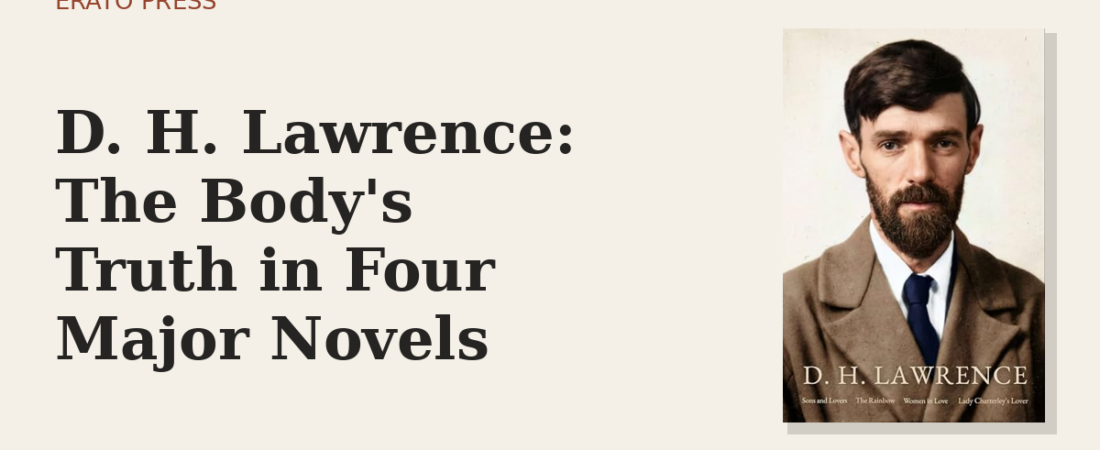
The Erato Press edition assembles all four novels in a single volume, with afterwords that follow this quarrel from book to book rather than treating each as an isolated scandal or set text. It is built for the reader who wants to see the whole arc of Lawrence’s argument with the modern world, in his own restless prose, and to judge for themselves what the body knows.
Enjoyed this piece?
Get the next one — our essays on the classics and news of each new Erato Press edition — straight to your inbox.