Near the close of Chip, of the Flying U — the 1904 novel that launched B. M. Bower’s career and a series that would feed her for thirty years — a cowboy finally meets his rival. For two hundred pages Chip Bennett has tormented himself over Dr. Cecil Granthum of Gilroy, Ohio, the man who receives the Little Doctor’s letters, the long lean Easterner with prior claim on the only girl God ever made right. Then Dr. Cecil arrives at the ranch, and Dr. Cecil turns out to be a woman: another lady physician, breezy and blue-eyed, who grins at Chip behind the heroine’s back. Pressed to explain, the Little Doctor offers the only defense she has. She never actually said that Cecil was a man.

It is a comic device older than the Western, and Bower handles it with the unforced lightness that was one of her surest gifts. But read across the length of her career it becomes something closer to a signature — a small coiled fable about how much trouble a name can make when you assume you know the sex behind it. Bertha Muzzy Bower published under her initials, and she grew so used to being addressed as “Mr. Bower” that she scarcely minded; reviewers praised “his” command of cowboy talk and “his” obvious saddle experience, and the editors buying her serials for an all-male pulp market did not always trouble to ask. The most successful woman ever to write the American pulp Western spent her professional life behind a set of initials that let readers take her for a man — and in her very first book she wrote a heroine who lets a jealous cowboy suffer for two hundred pages by failing to say that Cecil was a woman. Author and creation are running the same con. Bower’s just lasted a lifetime and sixty books.
The mask that bought authority
It is worth being precise about the sense in which the Western was a man’s genre. Women had written about the West before Bower and around her — the frontier romance, the captivity narrative, the local-color sketch all had distinguished female practitioners. What was closed to women was the specific commercial machine that turned the Western into a mass product: the story papers, the dime novels, and after about 1905 the all-fiction pulps with their gunfighters and their frankly masculine address to a frankly masculine reader. That machine ran on men with names like Clarence Mulford and Frederick Faust, the latter masked as Max Brand and a dozen others. Into it, and out the far side with a thirty-year career and editors who paid her well, came exactly one woman of the first commercial rank.
It mattered that she came in disguised. The initials were not a defiant feminist gesture; they were an accommodation to a market that would have flinched at “Bertha” on the cover of a cowboy story, and Bower, who wrote to support herself and her children, was not positioned to indulge in gestures. But the accommodation had consequences she could not have foreseen. To be read as a man was to be read straight — to have her cattle work and her cow talk and her round-up logistics accepted as the testimony of an insider rather than scrutinized as the surprising stunt of an outsider. The mask bought her the one thing a woman in that market could not otherwise buy: the presumption of authority. Readers did not come to her pages braced to catch an error of horsemanship. They took her word, because they took her for a man, and her word happened to be good — she had lived the life she described — so the trust held and the mask held with it.
The honest question is whether the work betrays its author’s sex, and the honest answer is: not where a reader expecting either melodrama or special pleading would look, but unmistakably elsewhere. Bower does not write softer Westerns in the sense of weaker ones. The cattle still die in the blizzard; the prairie fire still comes; the men are not gentle. What she does instead is rebalance the genre’s attention. The center of gravity in a Bower novel is rarely the duel and almost never the killing. It is the meal, the practical joke, the courtship conducted sideways, the problem of getting a herd across a river or a homestead through a winter. Violence happens, but it is one hard fact among many in a world made mostly of work and company. A reader who came to Bower for the gunfight would be perpetually arriving late and finding everyone already at supper.
The ranch is the protagonist
Open almost any Flying U novel and the first thing you meet is not a hero but a household. Chip begins with the weekly mail arriving and a cowboy named Shorty being called back peremptorily by the Old Man — James G. Whitmore, cattleman, who would be startled to learn that his hands call him the Old Man behind his back. Before there is a plot there is a place with social texture: a boss with a nickname he doesn’t know about, a crew with its own private language, a routine that tells us this world existed before the book started and will go on after it ends. Bower’s instinct, again and again, is to establish the community first and let the story grow out of it, rather than drop a stranger into an empty landscape and watch what he does. The Flying U is not a backdrop. It is the thing that outlasts every adventure, and the thing the books are finally about.
The crew has a name within the fiction, and it is the truest phrase Bower ever coined: the Happy Family. Weary and Cal and Happy Jack and Slim and the Native Son recur across novel after novel, aging a little, marrying off one by one, accumulating the shared history that makes an ensemble feel like an institution rather than a roster. The phrase is affectionate and faintly ironic at once, because the Happy Family is not always happy; it is held together less by blood than by the long enforced intimacy of men who work and eat and sleep in the same small compass for years. They quarrel and sulk and play elaborate, sometimes cruel pranks; they carry grudges through whole chapters and drop them at supper; they close ranks instantly against any outside threat to one of their own. Anyone who has belonged to a crew — a ship’s company, a kitchen, a band — recognizes the emotional physics with a jolt. The classic Western is built on a fantasy of self-sufficiency, the man who needs no one and can be reduced to himself and lose nothing essential. Bower’s imagination runs the other way. Take a Flying U cowboy out of the Happy Family and you have not revealed his essential self; you have amputated most of what makes him a self at all. That is why her favorite way to put a character through real trial is to threaten the community — the loss of the ranch, the breaking of the crew. The Flying U’s Last Stand builds its whole drama out of a threat to the survival of the place. In Bower’s best work, what can be lost is the world, not merely the life.
Comedy as structure, work as realism
The Western is usually called a tragic or elegiac genre — a literature of last stands and vanishing frontiers, of men out of time. Much of the tradition earns that. Bower does not. Her native mode is comic, and not in the sense of supplying relief between serious episodes, but in the structural sense that comedy organizes the whole. The Flying U books are comedies of manners transplanted to a Montana cow-camp: their engine is the friction and affection of a fixed cast in a closed society, their typical action is courtship and mischief and the working-out of misunderstandings, and their characteristic ending is not death but marriage, reconciliation, the renewal of the community. The practical joke is for Bower not a digression but a central device; a great deal of plot consists of someone scheming to make a fool of someone else and the slow comic justice by which the scheme rebounds. Humor is also the medium of her characterization. Happy Jack is gloomy, and the joke lives in the relentlessness of his pessimism and the affection with which the others puncture it. When a character observes that a man’s plumb crazy to go round blatting all he knows, the line establishes a value, characterizes the speaker, and is funny — all at once. Her comedy is never decorative. It is the form her seriousness takes, comic the way Shakespeare’s comedies are comic, where laughter is the sign of a community’s capacity to absorb its troubles and go on.
That comic foundation is one reason her reputation lagged her sales. Comedy is chronically undervalued by the criticism that decides what counts as serious, and the line of Westerns that wanted to be taken seriously — from Owen Wister’s The Virginian onward — wanted to be taken as tragedy. Bower’s cheerfulness reads, to a certain kind of critic, as lightness. But there is nothing shallow underneath it. It rests on an unsentimental knowledge of how people actually survive difficulty, which is mostly together and mostly by laughing. And it rests on something rarer still: a realism of work. Bower had lived on Montana ranches; she had seen the round-ups and brandings and the long winters, and the knowledge is everywhere in the texture of her prose. Other writers give you the romance of the cowboy; Bower gives you the job. Set her beside the two giants who flank her in the period. Zane Grey wrote the West as melodrama against sublime landscape, his emotions operatic, his daily labor nowhere in sight. Max Brand went further still, writing the Western as pure myth, his heroes superhuman, the gun and the horse heraldic and weightless. Bower stands at the opposite pole from both: the unglamorous, repetitive, skilled, exhausting work the cattle business actually consisted of, and the human comedy that grows up among people doing it. Lonesome Land, one of her hardest novels, is precisely a study of what homestead drudgery and isolation do to a marriage and to a woman raised soft for it — the romance of “going West” slowly, unsparingly dismantled. That clear-eyed attention has worn far better than the melodrama and the myth, and it earns Bower a permanent place among the classic Western novels worth reading.
The New Woman could rope
If Bower’s men are her great achievement as an ensemble, her women are her great achievement as individuals, and they are a more various company than the Western usually allows. The Little Doctor — Della Whitmore, a trained physician who comes West to keep house for her cattleman brother and stays to marry Chip and to practice in a country that badly needs her — is the prototype. She is not the schoolmarm waiting to be rescued, nor the saloon girl with the heart of gold, nor the rancher’s daughter who exists to be courted. She has a skill the community depends on, a sharp tongue, and a refusal to be condescended to that the cowboys find by turns infuriating and irresistible. When she lets Chip torment himself over the phantom Dr. Cecil rather than simply explaining, she is enjoying a small cruel power, and Bower clearly enjoys it too. Jean of the Lazy A, the 1915 heroine who can ride and rope and shoot with any man, takes over the running of the place when her father is wrongly imprisoned, and then — in one of Bower’s shrewdest gestures toward her own moment — becomes a star of the moving pictures, the Western heroine who steps off the range and into the new industry busy mythologizing the range for the rest of America. Competent in both worlds, owned by neither.
It would be anachronistic to call Bower a feminist in any programmatic sense. She was a working writer, not a polemicist; the marriages still happen, and domesticity still claims most of her heroines in the end. But within those limits she insisted, book after book, that women in the West were people with skills, judgment, and humor, and she dramatized the insistence with a wit that has not dated. She did one more thing that has been so completely absorbed into popular fiction that we forget someone had to discover it: she built, in the Flying U, one of the first great recurring-character series in American genre fiction, and with it the pleasure of the read-through — the satisfaction of knowing a fictional community well enough that each new installment is a homecoming. Read in sequence, the books trace an arc from the open range of Chip toward a fenced, homesteaded, modernizing Montana, and the comedy acquires an undertone of elegy without ever surrendering to it. The Happy Family ages; the country closes in. Bower’s genius was to register the passing of the frontier not as the abstract tragedy of the elegiac Western but as something happening to specific people we have come to love.
Frequently asked questions
Why did Bertha Muzzy Bower publish as “B. M. Bower”?
The initials were a practical accommodation to a pulp Western market that addressed itself to men and would have looked askance at a woman’s name on a cowboy story. The disguise had an unintended payoff: read as a man, Bower was read straight, her detailed knowledge of ranch work accepted as an insider’s testimony rather than scrutinized as an outsider’s stunt. Many readers and reviewers genuinely assumed she was male for years.
Which Bower book should I start with?
Chip, of the Flying U (1904) is the natural entry point — it introduces the ranch, the Little Doctor, and the Happy Family, and contains the famous Dr. Cecil joke. From there, The Happy Family and The Flying U’s Last Stand deepen the ensemble, while Lonesome Land shows her darker, more unsparing register.
How is Bower different from Zane Grey and Max Brand?
Where Grey wrote melodrama against sublime landscape and Brand wrote frank myth with superhuman heroes, Bower wrote the everyday: the meal, the joke, the courtship conducted sideways, and above all the skilled, exhausting labor of the cattle business, rendered by someone who had actually done it.
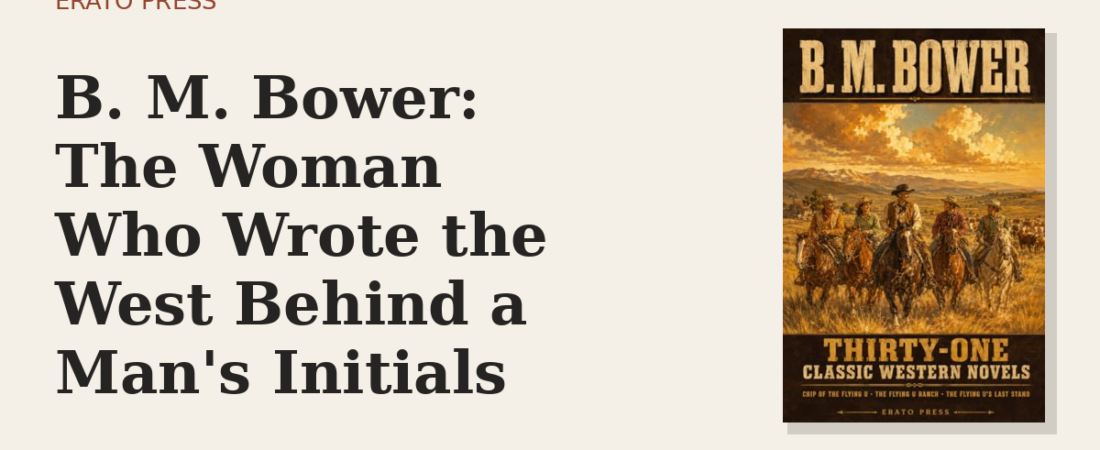
Erato Press has gathered thirty-one of Bower’s Western novels into a single annotated volume, with an original critical essay that makes the full case for her as the genre’s great homemaker rather than its outlaw. It is the easiest way to do what Bower’s first readers did — settle into the Flying U and stay through the seasons.
Read the Erato Press edition →
Enjoyed this piece?
Get the next one — our essays on the classics and news of each new Erato Press edition — straight to your inbox.