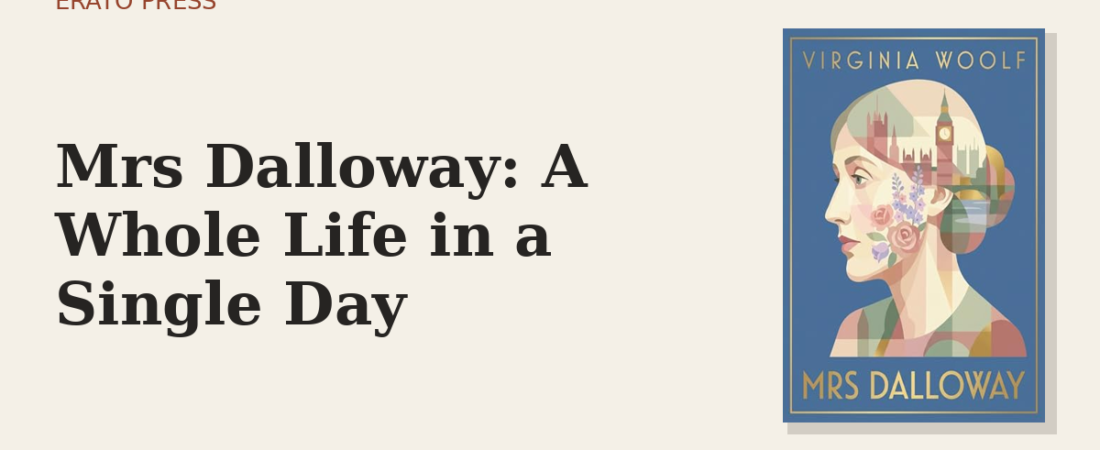
“Mrs Dalloway said she would buy the flowers herself.” From that famously quiet opening, Virginia Woolf built one of the defining novels of the twentieth century — a book in which almost nothing happens and everything is contained. Over the course of a single June day in 1923, as a society hostess named Clarissa Dalloway prepares for a party, Woolf moves in and out of a dozen minds, threads the present through the whole buried past, and shows that a single ordinary day, looked at closely enough, holds an entire life, an entire era, and the near presence of death. It is the great novel of consciousness, and the most beautiful demonstration of what the modernist revolution in fiction was for.

The stream of consciousness
Woolf’s method — the “stream of consciousness,” the flow of thought and memory and sensation as it actually moves through a mind — was the modernist answer to a discovery: that the old novel, with its plots and its external events, left out most of what it is to be alive. Real life, Woolf argued, happens inside — in the drift of association, the sudden flooding-back of the past, the way a smell or a sound in the present opens a door onto decades ago. So her novel dives beneath the surface of the day and gives us Clarissa’s whole inner life — her girlhood, the road not taken, the man she did not marry, the woman she once kissed — surfacing and submerging as she walks through London. Nothing is narrated from outside that could be felt from within. It is one of the summits of literary modernism, the movement that turned the novel inward.
Clarissa and Septimus: the double
Running beside Clarissa’s bright day is a dark twin. Septimus Warren Smith, a shell-shocked veteran of the Great War, moves through the same London on the same morning, but for him the world has become unbearable, cracked open by a horror the doctors cannot see and will not believe. The two never meet — but at Clarissa’s party, news of Septimus’s suicide reaches her, and she withdraws alone to absorb it, and understands, in a flash, that this stranger’s death is somehow bound to her own life, that he has died so that she might feel the value of living. Woolf, who knew madness and would take her own life, wrote Septimus out of the deepest knowledge, and made his fate the shadow that gives Clarissa’s ordinary happiness its unbearable poignancy. The war is over; the war is everywhere; the dead are at the party.
The poetry of the ordinary
What makes Mrs Dalloway more than a technical experiment is the beauty and tenderness with which Woolf renders ordinary experience — the striking of Big Ben, the flowers, the summer air, the sudden startling joy of being alive on a fine morning in a great city. She believed that these unremarked moments, the texture of a single day, were where life actually lived, not in the great events the history books record, and she wrote them with a lyric intensity that turns a walk to the florist into something close to ecstasy. The novel is short, and demanding, and once its music takes hold it is one of the most moving books in the language — a hymn to the fragile, ordinary, mortal fact of being here at all.
Why read it now
Because it is the most beautiful proof that the inner life is the real life, and because its themes — the long shadow of trauma, the distance between the self we show at parties and the self we carry alone, the preciousness of an ordinary day — belong entirely to our moment. It asks a little patience with its method; it repays that patience with some of the most luminous prose ever written in English.
Frequently asked questions
Is Mrs Dalloway hard to follow?
The shifts between minds can disorient at first, because Woolf rarely announces them. The trick is to stop looking for plot and to let the consciousness carry you; within a few pages the method becomes natural, and the novel is short enough to reread, which richly rewards it.
How does it relate to Ulysses?
Both compress a single day into a modernist epic of consciousness, and Woolf read Joyce with a mixture of admiration and rivalry. Mrs Dalloway is the shorter, more lyrical cousin — an ideal entry to the same revolution our honest guide to Ulysses takes up at greater scale.
Where should I start with Virginia Woolf?
Mrs Dalloway is the ideal beginning — shorter and more immediately moving than To the Lighthouse, and the purest example of her method. The Erato Press editions present her novels with critical essays on the art of consciousness.
Read the Erato Press edition →
and discover how much of a life fits inside a single day.
Enjoyed this piece?
Get the next one — our essays on the classics and news of each new Erato Press edition — straight to your inbox.