Before Dashiell Hammett, the detective was a brain in a chair. Poe’s Dupin reasoned out crimes from his armchair; Conan Doyle’s Holmes deduced a man’s history from his cuffs; the whole tradition of the puzzle-mystery treated murder as an intellectual diversion, a locked-room riddle to be solved by a superior mind and then forgotten over tea. Hammett, who had actually worked as a Pinkerton operative and knew what the trade smelled like, threw all of it out. His detective does not solve crimes by ratiocination. He solves them — when he solves them at all — by leaning on people, lying to them, outlasting them, and walking through cities thick with corruption where the police are bought and the client is the most dangerous person in the room. Hammett took the murder out of the country house and put it back where it belonged: in the street, in the money, in the body. In doing so he did not just write good crime novels. He invented a way of writing.

Prose stripped to the bone
The first thing you notice in Hammett is the surface, because he gives you almost nothing but surface. He had learned from the discipline of the pulps and from his own ear a style of radical exteriority: he tells you what people do, what they say, and what things look like, and he refuses, almost totally, to tell you what anyone feels or thinks. Open The Maltese Falcon and watch Sam Spade roll a cigarette while he absorbs the news that his partner is dead. Hammett spends a long, exact paragraph on the mechanics — the brown papers, the measured flakes of tobacco, the thumbs rolling the paper’s edge, the tongue at the seam — and not one word on grief. The reader is handed the gesture and left to supply the man. We learn later that Spade did not even like his partner; the cigarette tells us everything the omitted interior monologue would only have cheapened.
This is the famous “objective” or “behaviorist” method, and Hammett pushed it further than anyone. When Spade is woken at two in the morning to be told of the killing, his telephone voice is rendered as bare fragments — “Hello. . . . Yes, speaking. . . . Dead? . . . Yes. . . . Fifteen minutes. Thanks.” — and Hammett trusts those clipped words and the dark room around them to carry the whole shock. Nothing is explained. Nothing is editorialized. The prose has the flat, watchful quality of a surveillance report, which is precisely what Hammett had spent years writing for the Pinkertons. The effect is not coldness but a kind of brutal honesty: people are knowable only by what they do, and what they do is often a lie, so the reader must learn to read behavior the way a detective does. The style is the detective’s epistemology.
Red Harvest and the moral abyss
If The Maltese Falcon is Hammett’s most perfect book, Red Harvest is his most dangerous. His first novel sends the nameless Continental Op into Personville — “Poisonville,” everyone calls it — a Western mining town owned body and soul by a single tycoon and run by the rival gangs of crooks, gamblers, and bootleggers he once hired to break a strike and can no longer control. The Op is brought in, his client is murdered before he can even take the job, and he decides, more or less on his own authority, to clean the town out. His method is not detection. It is provocation. He sets the criminal factions against one another, feeds them lies, and stands back while they slaughter each other — and by the end the body count runs to dozens and the Op himself has begun to enjoy it.
That last fact is what makes Red Harvest a permanent shock. At the novel’s center the Op admits, in one of Hammett’s rare interior moments, that the violence is getting to him — that he has gone “blood-simple,” that he is starting to like the killing he has engineered. The detective, the supposed agent of order, discovers that he is not cleaning up the corruption so much as becoming an expression of it. Hammett, a committed leftist who had seen the strikebreaking trade from the inside, wrote the book as something close to a parable of capitalism’s violence: a town owned by one man, fought over by his hired thugs, “cleaned” only by a flood of more blood. There is no restoration of order at the end, only exhaustion. This is the moral universe that defines the hard-boiled school against the gentler tradition of the puzzle — a distinction worth understanding through the wider lens of the two souls of crime fiction, hard-boiled and cozy, which sit at opposite ends of what the genre believes about human nature.
Spade, and the code that is barely a code
Sam Spade has been so thoroughly absorbed into the culture — partly through Bogart’s performance, partly through a thousand imitations — that it is easy to forget how unsettling a creation he is. He is not a good man with a hard shell. He sleeps with his partner’s wife, treats his clients with open contempt, lies as easily as he breathes, and spends most of The Maltese Falcon being indistinguishable from the criminals he is maneuvering against. Hammett deliberately denies us access to Spade’s interior, so that for most of the book we genuinely cannot tell whose side he is on — whether he means to recover the falcon for himself, whether he is in love with the woman who hires him under a false name, whether he has any principle at all beyond self-preservation.
And then, at the very end, when he gives Brigid O’Shaughnessy up to the police for murdering his partner, he explains himself — and the explanation is the closest thing to a moral code the hard-boiled hero possesses. He did not love his partner, he says; the man was a son of a gun. But when your partner is killed, you are supposed to do something about it. It is bad for business to let the killer walk, bad all around, and the fact that he can’t even be sure of his own motives doesn’t change what he has to do. This is morality reduced to its irreducible minimum: not justice, not virtue, not love, but a professional refusal to be a sucker. Spade turns Brigid in not because he is good but because the alternative would make him something he cannot live with. The hard-boiled hero is defined not by what he believes but by the one line he will not cross even when crossing it would be easier. Hammett gave the detective a soul precisely by making it almost invisible.
What Hammett made possible
The line of descent is direct and enormous. Raymond Chandler, who admired Hammett extravagantly, said he had taken murder out of the Venetian vase and dropped it in the alley — that he gave it back to the people who actually commit it, for reasons, with the weapons at hand. Everything we now call noir begins here: the corrupt city, the compromised protagonist, the femme fatale who is more dangerous than any gunman, the flat declarative prose that refuses to moralize, the recognition that the line between the law and the lawless is a matter of paperwork rather than character. Chandler refined the style into something more lyrical and self-aware; Ross Macdonald deepened its psychology; James M. Cain pushed its fatalism to the edge; and the whole tradition of American crime film, from The Maltese Falcon onward, is unthinkable without the template Hammett cut.
What is easy to miss is how much of the detective story he kept even as he overturned it. The genre’s deep structure — the outsider who arrives, gathers a corrupt world’s secrets, and forces a hidden truth into the light — reaches back through Wilkie Collins to the very origins of the form, and Hammett honored it even as he stripped away its gentility. Readers who want to see how far the detective traveled from his Victorian cradle to Hammett’s Poisonville will find the whole arc opened up by Wilkie Collins and The Moonstone, the first great detective novel. Hammett did not abandon the form. He took its skeleton, burned off the manners, and dressed it in the truth.
Frequently asked questions
Should I start with Red Harvest or The Maltese Falcon?
Start with The Maltese Falcon if you want Hammett at his most controlled and complete — one detective, one tightly wound plot, the famous ending that defines the whole genre’s morality. Start with Red Harvest if you want his most ferocious and politically charged work, a commentary on corruption and violence disguised as a body-strewn thriller. Many readers do both in quick succession and find that the two books illuminate each other.
How much did Hammett’s Pinkerton career shape the books?
Profoundly. He worked as an operative for the Pinkerton National Detective Agency, including stints connected to strikebreaking, and the experience gave him both his material and his method. The flat surveillance-report prose, the conviction that detection is mostly legwork and lies rather than brilliant deduction, the deep cynicism about who really runs a town — all of it comes from having done the job. He wrote what he had seen, which is why it does not read like anyone who had only read other mysteries.
Is the hard-boiled style just about being tough?
No, and that is the common misreading. The toughness is a surface; the real innovation is the objective method — telling a story entirely through action and speech, withholding interiority so that character must be inferred from behavior. The famous laconic dialogue and violence are the visible signs of a deeper artistic discipline about what a writer is allowed to tell the reader. Imitators copied the attitude and missed the technique.
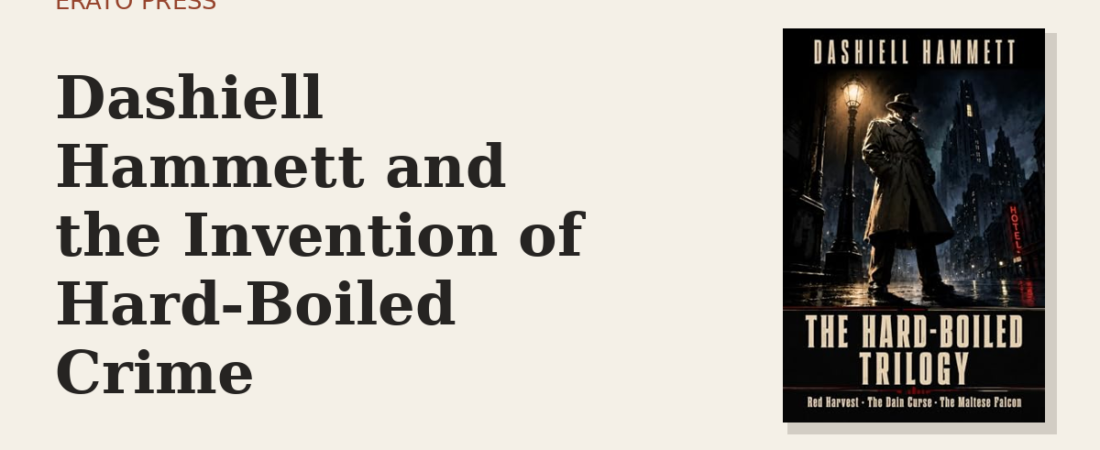
Hammett’s effects live in the smallest choices — a withheld feeling, a paragraph spent on a cigarette instead of a thought, a clipped line of dialogue carrying a whole shock — and they reward a reader paying close attention to surface. Our Erato Press edition collects his major hard-boiled work in clean, faithful texts with an introduction that places his style in the history of crime fiction and the politics of his own life, so the artistry under the toughness comes through. and walk into Poisonville with the man who put the murder back in the street.
Enjoyed this piece?
Get the next one — our essays on the classics and news of each new Erato Press edition — straight to your inbox.