Most people meet Dickens through abridgment, adaptation, or a school assignment they resented, which means most people have never met Dickens at all. They have met a brand — cobblestones, plum pudding, “please, sir, I want some more” — rather than the writer himself, who is stranger, funnier, angrier, and more formally daring than the Christmas-card version admits. The good news for a newcomer is that there is a right door, and it is not the same door for everyone. Where you should start depends on what you want a novel to do to you.

The single most important fact about how Dickens wrote — the fact that explains nearly everything readers find both exhilarating and frustrating in him — is that he wrote for serial publication. The novels came out in monthly or weekly parts, each ending on a hook, each responsive to the sales and the gossip of the previous installment. This is why the books are long, why the casts are enormous, why subplots multiply, and why the characters are built for instant recognition. It is also why they pulse with life: Dickens was writing to a public he could feel breathing on the other side of the page, and the immediacy never left his prose. Pick your starting point with the serial machine in mind and you will never be lost.
If you want the perfect novel: Great Expectations
Start here if you want to be convinced. Great Expectations (1860–61) is the most controlled thing Dickens ever made — relatively short, narrated in the first person, with nothing wasted and everything connected. The opening is one of the great hooks in English fiction: a small boy named Pip in a churchyard at dusk, seized by an escaped convict who turns him upside down to empty his pockets. That convict, Magwitch, vanishes for hundreds of pages and then returns to detonate the entire plot, because the “great expectations” Pip believes come from the frozen, jilted Miss Havisham in her decaying wedding dress in fact come from the criminal he once fed in a graveyard.
What makes the book modern is its irony of retrospect. The adult Pip is narrating his own younger self’s snobbery and self-deception, and the gap between the boy who is climbing the social ladder and the man who sees what the climb cost is the novel’s true subject. The wisdom Pip eventually earns has a price, and Dickens refuses to pretend otherwise. He even rewrote the ending — the famous final image of the “evening mists rising” and “no shadow of another parting” from Estella is the revised, gentler version, softened on a friend’s advice, and readers have argued for a century and a half about whether the first, bleaker ending was the truer one. Begin with this and you understand at once why Dickens belongs among the greatest novelists who ever lived.
If you want the social epic: Bleak House
Start here if you want Dickens at full power, with the throttle wide open. Bleak House (1852–53) is his most ambitious formal experiment, and its engine is a structural gamble that paid off completely: it is told in two alternating narratives. One is the gentle, retrospective first-person account of Esther Summerson, who keeps apologizing for writing about herself even as she quietly takes command of her own story. The other is an anonymous, present-tense voice that sweeps over the whole of England like a searchlight — “Fog everywhere,” the novel begins, fog rolling up the river and into the Court of Chancery, where the endless lawsuit Jarndyce and Jarndyce “drones on” until no living person understands what it is about.
The present tense is the secret weapon. It insists that the absurdity and cruelty Dickens is describing are not historical curiosities but a system operating now, grinding up real lives in real time. Chancery is not a backdrop; it is a death-machine that kills slowly through delay, and the novel follows its poison out from the courts into the slums, the great houses, and a smallpox infection that recognizes no class boundary. Bleak House is where you see Dickens’s deepest conviction made structural: that everything in a society is connected, that the comfortable cannot wall themselves off from the suffering they ignore, and that the novel itself is the instrument for tracing the connections. If you have read and loved the great Victorian social novels — if you have wondered, as our essay on whether George Eliot and Middlemarch make the greatest English novel — then Bleak House is the book that makes the rival case.
If you want to meet the man: David Copperfield
Start here if you want warmth and the whole arc of a life. David Copperfield (1849–50) was Dickens’s own favorite — “of all my books, I like this the best” — and it is the most autobiographical, drawing on the secret shame of his childhood stint pasting labels in a blacking warehouse after his father was thrown into debtors’ prison. The famous opening question sets the terms: “Whether I shall turn out to be the hero of my own life, or whether that station will be held by anybody else, these pages must show.”
The pleasure of Copperfield is the pleasure of a narrator looking back with full knowledge at a self who had none. We fall for the dazzling, careless Steerforth exactly as the boy David does — and the adult narrator’s tone lets us feel, before the plot confirms it, that this charm will betray us. The book is also a portrait gallery of Dickens’s finest comic creations: the perpetually insolvent, perpetually optimistic Mr. Micawber, forever waiting for something to “turn up”; and Uriah Heep, the most physically repellent of all Dickens’s villains, “umble” and damp and writhing, his too-jointed hands and red-rimmed eyes making his body an honest map of his rotten soul. That correspondence between the physical and the moral — the grotesque as moral cartography — is one of Dickens’s oldest tools, and Heep is its masterpiece.
If you want the gateway: A Tale of Two Cities or Oliver Twist
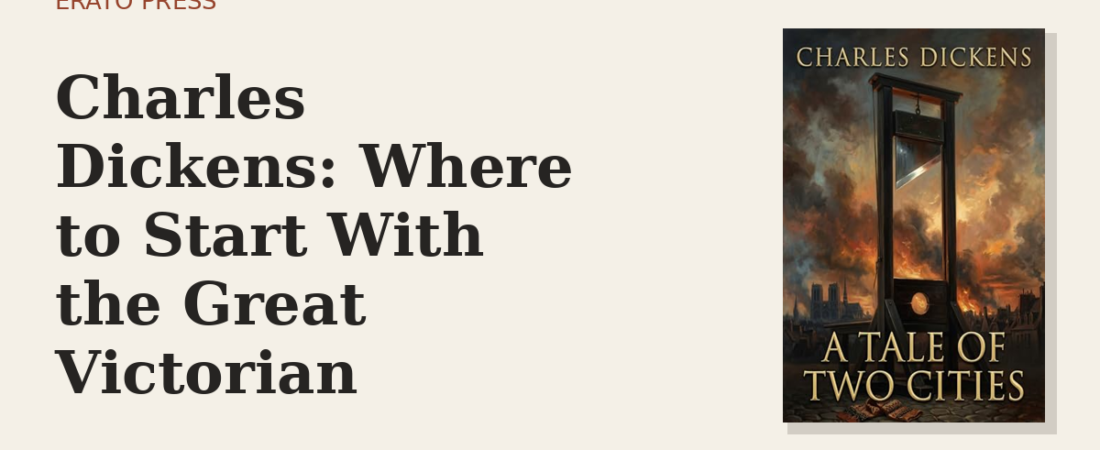
Start with one of these if you want to be carried fast. A Tale of Two Cities (1859) is the leanest, most plot-driven of the major novels, a tightly wound machine of the French Revolution that opens on the most quoted sentence Dickens wrote — “It was the best of times, it was the worst of times” — and closes on the most moving, as Sydney Carton walks to the guillotine in another man’s place: “It is a far, far better thing that I do, than I have ever done.” It is the late Dickens of concentrated intensity, the comic abundance stripped away in favor of a single, ferocious gesture of sacrifice. Some readers find it his most accessible novel for exactly that reason.
Oliver Twist (1837–39), by contrast, is early Dickens — rawer, more melodramatic, but burning with the social fury that never left him. It put the workhouse, the orphan, and the criminal underworld of Fagin and the Artful Dodger into the center of English fiction and dared respectable readers to look. It is uneven in the way apprentice work is uneven, but the murder of Nancy and the indictment of institutional charity have a force that no polish could improve. As a first taste of Dickens’s moral seriousness, it still does the job. And it is worth remembering that this appetite for an enormous, populated, episodic story — a hero set loose on a road through a whole society — is one of the oldest pleasures in literature; it is the pleasure that, as our essay on what Nolan has to work with in the Odyssey describes, the epic invented and the serial novel inherited.
Frequently asked questions
Is Dickens too sentimental for modern readers?
He can be, and the deaths of his angelic children are where it shows. But the sentiment is half the story. The same writer who weeps over Little Nell skewers lawyers, philanthropists, and self-made tycoons with a satirical precision that has dated not at all. Read him for the anger and the comedy and you will find the sentiment is the price of admission to a much larger imagination.
Do I have to read the whole enormous thing?
Yes, and the length is the point. These books were built to accumulate — the vast cast, the buried connections, the long-delayed payoffs only work because Dickens makes you live inside the world for hundreds of pages. The serial form trained him to reward patience. Skim him and you get the brand; read him whole and you get the writer.
Which order should I read them in?
You do not need to read them in order; each is self-contained. The most common happy path is Great Expectations first for its perfection, then David Copperfield for its warmth, then Bleak House once you trust him enough to follow him across a thousand pages. Start where your appetite is, not where the chronology is.
The Erato Press edition gathers the major novels with apparatus designed for exactly this kind of reader — tracing the serial structure that shaped each book, the social institutions Dickens was attacking, and the recurring obsessions (the haunting weight of the past, the body as moral evidence, the conviction that sympathy is a form of knowledge) that make the separate novels one continuous achievement. and find your own door into the great Victorian.
Enjoyed this piece?
Get the next one — our essays on the classics and news of each new Erato Press edition — straight to your inbox.