Virginia Woolf called Middlemarch “one of the few English novels written for grown-up people,” and the backhanded compliment still stings because it is true. The English novel before George Eliot had given us social comedy, gothic terror, the Bildungsroman, and the three-decker marriage plot, but it had rarely given us the inner life treated as a serious moral problem — the slow, grinding, often invisible business of how ordinary people fail and adjust and quietly become someone other than the person they intended to be. Eliot did that, at scale, in a provincial town nobody had heard of, and she did it so completely that the case for Middlemarch as the greatest English novel rests not on any single scene but on something harder to praise: the sheer density of moral intelligence per page.

Mary Ann Evans, who published as George Eliot, was the most learned person ever to write an English novel — a translator of Strauss and Feuerbach, a magazine editor, a woman who read German theology for pleasure and lived openly with a married man, George Henry Lewes, in defiance of Victorian England’s entire apparatus of respectability. She came to fiction late, in her late thirties, and to Middlemarch later still, finishing it in 1872 when she was past fifty. It is a mature writer’s book in the deepest sense: it does not believe in the consolations it dramatizes, and it refuses to let either its characters or its readers off easily.
The novel that takes failure seriously
The governing subject of Middlemarch is the gap between aspiration and outcome — what Eliot, in her famous Prelude, calls the fate of “later-born Theresas” who have “no epic life” available to them, only “a life of mistakes.” Dorothea Brooke wants to do great good in the world and has no instrument for it but marriage; she chooses, catastrophically, the desiccated scholar Edward Casaubon, mistaking his pedantry for grandeur and his coldness for depth. Lydgate, the brilliant young doctor, arrives in Middlemarch intending to reform medicine and make a discovery that will outlast him; he marries the lovely, shallow Rosamond Vincy and is slowly strangled by debt, by her unbreakable will, and by the small-town politics he is too proud to manage.
What makes this more than a catalogue of disappointments is Eliot’s refusal to make anyone a villain. Casaubon is not a monster; he is a frightened, mediocre man who knows, somewhere beneath his armor of footnotes, that his life’s work — the “Key to all Mythologies” — is already obsolete, and Eliot grants him one of the most devastating sentences in the language when she pauses to consider him: “he had an equivalent centre of self, whence the lights and shadows must always fall with a certain difference.” That is the moral engine of the whole book. Other people are not furniture in the story of our lives; each is the center of a story in which we are the furniture. Eliot calls the failure to grasp this “moral stupidity,” and she diagnoses it in nearly everyone, including, by implication, the reader.
Sympathy as a discipline, not a sentiment
It is easy to praise Eliot’s “sympathy” and miss how astringent it actually is. She is not asking us to be nice. She is asking us to perform an act of imagination that is genuinely difficult — to extend to other people the same assumption of interiority we grant ourselves without thinking. The most quoted passage in the novel makes the cost explicit: “If we had a keen vision and feeling of all ordinary human life, it would be like hearing the grass grow and the squirrel’s heart beat, and we should die of that roar which lies on the other side of silence.” Total sympathy would be unbearable; we survive by being “well wadded with stupidity.” Eliot’s prose is the controlled removal of a little of that wadding — just enough to make us feel the roar without dying of it.
This is why the famous narrator matters so much. Eliot’s omniscient voice is not a god looking down but a mind thinking alongside us, generalizing from the particular case to the moral law and back again, often within a single sentence. Henry James, who learned enormously from her and then pretended he hadn’t, complained that the book was “a treasure-house of detail, but an indifferent whole.” He was wrong about the whole and right about the detail: the wholeness is the accumulation of detail, the way a marriage curdles not in one scene but across a hundred small adjustments, the way Lydgate’s ruin is built out of furniture bought on credit and a wife who will not be argued with.
A web, not a hero
Eliot’s structural innovation — the thing that makes Middlemarch feel modern when so much Victorian fiction feels like clockwork — is that it has no protagonist. Dorothea is the closest thing to a heroine, but she vanishes for long stretches while Eliot follows Lydgate, or the banker Bulstrode whose buried past surfaces to destroy him, or the Garth family, or the young clergyman Farebrother. The image Eliot herself reached for was the web: “I at least have so much to do in unraveling certain human lots, and seeing how they were woven and interwoven.” Pull one thread — Bulstrode’s secret, Featherstone’s will, a single loan — and the whole cloth shifts. Society is the real subject, and the individual destinies are the means by which she lets us see it.
This makes Middlemarch the great anatomy of how communities actually work: through gossip, credit, reputation, the slow pressure of what the neighbors will think. The novel is set deliberately in the years around the 1832 Reform Bill, four decades before Eliot wrote it, so that its readers could watch a society on the edge of change and recognize, with a chill, how little the moral machinery had actually altered. Provincial England is not a backdrop here; it is a force, as deterministic in its way as weather. The Victorian novel’s other great women writers worked at a more concentrated, incandescent intensity — and if you want to feel that difference, set Eliot beside the Brontë sisters and the myth their seven novels built, whose passion runs hot where Eliot’s runs deep and wide. Eliot is the novelist of the long view, the cooled judgment, the marriage seen at year ten rather than at the altar.
The ending that refuses triumph
The greatness of the conclusion is that it withholds the conventional reward. Dorothea finds love, at last, with Will Ladislaw — but it is a diminished, ordinary love, and she sinks into a useful obscurity. The Finale’s final paragraph is one of the most morally precise things in English prose, and it is worth quoting because it contains the whole argument of the book: “the growing good of the world is partly dependent on unhistoric acts; and that things are not so ill with you and me as they might have been, is half owing to the number who lived faithfully a hidden life, and rest in unvisited tombs.”
That is not consolation; it is something braver. Eliot looks directly at the fact that most good is anonymous, most ambition thwarted, most lives “unhistoric,” and she finds in that very ordinariness the only honest grounds for hope. The novel that begins with Saint Theresa ends with an unmarked grave, and insists that the second is where actual virtue lives. No English novelist before her had been willing to make peace with so little, and to make that little feel like enough.
Frequently asked questions
Is Middlemarch hard to read?
It is long and its sentences are doing real intellectual work, but it is not obscure. Eliot writes to be understood; the difficulty is the difficulty of sustained attention, not of decoding. The reward is that no novel repays slow reading more fully — the famous passages about the “roar on the other side of silence” and the “equivalent centre of self” land harder when you have earned them across six hundred pages.
Why is it set in the past?
Eliot wrote in 1871–72 about the years 1829–32, the period of the great Reform Bill. The historical distance let her show a society poised for political change while quietly arguing that human nature and provincial pettiness change far more slowly than laws do. It is a deliberate irony aimed at her own complacent Victorian readers.
Where does Dorothea’s story actually leave her?
Deliberately small. She remarries, raises children, supports her husband’s political work, and is remembered by no monument — and Eliot frames this not as a failure but as the truest form of the “growing good of the world,” done by people who “rest in unvisited tombs.” The anticlimax is the point.
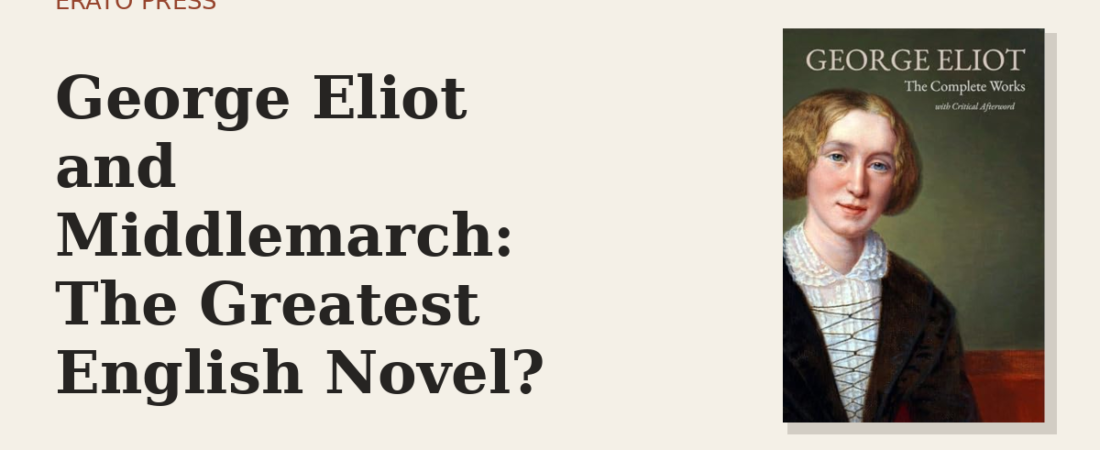
The Erato Press edition restores Eliot’s full apparatus and meets the novel on its own demanding terms, with critical material that traces how this provincial study became, for many readers, the high-water mark of the form. If you have been putting Middlemarch off because of its length, this is the edition that makes the case for why the length is the achievement.
Read the Erato Press edition →
and find out why so many novelists, asked for the greatest English novel, simply name this one and stop.Enjoyed this piece?
Get the next one — our essays on the classics and news of each new Erato Press edition — straight to your inbox.