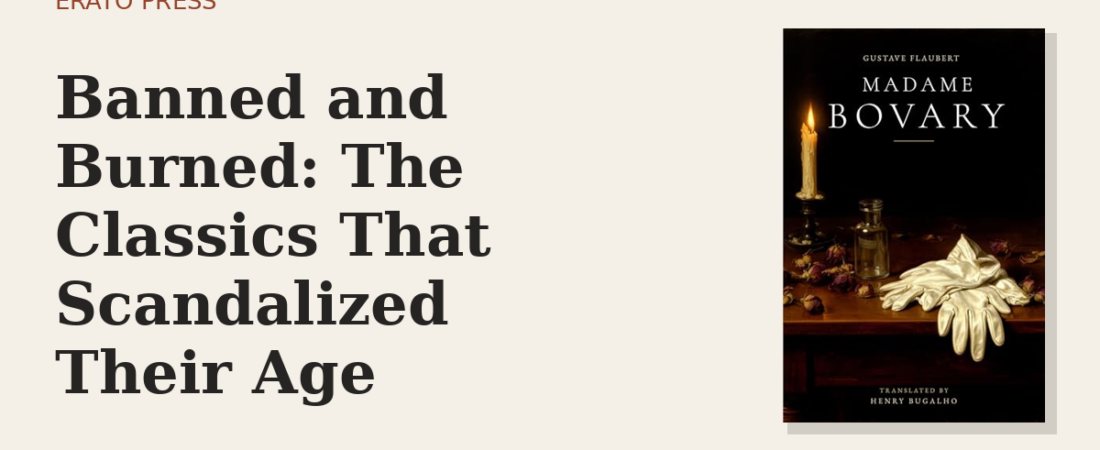
In January 1857, a public prosecutor named Ernest Pinard stood before a Paris court and accused a novel of an offense against public morals and religion. The novel was Madame Bovary; the author, a near-unknown provincial named Gustave Flaubert, sat listening as the state read his adulteress’s seduction scenes aloud as evidence. Pinard’s case was not that the book endorsed adultery—Emma Bovary, after all, dies in agony, poisoned by arsenic. His complaint was subtler and, in its way, more accurate: that Flaubert had described sin without the saving grace of authorial condemnation, that the prose was beautiful where it should have been punitive, that the novel refused to tell the reader what to feel. Flaubert was acquitted. But Pinard had identified, with a censor’s unerring instinct, exactly what was dangerous about the book—and in doing so he wrote the first chapter of a story that runs straight through the next century of literature.

The classics we now hand to students were, an astonishing number of them, born under indictment. To assemble the history of literary censorship is to assemble an alternative syllabus of the modern canon, and the pattern that emerges is not what the censors would have us believe. They almost never burned the bad books.
What the censors were actually afraid of
The official charge was always obscenity, blasphemy, or some threat to public order. But read the trial transcripts and a different anxiety surfaces. The prosecutors were rarely troubled by the depiction of vice as such—Victorian shelves groaned with cautionary tales of fallen women who died on schedule. What alarmed them was the withdrawal of judgment. Flaubert’s crime, in Pinard’s framing, was the famous impersonality of his method, the cool refusal to step forward and moralize. The reader of Madame Bovary: Flaubert and the Birth of Realism is left alone with Emma, unguided, and must reach his own verdict—and a reader who reaches his own verdict is a reader the state cannot instruct.
The same year as the Bovary trial, 1857, Charles Baudelaire was hauled before the identical court for Les Fleurs du mal and, unlike Flaubert, was convicted; six poems were ordered suppressed, and the ban was not formally lifted in France until 1949. Half a century of jurisprudence, in other words, against thirteen pages of verse. The disproportion tells you that what was on trial was never the page count of offending material but the principle that art might explore experience the authorities would prefer left unexplored. Obscenity was the available legal handle. The thing being gripped was harder to name.
The trials of the modern, 1890–1928
When Oscar Wilde published The Picture of Dorian Gray in 1890, the reviews were not merely hostile but prosecutorial in tone—one paper suggested the book was fit only for “outlawed noblemen and perverted telegraph boys,” and Wilde was pressed by his publisher to revise and expand the novel, toning down its homoerotic suggestion for the 1891 book version. That was not the end of it. Five years later the novel itself was entered into evidence against its author at his criminal trial for “gross indecency,” read aloud by prosecuting counsel as though Dorian’s portrait were a confession. Wilde had written, in his preface, that “there is no such thing as a moral or an immoral book. Books are well written, or badly written. That is all.” The court disagreed, and he went to Reading Gaol to prove it. No episode in literary history more nakedly fuses the censorship of a book with the destruction of a man.
The story repeats, with variations, across the turn of the century. Ulysses, James Joyce’s enormous reinvention of the novel, was prosecuted in the United States before it was even complete: the Little Review, which serialized it, was convicted in 1921 over the “Nausicaa” episode, and the book was effectively banned in America for more than a decade. What broke the ban is itself a landmark—Judge John M. Woolsey’s 1933 ruling in United States v. One Book Called Ulysses, which read the whole novel rather than its dirty fragments and found that while the effect of Ulysses on the reader “is somewhat emetic, nowhere does it tend to be an aphrodisiac.” Obscenity, Woolsey held, must be judged by the work’s effect on a person of average sensibility, taken as a whole and by its dominant intent. It is a curious fact that one of the foundational documents of free literary expression in the English-speaking world is a judge’s review of Ulysses; if you are weighing whether to attempt the book yourself, our essay Is Ulysses Worth Reading? An Honest Guide takes up the question Woolsey did not have to answer, which is whether the difficulty repays the labor.
And then Lady Chatterley’s Lover, the case that closes the era. D. H. Lawrence’s last novel, printed privately in Florence in 1928 because no English house would touch it, became the subject of the most famous obscenity trial of the twentieth century when Penguin Books published an unexpurgated edition in 1960 and dared the Crown to prosecute under the new Obscene Publications Act. The Crown obliged. The prosecutor, Mervyn Griffith-Jones, asked the jury the question that has come to define the whole vanished world of literary censorship: was this “a book that you would even wish your wife or your servants to read?” The phrasing—the assumption that there existed a class of reader who must be protected by their betters from their own appetites—lost the case in a sentence. Penguin was acquitted, sold three million copies, and the era of the great literary obscenity trial was effectively over.
The censor as inadvertent canon-maker
Step back from the individual trials and a perverse logic comes into focus. The act of suppression is an act of attention. To ban a book is to announce that it possesses a power worth fearing, and that announcement has, again and again, outlived the ban. Every title named here is now standard; the prosecutors are remembered, if at all, as the men who were wrong. Pinard’s reward for prosecuting Flaubert was to have his name preserved solely as a footnote to a masterpiece. Griffith-Jones’s question about wives and servants is quoted in every account of the 1960s precisely as a monument to obtuseness.
This is not because the censors lacked taste—several of them read acutely, and Pinard genuinely understood what Flaubert was doing. It is because the qualities that made these books dangerous were the same qualities that made them durable: the refusal to flatter the reader’s moral comfort, the insistence on rendering experience as it is rather than as the authorities wished it pictured. Censorship is a hostile review that happens to be enforceable by the state, and like all hostile reviews it tends to be most vehement about the work that has touched something true. The books that scandalized their age survived their age. The ones that merely titillated it are forgotten, unbanned and unread.
Frequently asked questions
Were these books actually burned, or just banned?
Both, depending on the regime and the decade. Legal suppression—seizure, fines, import bans, prosecution of publishers—was the more common fate in Britain, France, and the United States, and is the form most of these famous cases took. Literal burning was the signature of the more total censorships, most notoriously the Nazi book-burnings of 1933, which consumed works by many of the same authors the liberal democracies had merely banned. The phrase “banned and burned” spans a spectrum from a customs officer’s confiscation to a bonfire in a public square.
Did the bans help the books sell?
Often, eventually, and sometimes spectacularly. The lifting of the Lady Chatterley ban produced sales of millions within a year, and the notoriety of Ulysses guaranteed it an audience curious about what all the prosecution was for. But this came at real cost to living authors: Wilde was ruined, Baudelaire fined and humiliated, and many writers spent years unable to publish at all. The romance of the banned book is easier to enjoy at a century’s distance than it was to live.
Why do these particular books keep getting taught?
Because the trials clarified, rather than created, their importance. A book that a society felt compelled to prosecute is a book that pressed on that society’s deepest assumptions about sex, faith, class, and the limits of art—and those pressure points are exactly what later readers come to literature to understand. The censorship history is itself part of the reading: it shows you where the live wires were.
The Erato Press edition gathers this history into a single critical narrative, with the trial records, the censors’ arguments, and the writers’ defenses set side by side, so that the reader can watch a culture argue with itself about what a book is permitted to do. The scandals are not a lurid sideshow to these works; they are part of how the works came to mean what they mean.
Read the Erato Press edition →
Enjoyed this piece?
Get the next one — our essays on the classics and news of each new Erato Press edition — straight to your inbox.