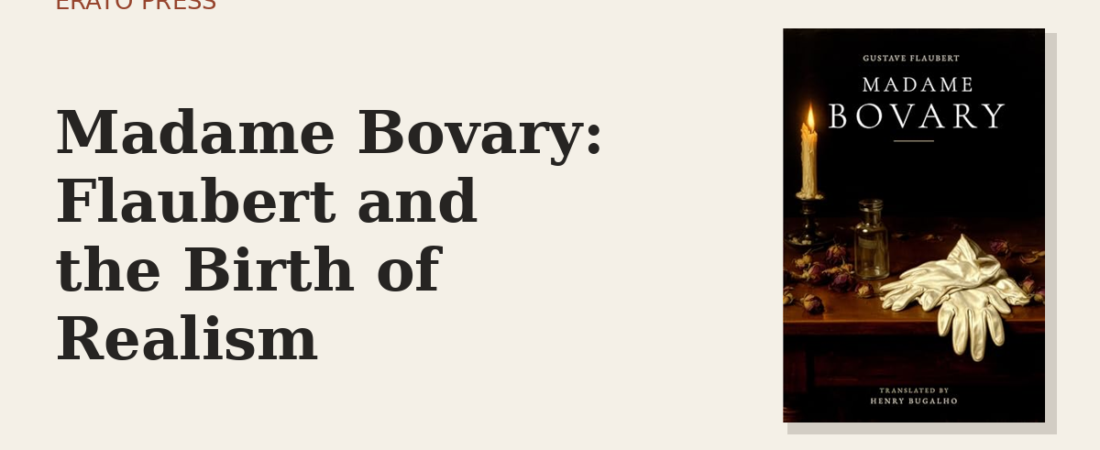
In 1857 the French state put a novel on trial for offending public morality, and lost. The novel was Madame Bovary, the author was Gustave Flaubert, and the prosecution’s failure did more for the book than any review could have: it announced to Europe that something new had arrived, something the censors could feel was dangerous before the critics could explain why. What scandalized the court was the adultery. What actually made the book dangerous was the prose. Flaubert had invented, or perfected, a way of writing that refused to tell the reader how to feel, and that refusal is the founding gesture of the modern novel.

Here is the thesis. Madame Bovary is not important because a provincial doctor’s wife takes lovers and ruins herself. It is important because Flaubert found a style precise enough to render a stupid, ordinary, deluded woman from the inside, without pity and without contempt, and in doing so he made the technique of the novel itself the subject. Everything that follows in literary fiction, the whole tradition of the controlled, impersonal narrator, runs back through this book.
Le mot juste and the agony of the sentence
Flaubert wrote slowly, monstrously slowly, sometimes a single page in a week, and the letters he sent during the five years of composition are a record of self-torture that has become legendary. He was hunting for what he called le mot juste, the exact word, the one and only word that would do, and he tested his sentences by shouting them aloud in his study to hear whether the rhythm broke. This was not vanity about prettiness. It was a conviction that style is not decoration laid over content but the thing itself, that there is no idea apart from the precise words that hold it. He dreamed, he said, of writing a book about nothing, a book held up by the internal force of its style. Madame Bovary is not about nothing, but it is held up that way: every detail, the blind beggar’s song, the rotting wedding bouquet, the agricultural fair, is placed with a jeweler’s deliberation, so that the surface of provincial banality is rendered with an exactness that turns banality into art.
The cost of this method is that nothing in the book is accidental, which means the reader who slows down is rewarded at the level of the sentence, not merely the plot. Flaubert is the writer who taught the novel that prose could be as exacting as poetry, and the trial of reading him properly is learning to notice how much weight each chosen word is carrying.
Free indirect style: the camera that thinks
The technical innovation that makes the book a hinge in literary history is style indirect libre, free indirect discourse. Flaubert did not invent it, but he was the first to build an entire novel on it, to make it the governing instrument. The method lets the narration slide into a character’s consciousness without announcing the move, so that the prose adopts Emma’s thoughts, her vocabulary, her self-flattering cadences, while never quite endorsing them. We get her romantic clichés in the third person, floating free of quotation marks, so that the reader is simultaneously inside her delusion and able to see its cheapness.
This produces the book’s characteristic irony, the famous Flaubertian coolness. When Emma swoons over the idea of love she has absorbed from sentimental novels, the prose swoons with her and judges her in the same breath. The narrator never steps forward to say “she was a fool.” He does not have to. The style itself, by lending Emma its full eloquence and then letting reality fail to meet it, performs the judgment without ever speaking it aloud. This is why the book felt so cold and so dangerous to its first readers: there is no authorial voice to comfort them, no moralizing presence to take their hand. The novelist has, in Flaubert’s phrase, made himself like God in his creation, present everywhere and visible nowhere.
Emma’s tragedy is a tragedy of reading
What is Emma Bovary’s sin, exactly? Not lust, not even ambition. Her tragedy is that she has read the wrong books and believed them. As a girl in the convent she devoured romances full of swooning passion, moonlit assignations, and noble lovers, and she has spent her life waiting for that literature to arrive in Yonville-l’Abbaye, a town that contains a pompous pharmacist, a weak and adoring husband, and the slow accumulation of debt. The gap between what she has been taught to desire and what provincial reality can supply is the engine of the whole book. Her affairs are not transgressions so much as attempts to make life resemble fiction, and each one curdles into exactly the disappointment the fiction never warned her about. Rodolphe, the practiced seducer, finds her professions of love tiresomely conventional precisely because he has heard them in the same novels she has.
Flaubert’s cruelty and his greatness lie in refusing to make Emma either a heroine or a cautionary tale. She is vain, shallow, selfish, and a neglectful mother, and she is also the only person in the book with any hunger for beauty, any sense that life ought to be larger than it is. The provincial reality that crushes her is genuinely crushing, populated by mediocrities like the pharmacist Homais, who ends the novel triumphant and decorated while Emma dies in agony from arsenic. The realism is not neutral. It is an indictment of a world in which the only available ideals are borrowed and false, and the only alternative to them is the smug stupidity of those who have no ideals at all.
Why this counts as the birth of realism
Realism as a program meant turning the novel’s attention away from the heroic and the exceptional toward ordinary life observed without illusion. Many writers attempted it. Flaubert achieved it because he matched the ordinary subject to a method ruthless enough to honor it: the refusal to sentimentalize, the surgical attention to material detail, the suppression of the consoling narrator. The death scene is the proof. Flaubert researched arsenic poisoning clinically and rendered Emma’s death without a shred of romantic dignity, the blackened tongue, the convulsions, the horrible practicality of it, against which the blind beggar sings his obscene little song outside the window. There is no transcendence offered. That withholding is the realist commitment in its purest form, and it is why the book reads as the threshold across which the nineteenth-century novel walked into modernity.
Frequently asked questions
Why was Madame Bovary put on trial?
The French government prosecuted Flaubert and his publisher in 1857 for offenses against public morality and religion, citing the adultery and the unflinching deathbed scene. The defense argued that the book in fact punished its heroine and upheld morality. Flaubert was acquitted, and the publicity turned the novel into a sensation. The irony is that the prosecutors sensed correctly that the book was subversive; they simply misidentified the subversion as the sex rather than the style.
What is free indirect style and why does it matter?
It is a narrative technique that renders a character’s thoughts in the third person, without quotation marks or attributive tags, so the narration takes on the character’s voice while remaining outside it. It matters because it lets a writer be simultaneously intimate and ironic, inside a mind and judging it. Flaubert made it the foundation of an entire novel, and nearly every subsequent novelist who handles point of view, from James to Joyce to the present, is working in the tradition he established.
Is Emma Bovary meant to be sympathetic?
Flaubert refuses to make that easy. She is shallow and self-deceiving, and the famous remark attributed to him, “Madame Bovary, c’est moi,” suggests he recognized her hunger for a fuller life as his own. The book neither excuses her nor lets the dull, respectable world that destroys her off the hook. Sympathy and judgment are held in the same sentence, which is exactly the difficulty the style was built to sustain.
The reward of reading Madame Bovary closely is hearing the prose do its double work, the swoon and the verdict in one motion, and that requires a translation and a presentation that respect Flaubert’s calibration rather than smoothing it. The Erato Press edition gives the novel an apparatus on the trial, the method, and the long ordeal of its composition, so that a reader can see how the most controlled sentences in French fiction were actually built. It is the book that made every novelist after it choose, consciously, how much to intrude.
Read the Erato Press edition →
Enjoyed this piece?
Get the next one — our essays on the classics and news of each new Erato Press edition — straight to your inbox.