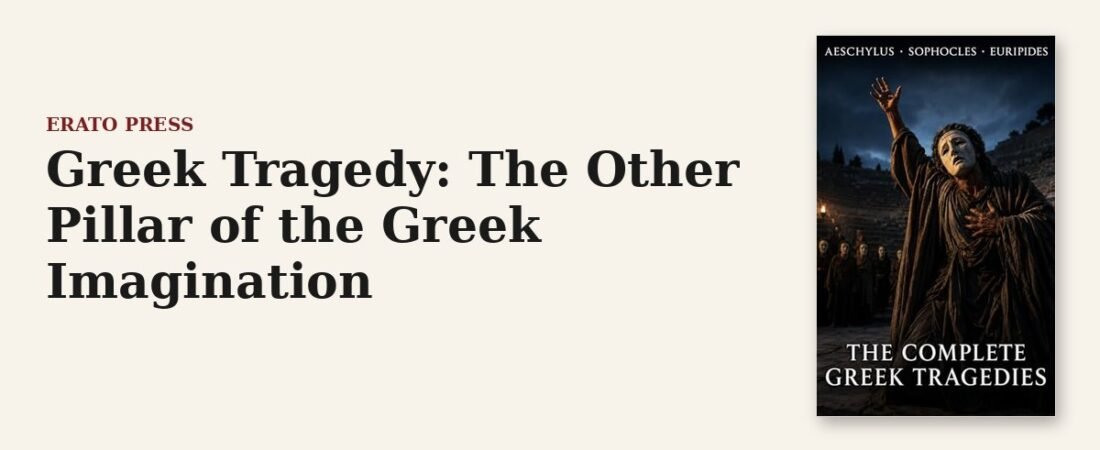
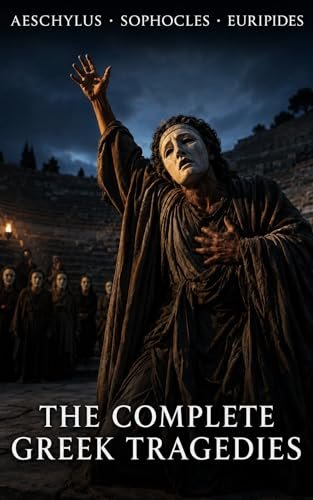
Short answer: If Homer is one pillar of the Greek imagination, tragedy is the other. In a single century, three Athenian playwrights — Aeschylus, Sophocles, and Euripides — invented Western drama and used it to stage the deepest questions a society can ask. The Complete Greek Tragedies collects the thirty-three plays that survive, and they are the natural next step for anyone the Odyssey has hooked — including, this summer, the crowds leaving Nolan’s film.
The paradox that produced tragedy
Tragedy was born from a contradiction. Fifth-century Athens, as our edition’s essay puts it, “was a city in the grip of a paradox that has never been satisfactorily resolved.” It was at once the most democratic society the ancient world had produced and one of the most ruthlessly imperialist; a community that prized rational debate in the Agora and the lawcourts while sustaining, at its ceremonial center, an art form devoted to the irrational, the fated, the divinely catastrophic. The theater of Dionysus, cut into the slope below the Acropolis, was not an escape from civic life but its most intense and self-interrogating expression. These plays were performed at a state festival, the City Dionysia, where foreign ambassadors watched and the orphans of fallen soldiers were paraded in armor. Tragedy was how a democracy thought aloud about everything democracy could not solve.
Aeschylus: the architecture of justice
Aeschylus is the father of tragedy, and his masterpiece is the Oresteia — the only complete tragic trilogy to survive antiquity, and one of the supreme architectural achievements in all of literature. Three plays bound by a single argument carry us from the darkness of private blood-feud to the light of civic law. It begins with a murder: Agamemnon, home from Troy, killed in his bath by his wife Clytemnestra — her revenge for the daughter he sacrificed at Aulis. The cycle of vengeance that follows can only be broken when Athena herself stops the bloodshed by inventing the law court: justice taken out of the hands of the wronged and given to the city. You can feel here the same Greek intuition Hesiod had about Zeus — that order is built not by annihilation but by integration. The connection to the war the Iliad tells is not incidental; tragedy lived on Homeric material.
Sophocles: the human measure
Sophocles won more prizes than any tragedian, and Aristotle built the whole theory of tragedy in his Poetics around one of his plays: Oedipus the King, the paradigm of hamartia — the fatal error — and of the terrible irony of a man whose every effort to escape his fate carries him straight into it. His Antigone stages a conflict with no clean resolution: a young woman’s duty to bury her brother against the state’s command, two goods colliding so that someone must be destroyed. Sophocles is the tragedian of the human measure — of how much a single, intransigent person can bear, and what it costs the world around them when they will not bend.
Euripides: the interrogator
Euripides is the most modern, the most troubling, the least comfortably resolved. His contemporary Aristophanes mocked him for making his characters too realistic, too unheroic, too willing to voice ignoble emotions — which is exactly why he speaks to us. In Medea he gives an abandoned woman a rage so articulate it indicts the whole structure that abandoned her. In The Trojan Women he shows war stripped of every shred of glory — the widows and captives in the smoking ruin of a fallen city — a play that reads like a furious rebuttal of the heroism the epics celebrate. Euripides took the myths Homer made and subjected them to the skeptical scrutiny of his own revolutionary century. He is where Greek literature begins to doubt itself out loud.
Why it belongs next to Homer
Epic and tragedy are the two halves of the Greek imagination, and they answer each other. Homer sings the glory of war; Euripides counts its corpses. Homer celebrates the homecoming of Odysseus; Aeschylus shows another homecoming, Agamemnon’s, ending in murder. Read the Odyssey first, by all means — but the tradition does not stop there. The tragedians took the same gods, the same Trojan War, the same heroes, and asked the harder questions: about justice, about suffering, about whether the gods are good. The thirty-three surviving plays are gathered in the Complete Greek Tragedies, and there is no better second act after Homer.
The film tie-in
Nolan’s Odyssey will send a wave of viewers back toward the Greeks this summer. Homer is the door; tragedy is the room behind it. The same myths the film draws on were re-staged, interrogated, and turned inside out by Aeschylus, Sophocles, and Euripides — and reading them is how a casual moviegoer becomes a real reader of the Greeks.
Read the Complete Greek Tragedies →
Related reading: Greek Classics: Where to Begin · Why the Odyssey Still Matters · Greek Mythology 101
This article contains affiliate links; as an Amazon Associate, Erato Press earns from qualifying purchases.
Enjoyed this piece?
Get the next one — our essays on the classics and news of each new Erato Press edition — straight to your inbox.