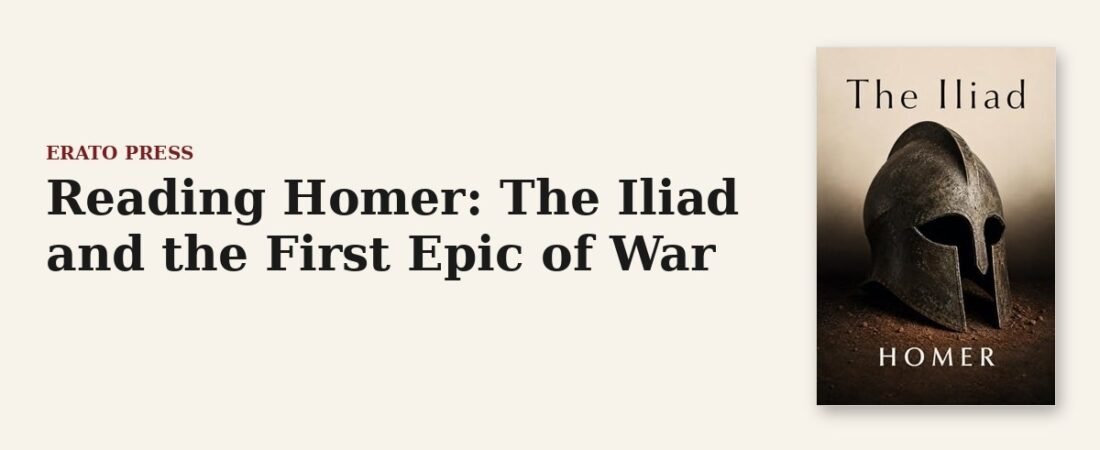
Short answer: The Iliad is harder and darker than The Odyssey — no homecoming, just a few weeks in the tenth year of a ruinous war — but it is the greater poem, the most accurate account of what war costs that the Western tradition possesses. It is not a celebration of battle. It is the opposite, and the difference is the whole point.
A poem about rage, not a war story
The Iliad announces its subject in its first word: menis, wrath — a word Homer reserves for gods and for Achilles. It is not really about the Trojan War; it covers only fifty-one days of it, and concentrates on about four. It is about one man’s anger, its catastrophic consequences, and his long, partial return to something like humanity. Achilles, insulted by Agamemnon over a captive woman, withdraws from battle; the Greeks begin to die in his absence; his refusal hardens past the point where any honourable settlement can reach it. When the embassy of Book IX offers him full restitution — his prize returned, treasure, a marriage, the rule of seven cities — he refuses, and delivers the most radical speech in the poem: that life is worth more than all the gold in the world, that he would rather live long and obscure than die young and famous. The insight is real. But he does not act on it. He does not go home. He sits on the beach and lets his comrades die, and it is this — not his rage, but his refusal to act on his own wisdom — that destroys him and his beloved Patroclus. Homer took the vast machinery of war and focused it on a single soul’s moral crisis, and in doing so invented the idea that an epic could be psychologically deep.
The poem of force
The greatest modern reading of the Iliad was written not by a classicist but by the philosopher Simone Weil, in occupied France in 1940–41. Her argument is that the poem’s true subject is force — “force that turns a human being into a thing.” She saw, with the clarity of someone living through a German occupation, that the Iliad never romanticizes force even in those who wield it most effectively. The moments of greatest martial success are also the moments of greatest human cost: Achilles’ return to battle produces not triumph but bodies piling at the river Scamander until the river itself rises in revolt. The force he embodies in the final books is not glorious. It is horrifying, and Homer shows it so, without comment — in the manner often called objective but better described as precisely and deliberately without consolation. What Weil’s reading underweights is the poem’s other current: its insistence on the dignity of those force destroys. The Trojans are not merely victims of Greek power. Hector, defending his city, his wife, his infant son, is by almost any measure the most fully realized human being in the poem — a protagonist who happens to be on the losing side.
Homer names his dead
The single most important formal decision in the poem is that Homer names the men who die. In the battle books he interrupts the action again and again to introduce a man at the very moment of his death: his name, his father’s name, his city, sometimes one detail of his life — he was good in battle, he was great-hearted, he was “like a poplar” — and then he is killed, in thirty words that are all he will ever get in all of literature, and the poem moves on. This is not desensitizing; it is the opposite. It makes killing expensive in a way no later epic manages. Each named death is a subtraction from the human world that the poem registers as a loss. The contrast with what came after is instructive: in the Aeneid, battlefield death tends to be catalogued without emotion; in the Chanson de Roland, it is elevated into martyrdom. Homer does neither. His dead are not statistics and they are not saints. They had a father and a home, and now they are gone, and the naming is the poem’s one refusal of the momentum that would make the killing invisible.
The enemy has a mother
The Iliad knows something most war literature does not: that the enemy has a mother. This is extraordinarily difficult to sustain — to grant equal weight, equal interiority, equal dignity to both sides without collapsing into false equivalence — and Homer sustains it for twenty-four books. What keeps the poem honest is Achilles’ transformation. His anger begins as wounded honour; after Patroclus dies, it becomes grief, and grief has no political solution. He kills Hector, then mutilates the body and drags it for twelve days — an act his own heroic code recognizes as wrong, which even the gods find excessive. He is a man whose system of meaning has collapsed and who has not yet found a replacement.
He finds it in the final book, when old King Priam comes alone, at night, into the tent of the man who killed his son. He kneels, takes Achilles’ hands — the hands that killed Hector — and asks him to remember his own father. The appeal works not through argument but through recognition: two men on opposite sides of the most famous war in literature, weeping together for what each has lost, recognizing one another across the abyss of enmity as men whose grief is the same grief. Then Achilles gives the body back — not because he must, but because he chooses to. The heroic code has no category for this act. It is something simpler and rarer: compassion. The poem ends not with Greek victory or the fall of Troy, but with a funeral, conducted with proper rites, for the best of the Trojans, in the city that will soon be destroyed: “Thus held they funeral for Hector tamer of horses.”
Why read the hard one
Because the Iliad gives you something almost nothing else does: the full weight of mortality and the full splendour of courage, held in a single gaze. What persists across three thousand years is not its values — the heroic code does not survive its own critique — but its precision: an unsparing attention to the specific weight of each thing, each wound, each grief in a particular body, that becomes a model of what attention to experience actually looks like. Read it slowly, in prose, and let its grief and grandeur work on you. It is where Western literature begins, and it has never been surpassed.
Read the Erato Press Iliad — with the full critical essay this post draws on →
Related reading: Greek and Classical Epics: Where to Begin · The Odyssey: Why Homer Still Matters · Greek Mythology 101: Hesiod and the Birth of the Gods
This article draws on the original critical essay “The Poem and Its Shadows,” written for the Erato Press edition. This article contains affiliate links; as an Amazon Associate, Erato Press earns from qualifying purchases.
Enjoyed this piece?
Get the next one — our essays on the classics and news of each new Erato Press edition — straight to your inbox.