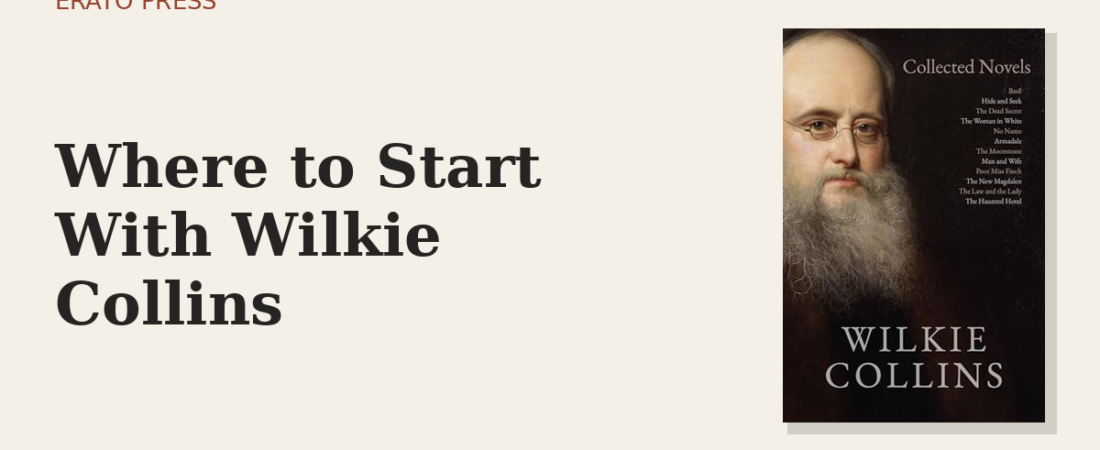
There is a particular pleasure in reading a writer who does not trust you to sit still. Wilkie Collins, the most ingenious and least respectable of the great Victorians, wrote books designed to be devoured in a single fevered sitting — and then he had the nerve to make them good. For decades he was filed under Dickens’s shadow, the clubbable friend who collaborated on Christmas numbers and shared a fondness for the theatrical. But the reader coming to him fresh in the twenty-first century discovers something stranger and more durable: a novelist who built the architecture of modern suspense, the locked diary and the unreliable witness and the documentary thriller, while smuggling in a quiet radicalism about women, property, and the law that his more reputable contemporaries rarely matched.
The difficulty is that Collins wrote a great deal, much of it uneven, and a newcomer can easily start in the wrong place and conclude he was a hack. He was not. The trick is sequence. Read him in the right order and you watch a writer discover, refine, and finally complicate his own invention. Here is the order I press on anyone who asks.

Begin where the sensation novel begins: The Woman in White
Start with The Woman in White (1859–60), and not merely because it is his most famous book. Start with it because it is the cleanest demonstration of what Collins could do that no one had quite done before. The premise is almost embarrassingly simple — a young drawing master, walking the Hampstead road at midnight, is touched on the shoulder by a woman dressed entirely in white who has escaped from somewhere and fears someone — but the execution invented a grammar. The novel is told as a sequence of testimonies, each narrator handing the baton to the next, “as the story of an offence against the laws is told in Court by more than one witness.” That courtroom conceit is the engine. It means you are never allowed to relax into a single trustworthy voice; you assemble the truth yourself, from fragments, exactly as a juror would.
And then there is Count Fosco — fat, silken, fond of his white mice and his pastries, and one of the most genuinely menacing villains in English fiction precisely because he is so good company. Collins understood, decades before the genre had a name, that the most frightening criminal is the charming one. The book also conceals a hard legal grievance beneath its thrills: the plot turns on a sane woman declared mad, imprisoned, and stripped of her identity, and on the ease with which a husband could lay hands on a wife’s fortune. This is the founding text of what the Victorians, half-scandalised, called the sensation novel, and to understand why it caused the uproar it did, it helps to read it alongside the larger story of The Woman in White and the Birth of the Sensation Novel. Begin here, and everything else in Collins makes sense.
Then the masterpiece: The Moonstone
From there, go to The Moonstone (1868), which T. S. Eliot called “the first, the longest, and the best of modern English detective novels” — a generous claim, but not an indefensible one. A great yellow diamond, looted from an Indian shrine, is bequeathed to a young Englishwoman and vanishes from her bedroom on the night of her birthday. Sergeant Cuff arrives with his roses and his melancholy, and almost every device the detective genre would spend the next century elaborating is already here in finished form: the country-house crime, the bungling local police giving way to the brilliant specialist, the false suspect, the reconstruction of the crime, the buried psychological clue.
But The Moonstone is more than a museum of firsts. Collins keeps the multiple-narrator method of The Woman in White and turns it into comedy and characterisation — the pious busybody Miss Clack, the loyal steward Betteredge consulting Robinson Crusoe as if it were scripture. And the novel carries a sting in its frame: the diamond is stolen property to begin with, taken by English soldiers in the storming of Seringapatam, and the book ends not with English order restored but with the jewel returning to India. For a novel of 1868, that is a remarkably uncomfortable thing to leave a reader holding. Read it second, and you see Collins at the peak of his control.
The wild ones: Armadale and No Name
Now you are ready for the books that show how far his imagination would actually go. Armadale (1864–66) is the most extravagant thing he wrote — a sprawling, fate-haunted plot involving two men sharing the same name, a prophetic dream rendered as a numbered list of premonitions, and, at its centre, Lydia Gwilt: red-haired, thirty-five, a forger and possibly a murderess, who keeps a diary so candid and so wittily unrepentant that she walks off with the entire novel. Victorian reviewers were appalled by her. Modern readers tend to fall a little in love. She is one of the great female villains of the century, and Collins clearly knew it.
Pair Armadale with No Name (1862), which I would argue is his most quietly subversive book. Two sisters, raised in comfort, discover after their parents’ sudden deaths that their parents were never legally married — and so, in the eyes of English law, the daughters are illegitimate, nameless, disinherited, entitled to nothing. The younger, Magdalen, refuses to accept it and sets out to reclaim her inheritance by deception, disguise, and a coldly strategic marriage. There is no diamond here and no woman in white; the suspense is entirely procedural and moral. Collins took the era’s pieties about female purity and the sanctity of property and ran them straight into the buzz-saw of his own anger at the law. No Name is the book that reveals the social conscience humming beneath all the machinery.
Why the sequence matters
You could, of course, read these in any order. But the orientation I am suggesting — Woman, then Moonstone, then Armadale and No Name — is a deliberate ascent. The first two are his most disciplined and most influential; they teach you to read him. The second pair are wilder, riskier, and more revealing of his temperament — his fascination with women trapped by law, his delight in the criminal who is more alive than the virtuous, his refusal to let a plot stay tidy. After these four, the rest of the considerable Collins shelf (The Law and the Lady, with its female amateur detective; the railway thriller The Dead Secret; the bleak late The Fallen Leaves) will reward you, though with diminishing certainty. Start with the four, and you will know whether you are his reader for life.
Frequently asked questions
Is Wilkie Collins worth reading if I already love Sherlock Holmes and Agatha Christie?
Especially then. Collins is the headwaters. The locked room, the surprising least-likely culprit, the eccentric detective whose methods baffle the police — Conan Doyle and Christie inherited these from The Moonstone, often quite directly. Reading Collins is reading the genre before its conventions hardened into formula, when they were still being discovered, which gives even his familiar moves a freshness the imitators lost.
Do I need to read Dickens first?
No. The two were close friends and collaborators, and Collins learned plenty from Dickens about serial momentum, but their books work in opposite directions: Dickens accumulates a whole society; Collins tightens a single mystery until it sings. If anything, Collins is the easier door for a modern reader to walk through, because the suspense pulls you forward on every page. You can come to Dickens afterward.
Which one is genuinely the best place to start?
The Woman in White, without hesitation. It is the most immediately gripping, it invented the form, and it contains Fosco. If you read the first hundred pages and feel nothing, Collins is probably not for you — but very few readers feel nothing.
The edition to read it in
Collins wrote to be read continuously, with the apparatus kept out of the way until you want it — and the Erato Press edition is built on exactly that principle, giving you a clean, well-set text with annotation that clarifies the Victorian law, the geography, and the serial history without ever interrupting the chase. For a writer this concerned with documents, testimony, and the precise machinery of plot, a carefully prepared edition is not a luxury; it is the difference between watching the trick and seeing how it is done. Begin with the book that began it all, and read the rest in order.
Read the Erato Press edition →
Enjoyed this piece?
Get the next one — our essays on the classics and news of each new Erato Press edition — straight to your inbox.