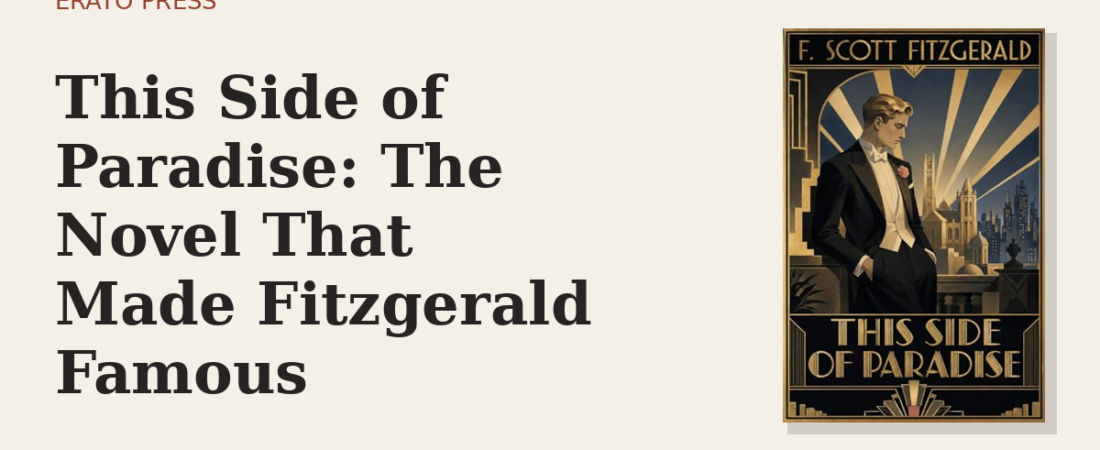
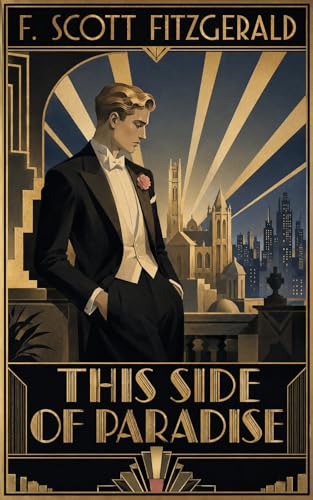
In 1920, a twenty-three-year-old named F. Scott Fitzgerald published a first novel about a handsome, vain, aimless young man drifting through Princeton and postwar disillusion, and woke up famous — rich enough, at last, to marry the girl who had turned him down for being poor. This Side of Paradise is a young man’s book, uneven and self-indulgent and dazzling by turns, but it captured something in the air so exactly that it made Fitzgerald overnight the voice of the Jazz Age, the chronicler of a generation of “beautiful and damned” young Americans who had grown up to find, as his hero puts it, “all Gods dead, all wars fought, all faiths in man shaken.” It is the messy, brilliant overture to one of the great American careers.
The portrait of a generation
Amory Blaine, Fitzgerald’s semi-autobiographical hero, is the beautiful egotist of the title — charming, clever, romantic, and adrift, moving through prep school and Princeton and a series of love affairs in search of a self and a purpose he never quite finds. The novel is less a tight story than a mood, a collage of poems and playlets and breathless set-pieces capturing the restlessness of gilded youth in the years just after the First World War: the parties, the petting, the ambition and the aimlessness, the sense of a generation that had inherited money and freedom but no faith. It scandalized and thrilled its readers precisely because it seemed to report, from the inside, the new morality of the young — and it announced the theme Fitzgerald would spend his life perfecting: the romance and the ruin of the American dream of self-invention.
The birth of a style
Even in its unevenness, the book crackles with the lyricism that would make Fitzgerald one of the great American prose stylists — the sudden shimmering sentence, the ache of longing and lost time already audible under the collegiate showing-off. He was learning in public, and you can watch the writer of The Great Gatsby forming inside the callow charm of his first book. The famous last line — “I know myself, but that is all” — is an adolescent’s grand gesture, and also a genuine note of the modern self-consciousness Fitzgerald would render, five years later, with heartbreaking mastery. To read This Side of Paradise is to catch a great talent at its raw, ambitious beginning.
The legend it launched
The novel’s success created “F. Scott Fitzgerald” — the golden boy of the Jazz Age, the beautiful couple with Zelda, the fast, doomed glamour that would end in crack-up and early death. It made him the spokesman for the generation whose disillusion Hemingway’s The Sun Also Rises would render in a colder key, and it set the stage for the American masterpiece to come. For anyone who loves Gatsby, this first book is essential — the seed from which that perfect flower grew, containing in rough form all the themes Fitzgerald would refine into greatness.
Why read it now
Because it is the dazzling, flawed announcement of one of America’s great literary talents and the definitive portrait of gilded youth adrift after a war — a mood every generation of restless, privileged young people rediscovers. Read it for the shimmer of the young Fitzgerald finding his voice, and for the pleasure of watching a masterpiece’s author begin.
Frequently asked questions
Is This Side of Paradise as good as The Great Gatsby?
No — it is a brilliant but uneven first novel, loose in structure and self-indulgent where Gatsby is flawless. Its value is as the electric beginning of Fitzgerald’s career and the fullest portrait of the Jazz Age youth he came to define.
How autobiographical is it?
Heavily. Amory Blaine’s Princeton years, romantic disappointments, and searching disillusion closely track Fitzgerald’s own, and the novel’s success really did make him rich and famous enough to marry Zelda Sayre.
Should I read it before or after Gatsby?
Either works, but reading it after Gatsby is especially rewarding — you see, in the raw first novel, all the themes Fitzgerald would later perfect. As a starting point it shows his talent being born.
Read the Erato Press edition →
and watch a great American writer wake up famous.
Enjoyed this piece?
Get the next one — our essays on the classics and news of each new Erato Press edition — straight to your inbox.