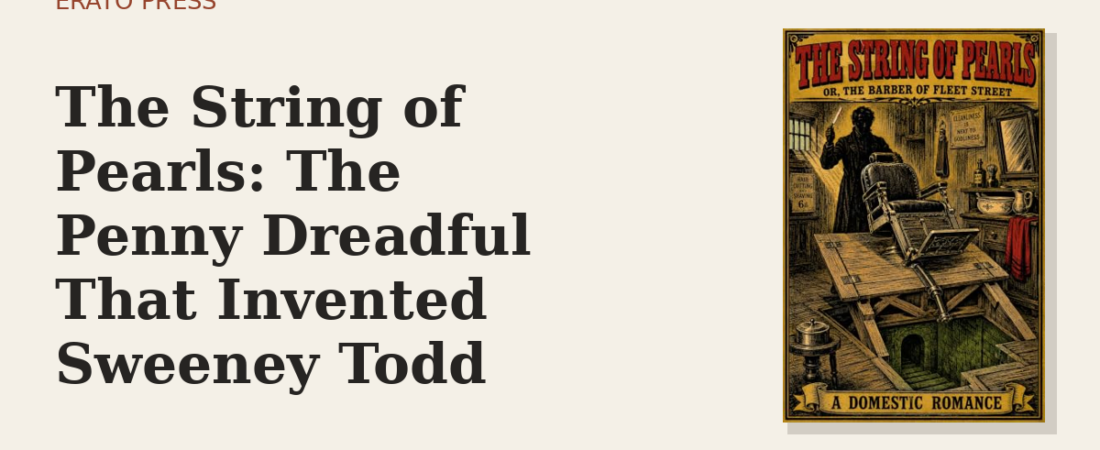

Sweeney Todd did not begin as a musical, or even as a single author’s invention. He began here, in 1846, as a serialized penny dreadful — cheap, disposable weekly fiction sold to a working-class London audience — commonly attributed to James Malcolm Rymer, though the authorship was murky even at the time. The barber, the pie shop next door, the trapdoor beneath the chair: all of it is already in place, fully formed, in this first telling.
What’s easy to miss, reading it now through a century of adaptations, is how much the original is a story about London itself — about a city so vast and anonymous that a man could vanish his customers one by one and have the evidence baked into the neighborhood’s most popular meat pies before anyone noticed the pattern.
It shares its DNA with the other Victorian penny-dreadfuls that turned urban anxiety into cheap, addictive horror — proof that the appetite for a good, gruesome serial predates the word ‘binge’ by a century and a half.
Enjoyed this piece?
Get the next one — our essays on the classics and news of each new Erato Press edition — straight to your inbox.