Gaston Leroux opens his novel with a straight face and an outrageous claim: the Phantom of the Opera existed. Not as a legend the ballet-girls invented, not as a superstition of the managers, but in flesh and blood. The whole of Le Fantôme de l’Opéra proceeds from that mock-documentary insistence—a journalist’s pose, footnotes and archives and respectable elderly witnesses marshaled to certify a story about a disfigured genius who lives beneath the Paris Opera and loves a young soprano to the point of murder. The thesis worth holding through the book is that this pose is the key to it. Leroux, a working reporter before he was a novelist, built the most enduring Gothic romance of the twentieth century by insisting it was fact, and the friction between his sober method and his lurid material is exactly what gives the novel its peculiar, lasting grip.

The reporter who certified a ghost
Leroux (1868–1927) came to fiction late and from journalism, and it shows on every page. Born in Paris and trained in law, he abandoned the courts to become one of France’s most celebrated reporters, a man who had covered real crimes, real trials, real revolutions before he ever invented one. When he turned to fiction he brought the reporter’s instincts with him: the locked-room precision of his detective Rouletabille in Le Mystère de la chambre jaune, and, in the Phantom, the documentary deadpan that frames the entire novel as an investigation. The famous opening foreword is written as reportage—the author sifting the archives of the Académie Nationale de Musique, struck by the coincidence between the phenomena attributed to the Phantom and a genuine, half-buried tragedy, and slowly persuaded that one might rationally explain the other.
This matters because it tells us what kind of book we are reading. The Phantom of the Opera is not pure fantasy; it is a Gothic story disciplined by a crime reporter’s craving for evidence, witnesses, and physical mechanism. The Phantom does not float through walls. He uses trapdoors, hidden passages, a lake in the cellars, acoustic tricks, and an architect’s knowledge of a building Leroux describes with almost obsessive accuracy. When the novel was first serialized in a daily newspaper in 1910, it attracted little critical notice—but the documentary frame is precisely what allowed its extraordinary afterlife, from Lon Chaney’s 1925 silent film to Andrew Lloyd Webber’s record-breaking musical of 1986. The story survives because Leroux first made us believe it could have happened.
The Palais Garnier as a haunted machine
The novel’s true setting is not “an opera house” but a specific one: the Palais Garnier, the vast and theatrical building that had opened in Paris in 1875, with its grand staircase, its gas-lit auditorium, its immense fly-tower, and—this is real—an underground water reservoir beneath the cellars. Leroux took the actual architecture of the place and made it the body of his monster. Erik, the Phantom, knows the Opera the way a spider knows its web, because he helped build it; he inhabits the spaces between the visible spaces, the cavities and corridors the audience never imagines as it watches Faust on the stage above.
This is the most original thing Leroux did with the Gothic tradition. The old Gothic put its horrors in remote castles and crumbling abbeys, safely distant in time and place. Leroux planted his in the most glittering modern building in the most modern city in Europe, directly under the feet of the fashionable audience. The chandelier that crashes into the auditorium, the haunted Box Five that must be left empty for the ghost, the managers terrorized into paying a monthly tribute—the horror erupts not from a medieval ruin but from beneath the floorboards of contemporary pleasure. The cellars descend through level after level toward the dark lake where Erik has his house, and the deeper one goes, the closer one comes to the torture chamber and the truth. The building itself becomes a vertical allegory: brilliance and spectacle on top, monstrousness and obsession below, and only a thin stage between them.
Erik, the mask, and the disfigured genius
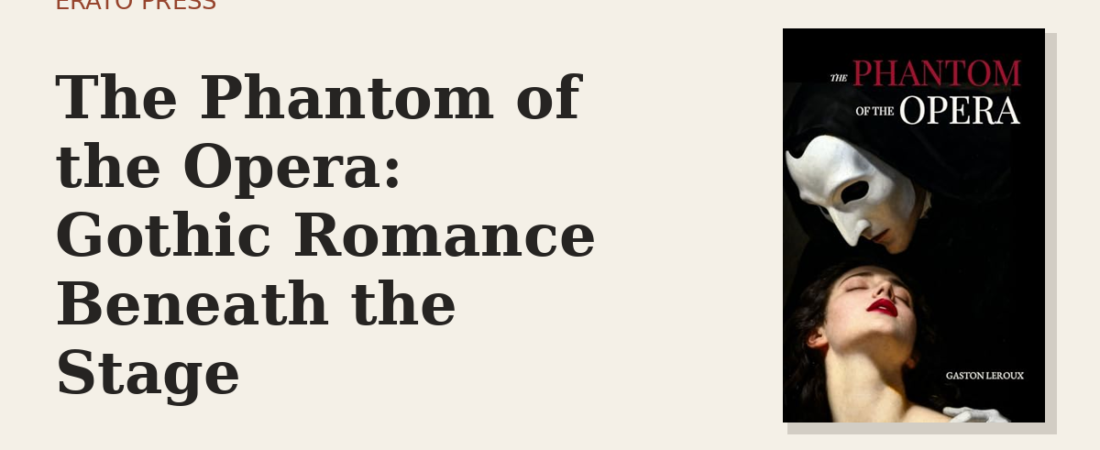
At the center is Erik, one of the great tragic monsters of popular literature, and the mask is the whole of him. He wears it because his face is a horror—Leroux gives him a death’s-head, a living corpse, born so hideous that his own mother could not bear to kiss him and gave him his first mask as a child. Everything Erik is flows from that wound. He is a genius—architect, magician, ventriloquist, composer—and every gift has been turned inward and curdled by a lifetime of being unlovable on sight. He has built himself a kingdom underground precisely because he cannot show his face in the world above.
What he wants is the one thing his genius cannot manufacture: to be loved. And so he fixes on Christine Daaé, the young Swedish soprano, training her voice in secret from behind her dressing-room mirror, posing as the “Angel of Music” her dead father promised would come to her. The obsession is monstrous and it is also, unbearably, sympathetic—Leroux never lets us forget that the murderer in the cellars is a man who has never once been touched without recoil. The novel’s most famous scene, when Christine tears away the mask and looks on his face, is the hinge of the whole book: the moment of exposure that the disfigured being most dreads and most needs. Erik’s tragedy is that he can compel obedience, fear, even pity, but the one transaction he craves—to be seen and not turned away from—is the one his face forbids.
Why it endures
Leroux’s plot creaks in places; the prose lacks the polish of the masters; and yet the book will not die, because it located a permanent nerve. The Phantom is the romantic outsider taken to his logical and terrible extreme—the lover so deformed, so isolated, so consumed by need that his love becomes indistinguishable from captivity and murder. He is Beauty and the Beast with the comforting ending stripped away, the Byronic hero rewritten as a stalker in the dark. The mask externalizes something everyone recognizes: the conviction that the true self is too monstrous to be shown, that to be known is to be rejected. That is why every generation re-stages the story. We keep returning to the man in the cellar because we suspect we know him.
Leroux was building, knowingly, on a century of Gothic invention that had taught readers to find sympathy in the monster and terror in desire. The Phantom belongs to the same lineage as the figure who, a dozen years earlier, had crossed from Transylvania into modern London—the aristocratic predator whose hunger is inseparable from love. Readers who want to trace how the Gothic monster became a romantic hero should turn to Dracula: How Bram Stoker Invented the Modern Vampire, where the same alchemy—dread fused with desire—is performed on a different beast.
Frequently asked questions
Is the novel very different from the musical?
Yes, substantially. Lloyd Webber’s musical streamlines the romance and softens Erik into something nearer a tragic lover. Leroux’s novel is darker, stranger, and more violent—it spends long stretches underground in the torture chamber, gives a large role to the mysterious figure known only as the Persian who knows Erik’s past, and treats the Phantom as a genuine criminal as well as a wounded genius. Readers who know only the stage version often find the book both grislier and more moving.
Who is the Persian, and why does he matter?
The Persian, the “daroga,” is one of the novel’s most important figures and a casualty of most adaptations, which cut him. He knew Erik in his earlier life—during the Phantom’s time as a magician and assassin at a foreign court—and he serves as the reader’s guide through the lower cellars and the torture chamber in the climactic chapters. His testimony is part of Leroux’s documentary apparatus: a witness who can vouch for the impossible.
Is Erik meant to be a villain or a victim?
Both, deliberately and at once. Leroux refuses to resolve the question, which is why the novel lasts. Erik commits real crimes—extortion, abduction, murder—and Leroux does not excuse them. But he roots every one of them in a lifetime of rejection so total that the reader cannot simply condemn him. The ending, in which Erik finally receives the one human gesture he has craved, is calculated to leave us grieving for the monster.
The Erato Press edition restores Leroux’s novel in full—the cellars, the Persian, the torture chamber, and the documentary frame that the adaptations leave behind—in a translation that keeps the reporter’s deadpan and the Gothic’s dread in the same breath. If you know only the chandelier and the half-mask, the book beneath them will surprise you.
Read the Erato Press edition →
and descend, past Box Five and the lake, to where the Phantom is waiting.Enjoyed this piece?
Get the next one — our essays on the classics and news of each new Erato Press edition — straight to your inbox.