On the Ides of March, 44 BC, a balding fifty-five-year-old Roman politician was stabbed twenty-three times by a group of senators at the foot of a statue of Pompey, his great rival, and bled to death on the floor of a theatre. Within a few generations his name had stopped being a name and become a title. The German Kaiser and the Russian Tsar are both worn-down forms of “Caesar,” a family name that conquered languages the way the man conquered Gaul. No one called the emperors of China or the kings of Persia “Caesar.” Yet for two thousand years the word has meant supreme power itself. How a particular man named Gaius Julius Caesar dissolved into a universal idea of authority is the question worth asking, and the answer reveals how myths are manufactured out of history, often by the mythmaker himself.

The argument here is that Caesar is the rare historical figure who engineered his own legend while alive, then had it completed by others after his death for purposes that had nothing to do with him. The Caesar we inherit is a collaboration between a brilliant self-publicist and the political needs of everyone who came after.
The man who wrote his own legend
Most ancient generals left their reputations to chance and to the historians. Caesar did not. He wrote his own account of his Gallic campaigns, the Commentarii de Bello Gallico, and he wrote it in the third person, referring to himself throughout as “Caesar” rather than “I.” The effect is one of cool, godlike objectivity: this is not a man boasting but History itself recording the deeds of a great commander. “All Gaul is divided into three parts,” the famous opening, has the calm authority of a textbook. It is in fact one of the most effective pieces of political propaganda ever composed, a campaign dispatch disguised as neutral chronicle, designed to be read by the Roman public while Caesar was still in the field building the army and the reputation that would let him seize the state.
The prose is deliberately plain, lucid, almost transparent, and that plainness is itself the trick. A man who writes so simply and clearly seems to have nothing to hide. Caesar uses the style to make his most ruthless decisions, the slaughter and enslavement of entire Gallic peoples, sound like the reasonable, regrettable necessities of a steady professional. He understood, long before the term existed, the power of controlling the narrative. By the time he crossed the Rubicon in 49 BC with the words “the die is cast,” he had spent years constructing, in his own words, the figure of the indispensable man whom Rome could not do without.
The assassination that backfired
The senators who killed him, led by Brutus and Cassius, believed they were destroying a tyrant and restoring the Republic. They called themselves the Liberators. They achieved the exact opposite of everything they intended, and in doing so they did more to make Caesar immortal than Caesar ever could have done himself. A living dictator can be opposed, resented, plotted against. A murdered one, struck down by men he had pardoned and trusted, becomes a martyr.
The transformation was swift and decisive. Caesar’s body was burned in the Forum by a grief-maddened crowd; his great-nephew and heir, the young Octavian, made the cult of the murdered Caesar the foundation of his own rise. Within two years the Senate formally deified him, declaring Divus Julius, the Divine Julius, a god of the Roman state, complete with a temple on the spot where his body had burned. Octavian, now styling himself Divi filius, son of a god, used his adoptive father’s sanctified name to crush the assassins at Philippi and eventually to become Augustus, the first emperor. The Republic the Liberators died to save was gone forever, replaced by exactly the one-man rule they had killed Caesar to prevent, now wearing his name as its title. The myth had eaten the man, and then the politics had eaten the myth.
Shakespeare and the afterlife of an idea
If Octavian made Caesar a god, the long centuries after made him a symbol endlessly available for reuse. Medieval and Renaissance Europe knew him as one of the Nine Worthies, a model of secular greatness. But it was Shakespeare, in Julius Caesar around 1599, who fixed the figure in the imagination of the English-speaking world, and he did something subtle with it. Shakespeare’s Caesar is barely in the play that bears his name; he is murdered in the third act. What survives him is precisely his ghost and his name, which haunt the conspirators to their ruin. Antony’s funeral oration, “Friends, Romans, countrymen,” turns the dead Caesar into a force more powerful than the living one ever was, swaying the mob with the mere word “honourable” until it curdles into accusation.
Shakespeare understood the central paradox better than the historians: that Caesar’s power was never finally about Caesar the man, weak, deaf in one ear, epileptic, vain, but about Caesar the idea, which his enemies could not kill because it did not live in his body. Every later age has reached for that idea and reshaped it to its needs. The American founders invoked Brutus the tyrannicide; Napoleon and Mussolini invoked Caesar the strongman. The same figure could be a warning against dictatorship or a model for it, depending on who was doing the invoking. That endless reusability is the surest sign that we are dealing with a myth rather than a man.
Reading the real Caesar against the legend
The strange result of all this myth-making is that the actual Gaius Julius Caesar, one of the genuinely extraordinary human beings of the ancient world, is harder to see than the symbol. He was a writer of crystalline Latin prose, a military innovator of the first rank, a reformer of the calendar we still use, a politician of dangerous charm and genuine clemency who spared enemies others would have killed, which is partly why so many of them were close enough to stab him. To read his own Commentaries, and the accounts of Suetonius and Plutarch alongside them, is to watch the gap open between the human strategist and the deified abstraction. The point is not that the legend is false but that it was built, deliberately and then accidentally, and that knowing how it was built is the only way to recover the formidable, flawed man underneath.
Frequently asked questions
Did Julius Caesar actually say “Et tu, Brute?”
Almost certainly not in those words. That line is Shakespeare’s. The ancient sources differ: Suetonius reports that Caesar said nothing, or possibly murmured in Greek, “You too, child?” to Brutus, which carries a darker intimacy. The famous Latin phrase is a piece of the myth, not the history, which is fitting for a man so thoroughly remade by later imaginations.
Was Caesar ever actually emperor?
No, and this is a common confusion. Caesar held the office of dictator, eventually dictator perpetuo, dictator for life, but Rome was still nominally a Republic when he died. The Roman Empire and the title of emperor belong to his heir Augustus. Caesar’s name became the word for emperor only because his successors adopted it, which is the whole strange story in miniature.
Why are the Bello Gallico still read in Latin classes?
Because Caesar’s prose is a model of clarity, the cleanest narrative Latin ever written, which makes it ideal for students. The irony is that generations have learned the language by reading what is, at bottom, a masterwork of self-serving propaganda, absorbing Caesar’s version of events as the very foundation of their Latin.
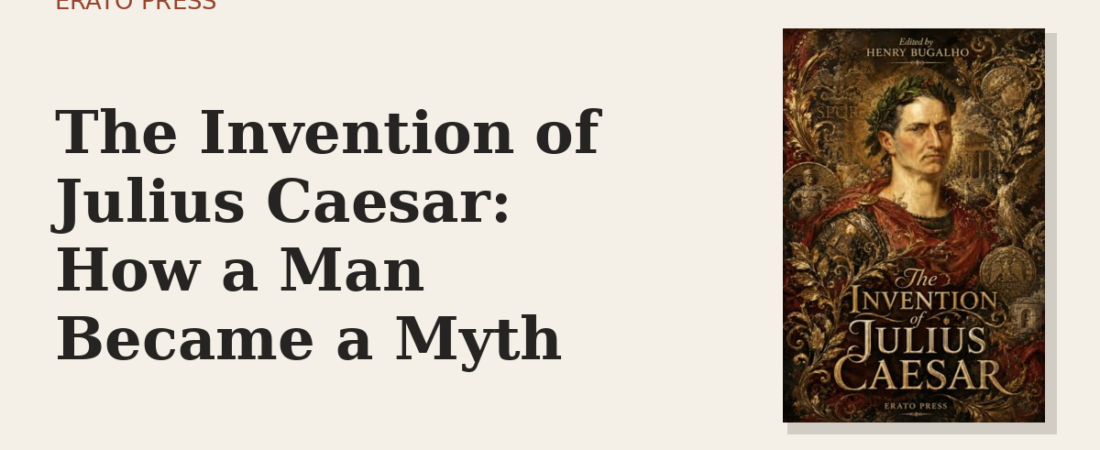
To separate the man from the myth, there is no substitute for reading Caesar’s own words against the historians who shaped his afterlife. The Erato Press edition presents the essential texts with the historical apparatus needed to see how the legend was assembled, layer by layer, from the general’s self-portrait to the god of the imperial cult to the symbol every later century has fought over. The result is a Caesar you can actually argue with, rather than a name that has swallowed its owner whole.
Read the Erato Press edition →
Enjoyed this piece?
Get the next one — our essays on the classics and news of each new Erato Press edition — straight to your inbox.