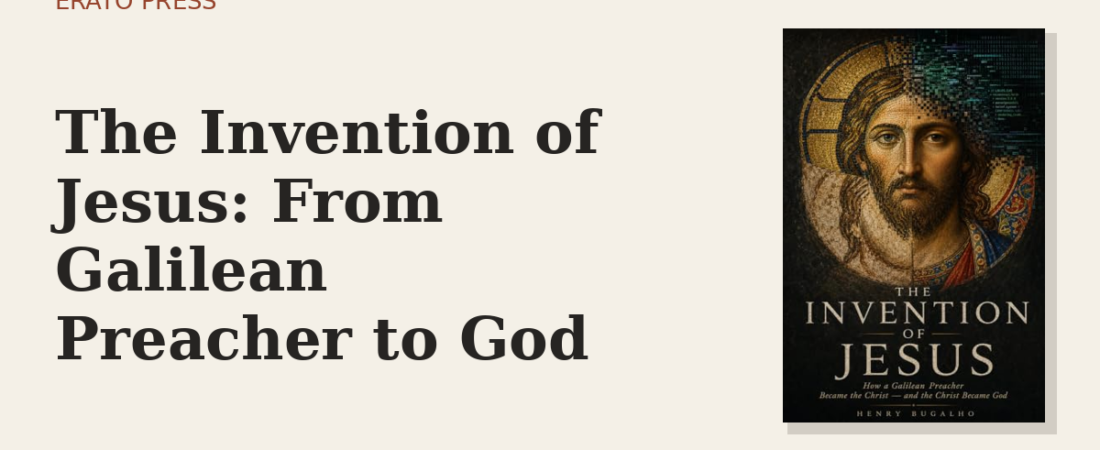
Somewhere around the year 30 of the common era, an itinerant Jewish preacher from the Galilean hills was executed by the Roman authorities in Jerusalem, by the standard provincial method for sedition: crucifixion. He left no writings. He held no office. Outside a small circle of followers and the brief notice of a colonial governor, almost no one in the Roman world knew his name. Three centuries later, assemblies of bishops convened by a Roman emperor declared this same man to be God, of one substance with the Father, eternal and uncreated. Between those two facts lies one of the most consequential transformations in human history: how a Galilean preacher became the Christ of the creeds. This is not a question of whether the transformation is true. It is a question of how, historically, it happened.

The thesis of any serious inquiry into the historical Jesus is that there is a real and recoverable distance between the man and the doctrine — between Jesus of Nazareth, a figure of first-century Palestinian Judaism, and the Christ of later theology, a figure of Greek metaphysics and imperial church councils. To trace that distance is not to attack faith. The historical question and the theological question are simply different questions, and the confusion of the two has produced centuries of bad history and anxious belief. What follows is the historical question, pursued on its own terms.
The problem of the sources
Everything begins with what we have to work with, and what we have is thinner and stranger than most readers assume. There is no contemporary account of Jesus — nothing written during his lifetime, by anyone. The earliest Christian documents are the genuine letters of Paul, written roughly 50 to 60 CE, two decades after the crucifixion, by a man who never met the living Jesus and who shows remarkably little interest in his earthly life, his teachings, or his miracles. Paul preaches a crucified and risen Christ, a cosmic redeemer, almost without biographical detail. The gospels — Mark first, around 70 CE, then Matthew and Luke drawing on Mark, then John, latest and most theologically developed, near the century’s end — were written forty to seventy years after the events, in Greek, far from Galilee, by authors who were not eyewitnesses and who were composing not biography in our sense but proclamation.
The non-Christian evidence is genuinely sparse. The Jewish historian Josephus mentions Jesus twice near the end of the first century, though one passage has plainly been doctored by later Christian copyists. The Roman writers Tacitus and Pliny, early in the second century, confirm only that Christians existed and that their founder was executed under Pontius Pilate. That is essentially the external record. It is enough to establish, against the few who deny it, that a man named Jesus very probably lived and was crucified — but it is nowhere near enough to verify the gospel narratives, which remain the testimony of the movement about itself. The honest historian works with sources that are late, partisan, and written to persuade, and says so plainly.
Reading the gospels as evidence, not biography
The decisive methodological move — pioneered by scholars from Albert Schweitzer through the twentieth-century form critics down to figures like E. P. Sanders, Geza Vermes, and Bart Ehrman — is to read the gospels as layered documents in which an actual historical memory is overlaid with decades of theological development. The tools are by now well established. Where the gospels disagree, the disagreements are informative: the contradictory genealogies of Matthew and Luke, the irreconcilable nativity stories, the differing accounts of the empty tomb all reveal authors shaping material toward distinct ends. Where a detail is awkward or embarrassing — Jesus baptized by John, implying subordination; his cry of abandonment on the cross; his execution as a criminal — it is more likely historical, because no one would invent something that complicated the message.
What emerges from this sifting is a recognizably first-century Jewish figure: an apocalyptic preacher who announced the imminent arrival of the Kingdom of God, who taught in parables, who gathered followers, who came into fatal conflict with the Temple authorities and Rome. Schweitzer’s great insight, more than a century old and still bracing, was that this Jesus expected the world to end soon — in his own generation — and that it did not. The earliest layers of the tradition show a man profoundly embedded in the hopes and idiom of Jewish apocalypticism, not a philosopher of universal ethics and certainly not yet a member of a divine Trinity. The Trinity is not in the Galilean material. It arrives later, and from elsewhere.
From preacher to God: the slow ascent
The transformation was gradual, and the gospels themselves preserve its stages like geological strata. In Mark, the earliest, Jesus is adopted as God’s son at his baptism and is strikingly human — he is ignorant of some things, he is angry, he is anguished. By Matthew and Luke, the divine sonship is pushed back to his conception and birth. By John, written last, the ascent is complete: “In the beginning was the Word, and the Word was with God, and the Word was God.” A reader moving through the four gospels in the order they were written watches the figure of Jesus rise, decade by decade, from prophet to pre-existent divine Word. The Christology gets higher the further the documents stand from the events they describe. That pattern is the single most important fact in the whole inquiry.
The final ascent was not biblical at all but conciliar and imperial. The crucial doctrines — that Christ is fully God, of one substance (homoousios) with the Father — were hammered out in the fourth century, at the Council of Nicaea in 325 and Constantinople in 381, under the patronage and pressure of Roman emperors who needed a unified church to help hold a fracturing empire together. The losing position at Nicaea, Arianism, held that Christ was created and subordinate — a view many in the early church found perfectly natural, and one arguably closer to the plain sense of the older texts. It lost not only on theology but on politics. The God of the creeds was, in part, the product of an imperial committee with a vested interest in the outcome. To say so is not blasphemy; it is documented church history.
Why the distinction matters
None of this is offered to debunk. The historical method has nothing to say about whether the resurrection occurred or whether the doctrines the councils affirmed are true — those lie outside its competence by definition, and an honest inquiry admits its own limits. What history can do is recover the human figure that the doctrine grew around, and in doing so restore something the centuries of theology had buried: a real man, in a real province, under a real empire, who said and did particular things in a particular language, and whose memory was so powerful that it survived his execution and grew, over generations, into the central figure of Western civilization. The Galilean preacher is not less interesting than the Christ of the creeds. He is, for the historian, the more astonishing of the two, precisely because everything else was built on him.
Frequently asked questions
Does this study claim Jesus never existed?
No — quite the opposite. The serious historical consensus, which this inquiry shares, is that a Jewish preacher named Jesus almost certainly lived in first-century Galilee and was crucified under Pontius Pilate. The “mythicist” position that he never existed at all is a fringe view. The real and difficult question is not whether he lived but how the man who lived became the God who was worshipped.
Is this an attack on Christian faith?
It is not framed as one. The historical question — what can be reconstructed from the sources about the man and his world — is genuinely separate from the theological question of whether the church’s claims about him are true. Many practicing Christians read historical-Jesus scholarship without losing their faith, and many of its leading scholars have been believers. The study is rigorous and even-handed, not polemical.
Why are the sources so late and so few?
Because Jesus moved in a small, non-literate movement on the margins of a provincial society, and because his earliest followers expected the world to end imminently — which left little reason to write biography. By the time the gospels were composed, the eyewitnesses were dying and the expected end had not come, and the need to fix the memory in writing became urgent. The lateness of the sources is itself a historical clue worth reading carefully.
The Erato Press edition presents this critical study with the scholarship laid bare — the sources weighed, the gospel layers separated, the road from Galilee to Nicaea mapped step by documented step — for any reader who wants to understand, soberly and without either piety or polemic, how a Galilean preacher became God.
Read the Erato Press edition →
Enjoyed this piece?
Get the next one — our essays on the classics and news of each new Erato Press edition — straight to your inbox.