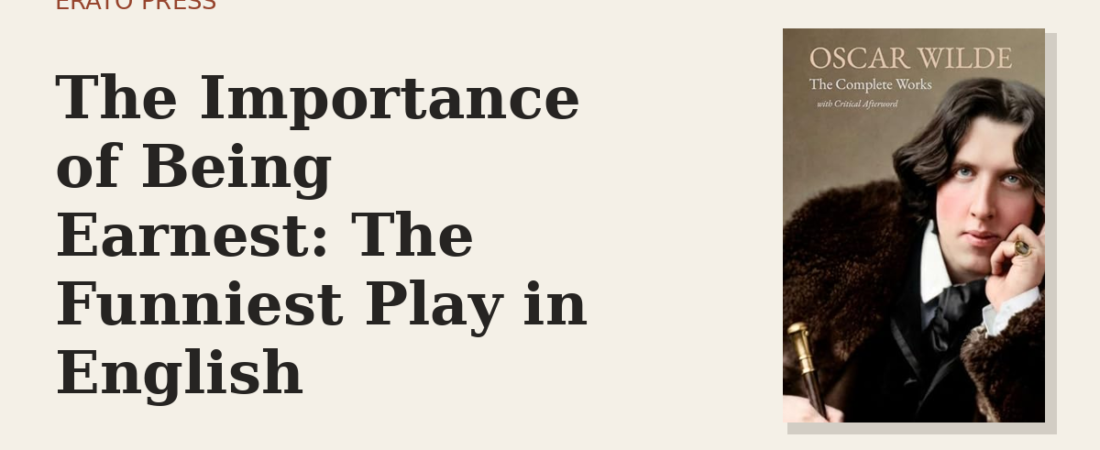
“The truth is rarely pure and never simple.” Oscar Wilde’s The Importance of Being Earnest (1895) is, by wide agreement, the funniest play in the English language — a perfect soufflé of wit in which two young men each invent a fictitious person to escape their social obligations, fall in love, and are nearly undone by a handbag, a muffin, and the terrifying Lady Bracknell. It is a comedy so light it seems to float, and yet under the sparkle it is one of the most quietly subversive works of its age: a play that mocks, with deadly elegance, the whole edifice of Victorian earnestness, respectability, and moral seriousness, and that turns triviality itself into a philosophy. Wilde called it “a trivial comedy for serious people,” and the joke, as always with Wilde, has a blade in it.

The perfection of the epigram
The play’s surface is pure verbal delight — the most sustained display of wit any English dramatist ever achieved. Nearly every line is an epigram, a paradox, a beautifully turned inversion of a respectable platitude: “All women become like their mothers. That is their tragedy. No man does. That’s his.” “I never travel without my diary. One should always have something sensational to read in the train.” Wilde weaponizes cleverness itself, and the effect is dizzying: a world in which style has entirely replaced substance, where the characters care passionately about cucumber sandwiches and christenings and not at all about the things they are supposed to care about. It is comedy raised to the condition of music, and it has never been equaled.
The satire under the sparkle
But the froth is subversive. Wilde’s target is the central Victorian virtue named in his title — earnestness, the solemn moral seriousness the age prized above all — and the whole play is a sustained, gleeful demolition of it. His characters are gloriously frivolous, ruled by appetite and vanity and style, and the play sides with them entirely against the pompous, hypocritical respectability they evade. Lady Bracknell, monstrous and magnificent, is the voice of that respectability, reducing love and marriage to a matter of income and address with a coldness the comedy exposes as the real immorality. Beneath the laughter, Wilde is arguing — as the aesthete our essays on his darker work explore from another angle — that Victorian moral seriousness was itself the great hypocrisy, and that honesty about pleasure was more truthful than the age’s solemn cant.
Wilde at his summit — and the fall to come
The play opened in triumph in February 1895, the peak of Wilde’s dazzling career — and within weeks he would be arrested, tried, and imprisoned for homosexuality, his name struck from the theatre bills of the very play conquering London, his life destroyed. That terrible irony shadows the comedy forever: the funniest play in English was written by a man about to be broken by the hypocritical respectability it mocks, and its glittering defense of style, pleasure, and the double life reads, in hindsight, as the coded testament of a man living a double life in a society that would not forgive it. The laughter and the tragedy are inseparable, which only deepens the play’s strange perfection.
Why read it now
Because it is the wittiest thing ever written in English and a small miracle of comic construction — a play you can read in an hour and quote for a lifetime — and because its mockery of solemn respectability and its defense of style and pleasure against hypocrisy have lost none of their sting. Under the sparkle is one of literature’s sharpest, and most poignant, acts of rebellion.
Frequently asked questions
Do I need to see it performed?
It dazzles on the page — the wit is all in the language — though it sparkles further in performance. Reading it lets you savor every epigram at your own pace, which is its own pleasure.
What is Wilde satirizing?
Victorian “earnestness” — the age’s prized moral solemnity and respectability — which he exposes, through his gloriously frivolous characters and the monstrous Lady Bracknell, as hypocrisy dressed as virtue. The play defends style and honesty about pleasure against solemn cant.
How does it relate to Wilde’s downfall?
It premiered at the height of his fame in early 1895, just before his arrest and imprisonment for homosexuality destroyed him. The comedy’s defense of the double life and its mockery of respectability read poignantly in light of the tragedy that immediately followed.
Read the Erato Press edition →
and laugh with the wittiest — and most quietly rebellious — play in English.
Enjoyed this piece?
Get the next one — our essays on the classics and news of each new Erato Press edition — straight to your inbox.