Between roughly 1450 and 1750, somewhere on the order of forty to sixty thousand people in Europe and its colonies were executed for the crime of witchcraft. The overwhelming majority were women, most were poor, many were old, and almost none had done anything at all. The popular imagination files this under the medieval and the superstitious — a dark age of ignorance, safely behind us. The historical record says something far more disturbing. The great witch hunts were not a relic of the Middle Ages but a product of the early modern period: the age of the printing press, of expanding states, of educated jurists and learned theologians. They were carried out by the literate, the powerful, and the procedurally meticulous. Understanding how they happened means abandoning the comforting story of ignorance and looking instead at the machinery of persecution, which was built by clever men and worked exactly as designed.

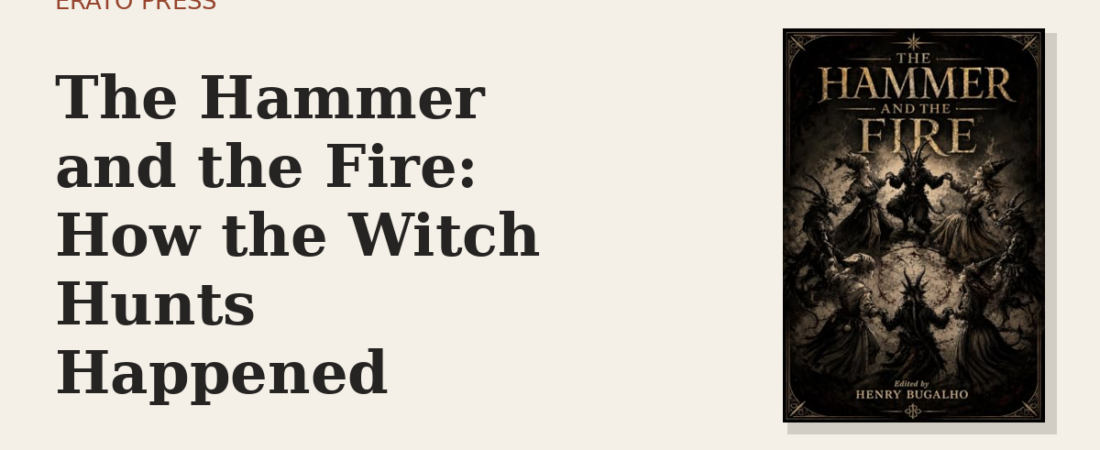
The thesis of The Hammer and the Fire is that the witch hunts were a system, not a frenzy — an interlocking apparatus of theory, law, and procedure that, once assembled, could manufacture guilt from almost any starting point. Three components made it work: a body of authoritative texts that defined the crime and licensed its prosecution; a legal procedure, built around confession and torture, that was nearly incapable of producing an acquittal; and a social mechanism by which accusation spread outward from a single name to engulf a community. Each part is documented in the surviving record. Together they explain how rational institutions produced an irrational slaughter, and why the same logic recurs whenever a society decides that a hidden enemy is in its midst.
The book that built the engine: the Malleus Maleficarum
In 1486 a Dominican inquisitor named Heinrich Kramer published the Malleus Maleficarum — the “Hammer of Witches” — in the German city of Speyer. Its timing was decisive: the printing press was new, and the Malleus became one of the early bestsellers of the print era, running through edition after edition across two centuries. What Kramer produced was not a wild rant but a structured manual. It argued, in three methodical parts, that witchcraft was real, that it was the work of a vast diabolical conspiracy, and — crucially — that it was overwhelmingly a crime of women, whom Kramer’s text painted as intellectually weaker and more carnally susceptible to the Devil’s recruitment. It then laid out, in practical detail, how to detect, prosecute, and execute the accused.
The importance of the Malleus is not that everyone believed every word; many theologians criticized it, and even the Inquisition’s own scholars regarded Kramer as a fanatic. Its importance is that it converted a diffuse folk anxiety into a usable doctrine and put that doctrine into the hands of magistrates who needed a procedure. It reframed the witch from a figure of village suspicion into a member of an organized satanic sect — and once the crime is conspiracy, the logic changes. A conspirator’s denial is evidence of cunning; a confession implicates accomplices; the absence of proof proves only how well the conspiracy hides. The Malleus supplied the conceptual architecture that turned scattered fear into a repeatable legal process.
How the law guaranteed its own verdicts
The deadliest part of the machine was not the theology but the procedure, and it is here that the witch hunts reveal their true character. Across much of continental Europe, criminal justice operated under inquisitorial procedure in which a full confession was the “queen of proofs” — the gold standard of guilt — and in which torture was a legally sanctioned instrument for obtaining it. For an ordinary crime, this was dangerous enough. For witchcraft, it was catastrophic, because witchcraft was a crime with no physical evidence. There was no stolen goods to recover, no body to examine. There was only the confession, and the confession could be produced.
Consider the mechanics. The accused was interrogated under threat and then application of pain. Whatever she confessed under torture had, by the rules, to be “freely” repeated afterward without torture to count — but a refusal to repeat it meant a return to the instruments. Under that pressure, people confessed to flying to sabbaths, to copulation with demons, to suckling familiar spirits. And then came the question that turned a single death into a wave: who else was there? The tortured woman, desperate to end the agony and prompted by her interrogators, named names. Those names were arrested and tortured in turn, and named more. This is why witch hunts came in clusters and chain reactions rather than as isolated trials: the procedure was self-propagating. An acquittal was nearly impossible to engineer, because every outcome confirmed guilt. Confession proved witchcraft; stoic silence under torture proved the Devil’s help; physical anomalies like a mole or birthmark became the “Devil’s mark,” insensible to pain when pricked with a needle. The system was closed. It is the central, chilling lesson of the history: a procedure can be perfectly orderly and produce nothing but lies.
Daemonologie, or persecution from the throne
It would be a mistake to imagine the witch hunts as the work of ignorant mobs acting against the wishes of their betters. At the highest levels of authority, the learned theory was embraced and extended. In 1597 King James VI of Scotland — later James I of England, the monarch who would lend his name to the King James Bible — published Daemonologie, a scholarly dialogue defending the reality of witchcraft and the duty of the state to root it out. James had been personally convinced by the North Berwick trials of the early 1590s, in which a group of accused were tortured into confessing a conspiracy to raise storms against his ship. A reigning king put the prestige of the crown and the apparatus of the law behind the hunt.
This royal endorsement matters because it locates the witch hunts where they belong: not in the gutter but in the corridors of power, sustained by the most educated institutions of the age. The hunts intensified precisely where state and church were building their authority and anxious about disorder — in the fractured territories of the Holy Roman Empire, during the religious wars that tore Europe apart after the Reformation. Fear of a hidden enemy is most useful to authorities who need to explain misfortune, demonstrate vigilance, and consolidate control. The persecution of witches was, among other things, a way of governing through dread. The same dynamic by which a population is taught to see secret enemies everywhere — to read its neighbors as agents of a malevolent conspiracy — is the dynamic our essay on manufacturing an enemy and how propaganda dehumanizes traces into the modern era, where the techniques survived the theology that first deployed them.
Salem, where the machine ran in the new world
The Salem trials of 1692 in Massachusetts are the episode Americans know best, and they are instructive precisely because they came late, in a Puritan colony that thought of itself as enlightened. The outbreak followed the now-familiar pattern: a few afflicted girls, a cluster of accusations, a special court convened to hear them. What made Salem so lethal was a procedural choice — the admission of “spectral evidence,” testimony that the accused’s spirit had appeared to torment the victim. Since a spectre could not be cross-examined and its existence could not be disproved, this evidence was, like the witch’s confession in Europe, impossible to rebut. Twenty people were executed, most by hanging, one — Giles Corey — pressed to death under stones for refusing to plead.
Salem also shows how such episodes end: not through a sudden return of reason but when the machine threatens the powerful. As accusations climbed the social ladder toward magistrates’ wives and the governor’s own circle, the authorities lost their nerve. Spectral evidence was thrown out, the special court dissolved, and within a year the colony was issuing apologies and, eventually, restitution. The hunt stopped not because Salem decided witchcraft was unreal but because the procedure had begun to consume its own architects. That, too, is part of the pattern, and part of why the history rewards sober study rather than sensational retelling: these events were not aberrations of mood but failures of method, and methods can be examined.
Frequently asked questions
Were the victims really mostly women?
Yes. Across Europe roughly three-quarters to four-fifths of those executed for witchcraft were women, though the proportion varied sharply by region. The Malleus Maleficarum had explicitly gendered the crime, and the social reality — widows, healers, midwives, the poor and the quarrelsome old woman without a protector — meant that suspicion fell on women who were already vulnerable. The hunt mapped onto existing fault lines of power.
Was this a medieval phenomenon?
No, and the misconception matters. The intense witch hunts peaked between about 1560 and 1660 — the era of the printing press, the Reformation, the scientific revolution, and the centralizing state. They were an early modern catastrophe carried out by literate, institutionally sophisticated societies, which is what makes them genuinely frightening rather than merely quaint.
How many people actually died?
Serious modern scholarship, working from surviving trial records, estimates somewhere between forty thousand and sixty thousand executions — far fewer than the millions sometimes claimed in popular accounts, but a vast and deliberate slaughter nonetheless. Honest history means resisting both the minimizers and the exaggerators and following the documents.
This is the spirit of the Erato Press edition of The Hammer and the Fire: a documentary history that works from the primary sources — the Malleus, the trial transcripts, Daemonologie, the Salem court records — to reconstruct the persecution as a system that can be understood, dismantled in its logic, and recognized when its descendants reappear. It refuses both the horror-show approach and the smug distance of hindsight, treating the victims as people and the machinery as a warning. and learn how the hunts actually happened — not in a dark age, but in the bright early light of the modern world.
Enjoyed this piece?
Get the next one — our essays on the classics and news of each new Erato Press edition — straight to your inbox.