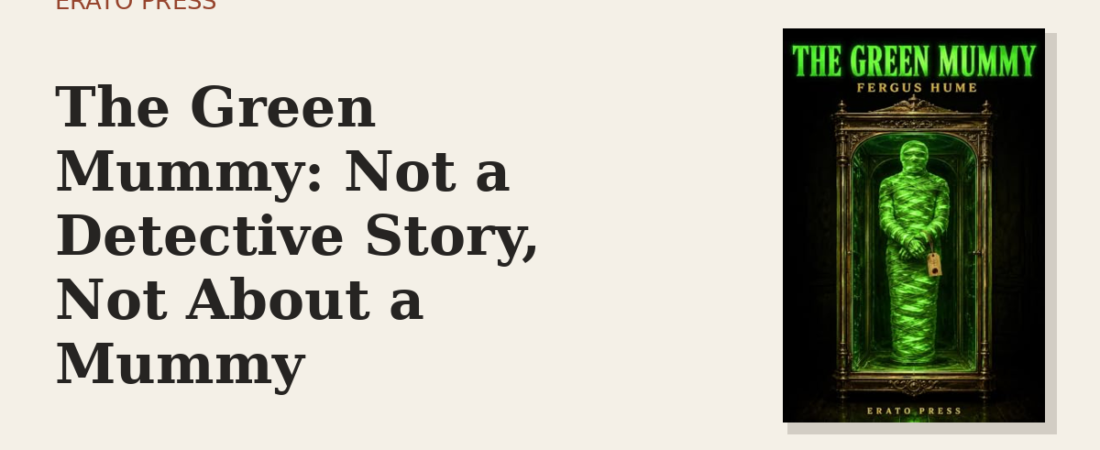

Fergus Hume sold more copies of his first novel, The Mystery of a Hansom Cab, than Arthur Conan Doyle ever sold of a single Sherlock Holmes book — and then spent the rest of his career failing to repeat it. The Green Mummy is the strangest of his attempts: a title that promises Egyptology and delivers a small English seaside town, a stolen jade idol, and a corpse painted green to look like an antiquity that never actually appears on stage.
It is, in other words, a con — but a very 1908 kind of con, playing on a public newly obsessed with tombs and curses a full fourteen years before Tutankhamun made headlines. Hume understood that readers wanted the atmosphere of Egypt more than the history of it, and he built an entire mystery out of the gap between the two.
Erato Press pairs it with a critical afterword on Hume’s strange career: a bestseller who was cheated out of the rights to his own hit novel, and who spent thirty years chasing its shadow in titles exactly this deceptive.
Enjoyed this piece?
Get the next one — our essays on the classics and news of each new Erato Press edition — straight to your inbox.