
If the Russians gave the novel its soul, the French gave it its eyes. Across the nineteenth century, three French writers taught fiction to look at the real world with an unflinching, forensic clarity that changed literature forever — and each pushed the project one step further than the last.
Balzac came first and biggest, determined to map an entire society in the ninety novels of the Human Comedy — money, ambition, and the machinery of Paris, rendered with volcanic energy. Flaubert then narrowed and perfected: in Madame Bovary he spent years hunting the exact word, the perfect sentence, proving that realism could be high art, that how a thing is written matters as much as what. And Zola took it to the extreme, turning the novel into a scientific autopsy of society — the mines, the slums, the appetites laid bare.
Together they invented the realist novel as we know it: the belief that fiction’s job is to tell the truth about ordinary life, without idealizing it, without looking away. Every novelist since who has tried to show the world as it actually is — the good and the sordid, the money and the desire — is working in the tradition these three built.
Erato Press publishes all three, complete. Read them in order and watch the modern novel come into focus.
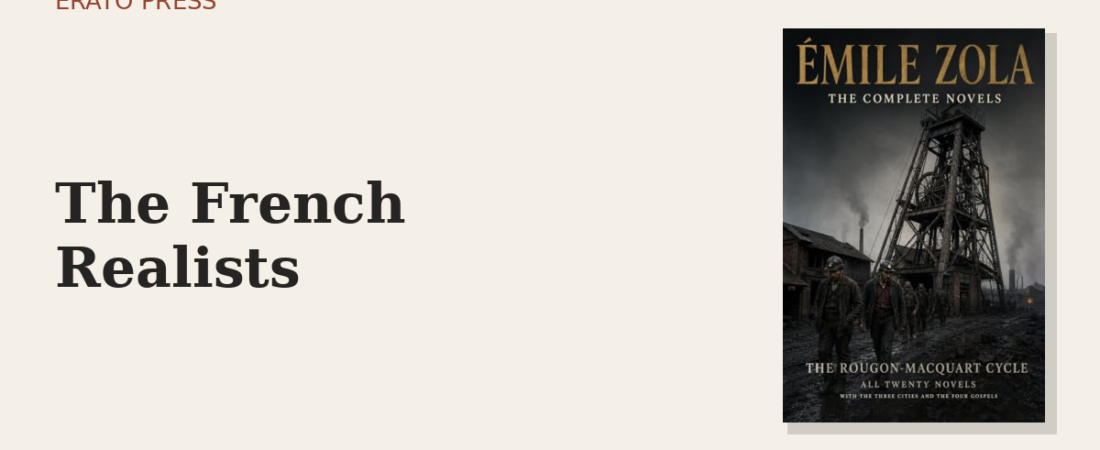
Read Émile Zola: The Complete Novels →
Enjoyed this piece?
Get the next one — our essays on the classics and news of each new Erato Press edition — straight to your inbox.