Almost everyone arrives at Sherlock Holmes through the same four doors: A Study in Scarlet, “The Speckled Band,” The Hound of the Baskervilles, and “The Final Problem” with its plunge over the Reichenbach Falls. They are wonderful, and they are also a trap, because they have trained more than a century of readers to think of the canon as a handful of greatest hits surrounded by filler. It is not. Arthur Conan Doyle wrote four novels and fifty-six short stories about Holmes across forty years, and the argument of this essay is that the canon’s real interest lies precisely in the territory the famous adaptations never reach—the failures, the half-comic trifles, the stories where Holmes loses, the late tales written by a tired author who had grown to resent his own creation. To read the complete Holmes is to discover a far stranger and more uneven body of work than the legend allows, and a far more interesting one.

The shape of the canon
Start with the scale, because the scale is the point. The “Complete Sherlock Holmes” is not a single sustained work but an accumulation across two distinct careers. Doyle introduced Holmes in 1887, killed him in 1893 because he felt the detective was diverting him from the serious historical novels he wanted to write, and—under relentless public and financial pressure—resurrected him in 1901 and kept writing him until 1927, three years before his own death. The canon therefore divides naturally: the early stories that made Holmes a phenomenon, and the later ones written by a man who had buried the character and dug him up again, and whose enthusiasm visibly waxes and wanes.
This matters for how you read. The four novels are the outliers—Doyle was never quite at home at novel length with Holmes, and even The Hound, the best of them, exiles Holmes from much of his own book and works largely because of its atmosphere. The form Doyle perfected was the short story: a single problem, a single sitting, a structure tight enough to deliver its shock and get out. The fifty-six stories are the true canon, collected across five volumes from the Adventures of 1892 to the Case-Book of 1927. The hits are scattered through them; so is everything that makes Holmes more than a parlor trick.
The method, examined honestly
What people remember about Holmes is the method—the lightning chains of inference, the cold-reading of a stranger’s profession from his cuffs and calluses. What close reading of the whole canon reveals is that Doyle was far cannier about the method than the legend suggests. Holmes calls it “deduction,” but it is almost never deduction in the logician’s sense; it is abduction, inference to the best explanation, a process that produces likely guesses dressed as certainties. Doyle knew this. He repeatedly shows Holmes being wrong, jumping to conclusions, or arriving at the right answer for theatrical rather than rigorous reasons.
The honest reader notices, too, how much of the method’s force is rhetorical. Holmes withholds his reasoning until the climax so that the explanation lands as revelation; reverse the order and many of the deductions look like lucky stabs. This is not a flaw to be apologized for—it is the engine of the genre Doyle was inventing, the contract by which the detective story still operates. The interesting stories are the ones where Doyle lets the seams show: where Holmes admits a theory was mistaken, or where the criminal proves cleverer than the detective. Reading past the hits means reading for those moments, and they are everywhere once you look. For a fuller map of how the canon rewards rereading, our companion piece offers The Complete Sherlock Holmes: A Reading Guide, a route through the volumes that does not stop at the famous four.
The stories nobody adapts
The richest reward of the complete canon is the lesser cases—the ones too odd, too quiet, or too morally tangled to make good television. “The Yellow Face” is the story where Holmes is simply, completely wrong, builds an elaborate sinister theory, and finds the truth is tender and domestic rather than criminal; Doyle has Holmes ask Watson to whisper “Norbury” in his ear whenever he grows overconfident again. “The Adventure of the Cardboard Box,” long suppressed for its subject matter, is a study in jealousy and murder darker than anything in the hits, and ends with Holmes asking aloud what purpose such suffering can possibly serve—a flash of metaphysical despair you will not find in the popular image of the cool reasoning machine.
Then there are the stories where Holmes lets the criminal go, having judged the law a cruder instrument than his own conscience—”The Blue Carbuncle,” with its Christmas mercy, or “The Abbey Grange,” where he convenes a private jury of two and acquits a killer. There are the comic trifles, like “A Scandal in Bohemia,” where Holmes is outmaneuvered by Irene Adler and learns, for once, to lose with grace. And there are the strange late experiments of the Case-Book, some narrated by Holmes himself rather than Watson, a few drifting toward the supernatural and the lurid as Doyle’s interest in spiritualism colored his final years. These stories are uneven—some are frankly weak—but their unevenness is itself instructive. It shows you a writer wrestling with a creation he could neither escape nor fully respect, and the friction produces things the polished hits never could.
Watson, and the warmth underneath
One last thing the complete reading restores: Watson. The adaptations have reduced him to a bumbling foil, but the canon’s Watson is the reason the whole edifice stands. He is the narrator, and the stories live or die on the texture of his voice—loyal, decent, a little vain about his own romances, quietly heroic, and the only person on earth Holmes loves. The famous coldness of Holmes only registers as coldness because Watson is warm; the method only thrills because Watson is there to be amazed by it. Read the canon end to end and you find that the real subject, beneath all the ciphers and cabs and dying-message clues, is a friendship—two men growing old together across forty years of London fog. The hits give you the puzzles. The complete canon gives you the marriage of true minds that holds the puzzles together.
Frequently asked questions
In what order should I read the Sherlock Holmes stories?
Publication order is the most rewarding, because it lets you feel Doyle’s own changing relationship to the character—the early confidence, the killing-off, the reluctant return, the weariness of the late tales. Begin with A Study in Scarlet for the meeting of Holmes and Watson, then move through the Adventures and Memoirs, which contain the bulk of the great short stories, before the novels and later collections. The internal chronology of the cases is famously inconsistent, so don’t try to read by it.
Are the later stories worth reading, or do they decline?
They are worth reading precisely because they are uneven. Doyle’s enthusiasm clearly flagged after the resurrection, and the Case-Book contains some of his weakest work—but it also contains genuine experiments, stories narrated by Holmes himself and tales that push into stranger emotional territory. The decline is real but partial, and watching a great popular writer struggle with a character he resented is one of the canon’s hidden pleasures.
What makes the complete canon different from a “best of” collection?
A “best of” gives you Doyle’s most polished puzzles and a single, flattering image of Holmes the infallible reasoner. The complete canon gives you the whole man: the Holmes who is wrong, who shows mercy, who is outwitted, who grows bored and despairing; the Watson whose voice carries everything; and the long arc of a friendship. The famous stories are a portrait. The complete works are a life.
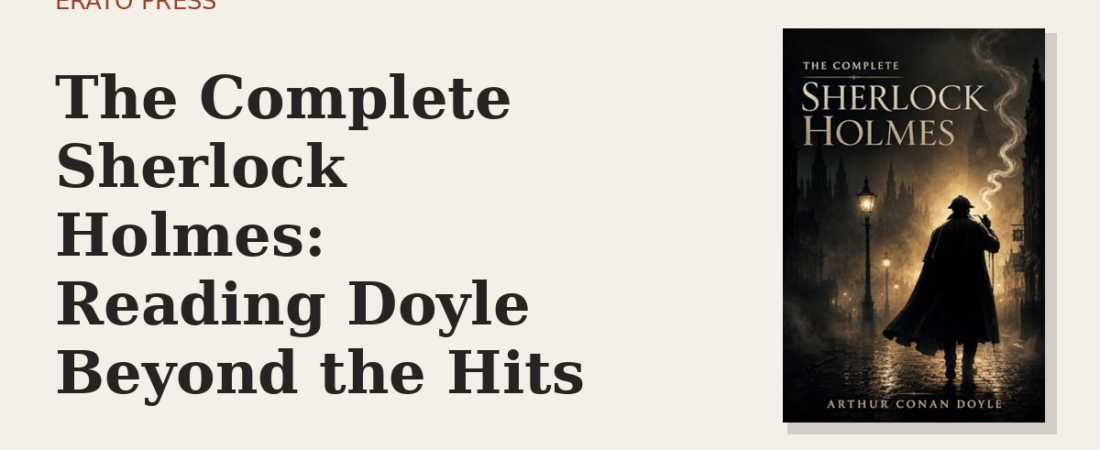
The Erato Press edition gathers the entire canon—all four novels and all fifty-six stories—in a single clean text, so that the lesser cases sit beside the hits where they belong and the whole strange, uneven, deeply human achievement can be read as Doyle’s readers first met it. If you have only ever visited Baker Street through the famous four, there are fifty-some doors you have not yet opened.
Read the Erato Press edition →
and meet the Holmes the adaptations leave out.Enjoyed this piece?
Get the next one — our essays on the classics and news of each new Erato Press edition — straight to your inbox.