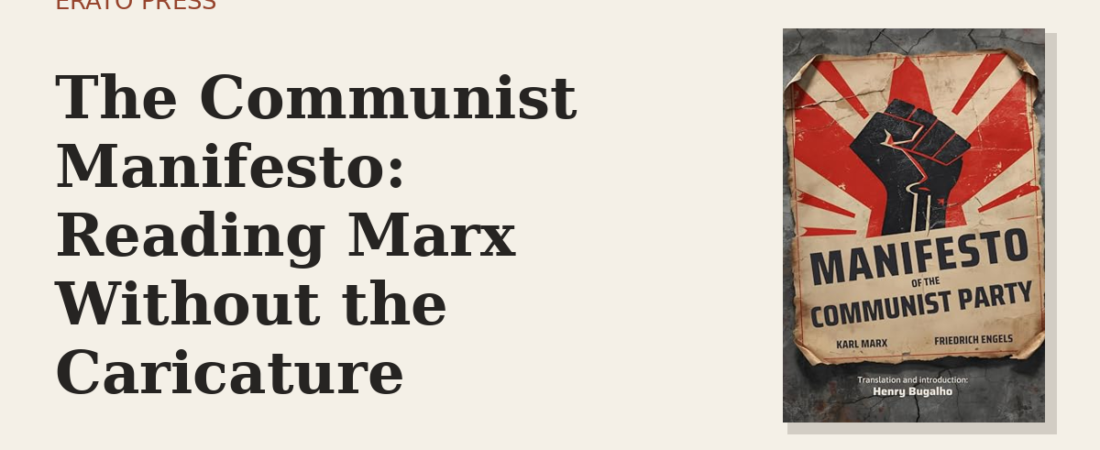
Few documents have been more thoroughly read about and less thoroughly read than the Manifesto of the Communist Party, the slim pamphlet Karl Marx and Friedrich Engels published in London in February 1848. For most of the twentieth century it arrived prejudged, a sacred text on one side of an iron curtain and a satanic one on the other, until the actual forty-odd pages disappeared behind the wars fought in their name. To pick the thing up now and read it plainly — as a historical document produced by two particular men at a particular and incendiary moment — is a faintly disorienting experience. It is shorter than its reputation, stranger, more literary, and in places more wrong and more right than either its champions or its enemies have let on. It is, above all, a piece of writing, and it deserves to be read as one before it is enlisted as a weapon.

The argument of this essay is simple: the Manifesto is best understood not as a blueprint for the regimes that later claimed it, nor as a self-evident monstrosity, but as a brilliant, time-stamped document of 1848 — a year of revolution across Europe — whose lasting power lies as much in its analysis of capitalism as in its program for replacing it. Read it that way, with the Cold War noise turned down, and you find a text that even committed opponents of its conclusions have learned from, because the questions it raises about industrial society did not vanish when the politics built on it collapsed.
A document of its moment
The Manifesto was commissioned. The Communist League, a small association of radical German émigré workers, asked Marx and Engels to produce a statement of principles, and they delivered it just weeks before revolution broke out in Paris and spread to Vienna, Berlin, Milan, and beyond. The timing is not coincidence but context: 1848 was the year the European order built after Napoleon seemed about to come apart, when liberals, nationalists, and the new industrial working class all pressed at once against the old monarchies. The pamphlet was meant to give one of those forces a voice and a theory. It speaks throughout in the urgent present tense of a crisis its authors believed was already underway and about to be decided.
This matters because so much of what reads as prophecy in the Manifesto is better understood as wager. Marx and Engels expected the proletarian revolution soon, in the most advanced industrial countries — England, France, Germany — as the next turn of a wheel already spinning. They did not foresee that revolution would instead arrive, seventy years later, in agrarian Russia, a country their own theory marked as unready. The regimes that invoked them were a development they could not have predicted and the text does not describe. To read the Manifesto as a recipe for the Soviet Union is to read it backwards, through events that came after, against the grain of what it actually says.
What the pamphlet actually argues
Strip away the slogans and the document advances a connected chain of claims. First, that history is driven by class struggle — “the history of all hitherto existing society is the history of class struggles” — a contest, in every age, between those who own the means of producing wealth and those whose labor produces it. Second, that capitalism is a distinct and revolutionary stage in that history, having swept away the old feudal bonds and divided society into two great hostile camps: the bourgeoisie, who own the factories and the capital, and the proletariat, who own nothing but their capacity to work and must sell it to live. Third, that capitalism contains contradictions that will, the authors argue, generate its own gravediggers — concentrating workers in cities and factories, immiserating them through competition, and thereby forging the very class that will overthrow it.
The famous concluding demands — abolition of private property in the means of production, a heavy progressive income tax, free public education, centralization of credit and transport — are program, and they are the most dated part of the text, tied to conditions and assumptions of the 1840s. But the diagnosis that precedes them is what has kept readers coming back. And here lies a fact that surprises people who know the Manifesto only by reputation: its long central passage on the bourgeoisie is one of the most vivid celebrations of capitalism’s dynamism ever written. Marx and Engels marvel at how the bourgeoisie “has created more massive and more colossal productive forces than have all preceding generations together,” how it has battered down every Chinese wall, drawn all nations into a single world market, and dissolved every fixed relation in a storm of perpetual change — “all that is solid melts into air.” This is not the writing of men who hated industry. It is the writing of men awed by it, who believed its very triumph would prove its undoing.
The power of the rhetoric
It is easy to forget that the Manifesto is a literary masterpiece independent of whether one accepts a word of its politics. It opens with one of the great first sentences in any language — “A spectre is haunting Europe — the spectre of communism” — a line that does in eight words what a paragraph of argument could not, conjuring a thing the authorities fear, intangible and inevitable, before the reader knows what it is. The prose throughout is propulsive, antithetical, built on the rhythms of the King James Bible and the cadence of the speech-maker. Its closing — “The proletarians have nothing to lose but their chains. They have a world to win. Working men of all countries, unite!” — is engineered for the throat as much as the page. Marx had trained as a doctor of philosophy and read law and poetry; Engels was a gifted journalist. Between them they produced a polemic whose force is inseparable from its style.
To notice this is not to praise or condemn the content. It is to understand why the document spread as it did. A weaker stylist would have written a forgotten committee report. The Manifesto endures partly because it is unforgettable as language — because its metaphors lodge in the mind and its sentences scan. Any honest reading has to reckon with the fact that some of its persuasive power was always aesthetic, and that the same gift for the resonant phrase that made it a rallying cry also made it easy to quote without comprehension, on either side.
Beyond the Cold War caricature
The hardest thing about reading the Manifesto today is setting aside the apparatus of associations a century of conflict has bolted onto it — gulags and secret police on one hand, a cartoon of envy and tyranny on the other. Neither belongs to the text. The document is the work of two mid-nineteenth-century intellectuals trying to make sense of an economic transformation that was, in their lifetime, throwing millions off the land and into the new industrial cities under conditions we would now find barely believable. Whether or not their solution was sound — and the historical record on the regimes built in their name is its own grim verdict — the questions they pressed remain live: who owns what a society produces; whether markets, left alone, concentrate wealth and power; what is owed to the people whose labor makes the wealth; whether the relentless dynamism Marx so admired can also be a kind of violence.
Economists and historians who reject Marx’s politics root and branch still read him, because his account of capitalism as a system that revolutionizes itself, globalizes relentlessly, and periodically convulses in crisis described something real that smoother theories of the age missed. The way to read the Manifesto well, then, is neither as scripture nor as devil’s catechism, but as a primary source — argumentative, partisan, of its moment, and intelligent — to be argued with rather than worshipped or burned. That is how serious readers approach any consequential document, and there are few documents in modern history more consequential than this short, fierce, beautifully written pamphlet of 1848.
Frequently asked questions
Is the Communist Manifesto a plan for the Soviet Union?
No. Marx and Engels expected revolution in the most industrially advanced countries of Western Europe, and within their own lifetimes; the text reflects the conditions and crises of the 1840s. The communism that took power in agrarian Russia in 1917 — a society their theory deemed unprepared — and the states modeled on it were developments the authors did not predict and the pamphlet does not describe. Reading the Manifesto as a Soviet blueprint imposes later history onto a document written seventy years before it.
Why do non-Marxists still read it?
Because its analysis of capitalism is sharper and more durable than its program. The central passages on how industrial capitalism dissolves old social bonds, draws the whole world into a single market, and generates recurrent crises described forces that even Marx’s opponents recognize as real. You can find the diagnosis penetrating while rejecting the prescription entirely — and many of its most attentive modern readers do exactly that.
Is it difficult to read?
Less than its reputation suggests. The Manifesto is short — readable in an evening — and written to be understood, with a rhetorical drive that carries a reader along. The arguments are compressed and assume some familiarity with the 1848 context, which is precisely where good editorial notes earn their place, but the prose itself is among the most accessible Marx ever produced. He was, after all, trying to reach working people, not fellow professors.
Our edition presents the standard authorized English text with an introduction and notes that restore the pamphlet to 1848 — the revolutions, the Communist League, the intellectual world Marx and Engels were writing into — and that distinguish carefully between what the document argues and what was later done in its name. The aim is neither to convert nor to refute but to let a reader meet the actual text, in its actual context, and judge it for themselves.
Read the Erato Press edition →
and find out what the spectre actually said.Enjoyed this piece?
Get the next one — our essays on the classics and news of each new Erato Press edition — straight to your inbox.