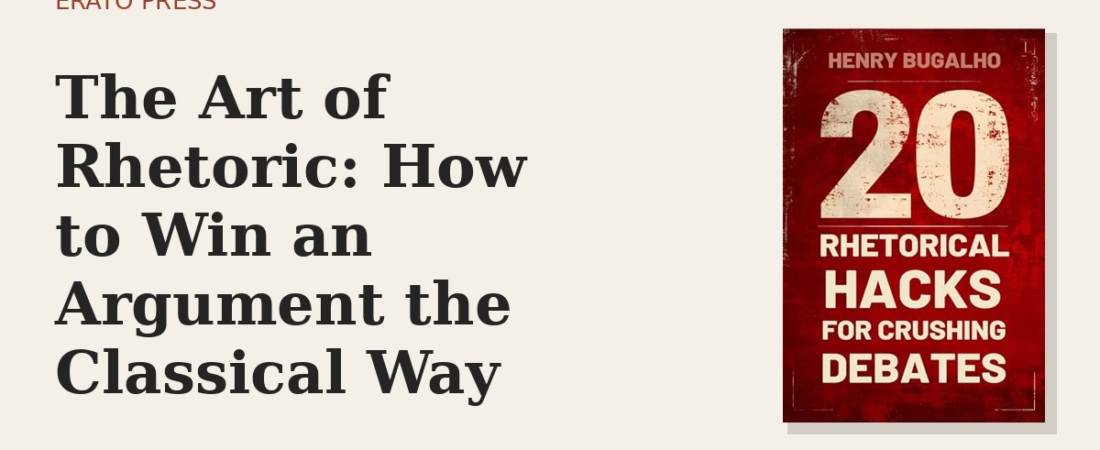
Watch any televised debate to its final seconds and you will see a curious thing: a candidate who has been thoroughly refuted, whose figures were wrong and whose evasions were exposed, will lean into the microphone and deliver one short, rehearsed phrase, “The future is now,” “Enough corruption,” “Think of the children”, and the audience will carry that phrase home as if it were the verdict. The careful reasoning of the previous hour evaporates. The last sound wins. Anyone who has noticed this and felt a flicker of disgust has already begun to study rhetoric, whether they know it or not.
The argument of this essay is that the classical art of rhetoric is neither an ornament nor a swindle, but a double-edged knowledge that every literate person ought to possess for both reasons at once: to persuade honestly, and to recognize when they are being manipulated. Aristotle systematized this art twenty-four centuries ago, and its core, the triad of ethos, pathos, and logos, remains the most useful map we have of how minds are actually moved. But there is a second, darker tradition running alongside it, the tradition of the Sophists, who taught that the appearance of victory is the only victory there is. To understand rhetoric fully is to hold both traditions in view, the noble and the cynical, because in practice they share the same toolbox.

The three appeals, and why they still govern us
Aristotle’s great insight was to divide the means of persuasion into three. Logos is the appeal to reason, the argument’s logical content, its evidence and inference. Pathos is the appeal to emotion, the speaker’s ability to put the audience into the state of feeling from which they will assent. Ethos is the appeal of character, the credibility, authority, and trustworthiness the speaker projects. What makes the scheme permanent is Aristotle’s refusal to rank them naively. He understood that logos alone rarely persuades anyone, that human beings decide first with feeling and credibility and only afterward recruit reasons. A flawless syllogism delivered by someone the audience distrusts will fail; a weak claim delivered by a figure of warmth and authority will often carry the room.
This is not a counsel of despair about reason; it is a realistic account of where reason sits. The honest rhetorician uses pathos to make an audience care about a truth they would otherwise ignore, and uses ethos to earn the standing required for the truth to be heard at all. The cynical rhetorician uses the same two appeals to smuggle a falsehood past the guard of logos entirely. The mechanics are identical. The difference lies wholly in whether the speaker is trying to illuminate or to obscure, and Aristotle, to his credit, knew that the art he was teaching could serve either master.
The Sophists, and the seduction of the appearance of victory
Before Aristotle there were the Sophists, the traveling teachers who, for a fee, promised to make the weaker argument appear the stronger. Plato despised them, and his contempt has shaped their reputation ever since, but they understood something about public persuasion that no idealist can afford to ignore: in front of a crowd, the perception of winning is a force independent of being right. The Sophist’s pupil learned to control not the truth but the frame, to decide which question the argument was really about, and so to ensure the contest was fought on ground where he could not lose.
The modern descendants of this art are everywhere, and they are worth naming precisely because naming them is the only defense. Consider the maneuver of the moral appeal: rather than answer an opponent’s evidence, the practitioner invokes a sacred value, the family, the nation, the children, and forces the opponent to defend himself against an unspoken accusation of cruelty. Who, in public, will say that they are not thinking of the children? The tactic works because it routes around the rational mind to the older, instinctual brain that responds to threats against the group, and against that primitive alarm a careful report has no chance. The argument is no longer about policy; it has become a contest over who can monopolize virtue.
Or consider the tactic of strategic retreat, the art of abandoning a debate at the very moment defeat looms, but abandoning it with the head held high so that flight resembles triumph. Pressed on an inconvenient fact, the practitioner declares the question beneath his dignity, “I won’t waste my time with this kind of accusation”, and the audience, weary of long explanations and instinctively reverent toward anyone who seems above the fray, takes the refusal for victory. This is what social psychologists call frame control: whoever defines the terms of the conversation controls it. By ruling a question unworthy of an answer, the speaker reconfigures the entire scene, so that it is no longer he who is cornered but his opponent who appears tiresome for insisting.
Recency, and the tyranny of the last word
The cynical tradition has always understood the architecture of memory better than the honest one has. There is a reason the last word matters out of all proportion to its content. Psychologists call it the recency effect: we remember most vividly what we heard last. The orator who masters this need not construct the soundest case; he need only reserve one sharp, sonorous phrase for the closing instant, and let it burn itself into the audience’s memory after the reasoning has faded. The opponent may have dismantled every point, but if he ends in silence while you end with a slogan, the room remembers the slogan.
What is striking is that the noblest orators in history exploited this same mechanism for honest ends. Cicero’s Quousque tandem, Catilina, abutere patientia nostra?, “How long, Catiline, will you abuse our patience?”, rang louder than any analysis of the conspiracy. Lincoln closed on “government of the people, by the people, for the people”; Churchill, on “we shall never surrender.” None of these men was a Sophist, yet each understood that the final cadence stamps the speech with its meaning. This is the crux of the whole subject: the tool is neutral. The recency effect serves Lincoln and the demagogue with equal fidelity, and the only thing that distinguishes them is what they choose to carve into the audience’s memory.
The usable lesson: rhetoric as self-defense
Here is where the classical and the cynical traditions resolve into a single practical wisdom. The most valuable reason to learn rhetoric is not to win arguments but to become unmanipulable. Once you can name the moral appeal as it is deployed against you, its spell weakens; once you recognize the victorious retreat for the evasion it is, the speaker’s apparent serenity stops impressing you; once you understand that the closing slogan is engineered to overwrite the preceding hour, you can refuse to let it. The catalogue of debate tricks, examined honestly, turns out to be a curriculum in intellectual immunity. To study how an audience is fooled is to stop being that audience.
This is why the great handbooks of persuasion, from Aristotle’s onward, have always carried a double face. They can be read as instruction in attack or instruction in defense, and the wisest readers have always read them as both. The person who has worked through the full inventory of appeals and tricks emerges not as a more dangerous manipulator, necessarily, but as a citizen harder to manipulate, which in an age of fifteen-second clips and viral slogans is the rarer and more valuable condition. The art that the Sophists sold as a weapon is most worth owning as a shield.
Frequently asked questions
What are ethos, pathos, and logos in plain terms?
Logos is the appeal to reason, your evidence and logic; pathos is the appeal to emotion, the feeling you stir in your audience; ethos is the appeal of character, the credibility and authority you project. Aristotle’s enduring point is that the three work together, and that reason alone, without trust and feeling behind it, rarely persuades anyone.
Is rhetoric just a polite name for manipulation?
The same techniques can illuminate or deceive, which is exactly why the art is worth mastering. The moral appeal, the strategic retreat, the engineered last word, each can serve a true cause or a false one. Learning to recognize them is the surest protection against being deceived by them, so the study of rhetoric is as much a defense as a weapon.
Why does the last word carry so much weight in a debate?
Because of the recency effect: memory privileges what it heard most recently. A debater who ends with a vivid, rehearsed phrase can overwrite an hour of an opponent’s superior reasoning. Cicero, Lincoln, and Churchill all exploited this for noble ends, but so does every demagogue with a slogan, which is why the closing moment deserves your suspicion as much as your admiration.
Henry Bugalho’s commentary brings the classical theory and the street-level tactics into a single frame, treating the cynical playbook of modern debate as the living, disreputable heir of an ancient art, and using one to illuminate the other. The Erato Press edition pairs the foundational tradition of rhetoric with that sharp, satirical anatomy of how arguments are actually won and lost today, so the reader finishes equipped to persuade honestly and, just as importantly, to refuse being persuaded dishonestly.
Enjoyed this piece?
Get the next one — our essays on the classics and news of each new Erato Press edition — straight to your inbox.