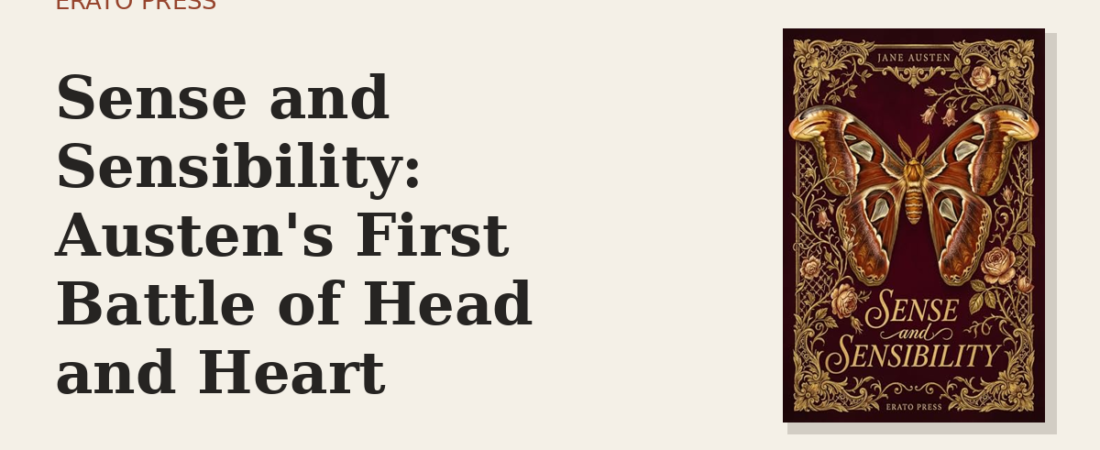
Jane Austen’s first published novel (1811) sets up its great question in its title and its two heroines. Elinor Dashwood is “sense” — self-command, discretion, the governance of feeling by judgment. Her sister Marianne is “sensibility” — the cult of intense emotion, of romantic transport, of feeling displayed and indulged. Both love; both are disappointed, even betrayed; and the novel watches how each meets the blow. It is Austen’s first full treatment of the theme that would run through all her work — the proper relation of reason and feeling — and though it is early, and a shade more schematic than her later masterpieces, it is a wise, moving, and often very funny book about the danger of feeling too much and the loneliness of feeling in silence.

Two sisters, two ways of suffering
When Elinor loves the reticent Edward Ferrars and learns he is secretly, bindingly engaged to another woman, she suffers in near-total silence, keeping the secret, protecting her family, governing her anguish so completely that even Marianne thinks her heart untouched. When Marianne loves the dashing Willoughby and is publicly, humiliatingly cast off, she collapses into a display of grief so total that she nearly dies of it. Austen sets the two responses side by side and refuses an easy verdict. Marianne’s openness is generous and alive where Elinor’s control can look cold; but Marianne’s abandonment to feeling nearly destroys her, while Elinor’s discipline preserves her and everyone around her. The novel’s wisdom is that neither extreme will do — that sense without heart is barren and sensibility without judgment is suicidal — and that the work of growing up is to marry the two.
The economics of love
Under the romance runs Austen’s clear-eyed, unillusioned view of what marriage meant for women of her class: economic survival. The Dashwood sisters are made suddenly poor by the workings of inheritance law (the novel opens with a masterly, chilling scene of a brother talking himself out of helping his half-sisters), and their romantic hopes are shadowed at every turn by money — who has it, who needs it, who will marry for it. Willoughby abandons Marianne not because he stops loving her but because he cannot afford her; the whole marriage market is laid bare as a system in which feeling and finance are hopelessly entangled. Austen never lets the reader forget that for a woman without fortune, love and security were the same anxious question, a theme our essay on Pride and Prejudice follows into her most famous book.
The quiet triumph of Elinor
Though the novel is even-handed, its deepest sympathy is with Elinor, and her long endurance is one of Austen’s most moving portraits of quiet heroism. To feel deeply and show nothing, to comfort others while carrying an unspeakable disappointment, to keep faith with duty when the heart is breaking — this is a heroism the world does not applaud because it cannot see it, and Austen honors it as few writers have. When Elinor’s control finally breaks, in a single burst of tears at the news that Edward is free, the release is overwhelming precisely because we have watched her hold it in for so long. It is the reward the novel gives its most disciplined heart.
Why read it now
Because the war between head and heart is permanent, and Austen’s first anatomy of it is as sharp as anything written since. It is the ideal companion to her more famous novels — funnier and sadder than its reputation, wise about money and feeling alike, and built on two sisters whose opposite ways of loving still map the choices we make when the heart is at risk.
Frequently asked questions
Where does it rank among Austen’s novels?
It is her first published novel and slightly more schematic than Pride and Prejudice or Emma, but it is a mature, moving work with two of her richest heroines. Many readers love it best for Elinor’s quiet strength.
What do “sense” and “sensibility” mean?
“Sense” is good judgment and self-command; “sensibility” (in the eighteenth-century meaning) is refined, intense emotional responsiveness. Austen tests both extremes through the two sisters and argues for their union rather than either alone.
Is it a good first Austen?
It is an excellent entry, though Pride and Prejudice is the usual starting point. Read them together and you see Austen’s central theme — reason and feeling, love and money — developing across her career.
Read the Erato Press edition →
and decide for yourself which sister meets the world more wisely.
Enjoyed this piece?
Get the next one — our essays on the classics and news of each new Erato Press edition — straight to your inbox.