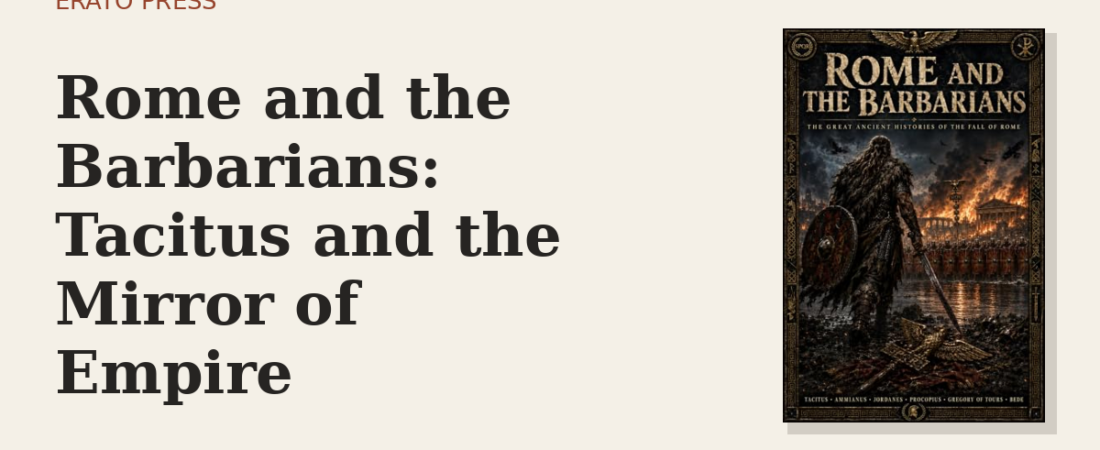
Nearly two thousand years ago, the greatest of Roman historians looked north, beyond the Rhine and the Danube, at the wild tribes Rome had never conquered, and wrote a short book about them that would echo, for better and for terrible worse, across the whole of later history. Tacitus’s Germania describes the customs, virtues, and ferocity of the ancient German peoples — and does so with a double purpose, for in praising the free, brave, uncorrupted barbarians he is also, unmistakably, holding a mirror up to the decadence of imperial Rome. This edition gathers Tacitus’s searching accounts of Rome and the peoples on its edge: the work of a moralist-historian who used the frontier to interrogate the heart of empire, in prose of unmatched concision and bite.

The barbarian as reproach
Tacitus’s Germania is one of the earliest and most influential examples of a permanent human habit: idealizing the outsider to criticize one’s own society. He depicts the Germans as poor but free, fierce but honest, faithful in marriage, contemptuous of luxury, governed by custom and courage rather than by the informers and tyrants that disgraced imperial Rome — and the implied contrast is savage. Rome, mistress of the world, is shown as soft, corrupt, and servile beside the hard virtue of the tribes it looks down on. Tacitus was the great anatomist of tyranny and decline, and he used the barbarians as a moral weapon against the empire he served, in the tradition of every writer who has praised the “noble savage” to shame the civilized.
The dangerous afterlife of a book
No ancient text has had a stranger or more sinister afterlife. Rediscovered in the Renaissance, the Germania was seized upon by German nationalists as proof of an ancient, pure, heroic German race — and in the twentieth century it was twisted by the Nazis into a founding document of their racial mythology, so prized that Himmler schemed to seize the manuscript. Tacitus, who meant his book as a critique of Rome, could not have imagined that it would one day be weaponized as a charter for racial fantasy. The story of the Germania‘s reception is a chilling case study in how a text can be captured and perverted by later ideologies — a warning that our essay treats with the honesty it demands.
The master of the poisoned sentence
Tacitus is, at the level of the sentence, one of the supreme stylists of antiquity — compressed, epigrammatic, dark, capable of condensing a whole indictment into a few words (“they make a desert and call it peace” is his). He wrote the history of the early empire as a study of the corruption of power, of how liberty dies and servility spreads, and his cold, brilliant pessimism has made him the favorite historian of everyone who has watched freedom decay from the inside. He is the natural companion to Gibbon’s great chronicle of Rome’s fall — the ancient master whose skeptical anatomy of empire Gibbon revered and echoed.
Why read it now
Because it is a masterpiece of concise, biting history and a permanent lesson in how societies imagine their enemies and their others — and because the dark story of how this small book was later weaponized is a warning our own age of resurgent nationalism needs to hear. Short, sharp, and profound, Tacitus remains the great historian of power and its corruptions.
Frequently asked questions
What is the Germania?
A short ethnographic work by Tacitus describing the ancient Germanic tribes — their customs, virtues, and ferocity — written partly as an implicit critique of Roman decadence by contrast with barbarian “virtue.”
Why is its history controversial?
Because it was later seized by German nationalists and then the Nazis as supposed proof of an ancient pure German race — a grotesque distortion of a book Tacitus wrote to criticize Rome. Its reception is a cautionary tale about the misuse of classics.
Is Tacitus hard to read?
His style is famously compressed, but in a good translation he is gripping and quotable. These works are short and their moral intelligence is immediate.
Read the Erato Press edition →
and see the empire through the eyes of the peoples it feared.
Enjoyed this piece?
Get the next one — our essays on the classics and news of each new Erato Press edition — straight to your inbox.