There are not many novels whose protagonist has been demoted to a common noun, and fewer still where the demotion counts as an insult. To call someone a Pollyanna is to accuse them of a soft head: of grinning through catastrophe, of mistaking denial for hope, of the kind of relentless cheer that curdles into a moral failing. The word does real cultural work; psychologists even coined a “Pollyanna principle” for our tendency to dwell on the pleasant. What almost no one who deploys the slur has done is read the book. And the book, when you actually read it, is stranger, harder, and more self-aware than its reputation allows.

Eleanor H. Porter published Pollyanna in 1913, and within a few years it had sold past a million copies, crossed onto Broadway, and been translated into Danish, Japanese, and a dozen languages between. Porter, who had trained as a singer at the New England Conservatory before turning to fiction in her late thirties, understood narrative the way a performer understands an audience: as the management of feeling toward a calculated effect. She lived long enough to watch her creation outgrow her and resented, by all accounts, the flattening of a carefully built character into a one-word punchline. The argument of this essay is that her resentment was justified — that the Glad Game is not the reflex everyone takes it for, but a discipline, and that the novel knows the difference even when its readers do not.
The Glad Game is a method, not a mood
The orphaned Pollyanna Whittier arrives at the cold house of her aunt Polly Harrington carrying a single inheritance from her dead father: a habit of mind. The Game began, the novel tells us, with a disappointment. A small Pollyanna had wanted a doll from the missionary barrel and received instead a pair of crutches. Her father’s response was to invent a rule — find something, anything, to be glad about — and the gladness he produced was that she did not need the crutches. This is the detail everyone forgets. The Game does not deny the crutches. It does not pretend the doll arrived. It begins precisely at the point of loss and works from it, which is a very different operation from the willful blindness the word “Pollyanna” now names.
Porter is careful to dramatize the Game as effortful. Pollyanna often has to think hard to find the gladness; sometimes she fails and has to be coached; sometimes the gladness she lands on is thin and provisional. What she practices is closer to a cognitive technique than a temperament — a deliberate redirection of attention toward whatever in a bad situation can still be salvaged. That this anticipates, by a century, the gratitude exercises of clinical positive psychology is not a coincidence so much as a sign that Porter had located something real about how a mind survives adversity. She was not preaching that nothing is wrong. She was dramatizing a way of remaining functional when much is.
The town, not the girl, is the real subject
Read structurally, Pollyanna is less a portrait than a chain reaction. The girl is a catalyst; the chemistry happens in the adults around her. The shut-in Mrs. Snow, the embittered recluse John Pendleton, the brittle and self-protecting Aunt Polly — each is a study in a particular Vermont species of emotional foreclosure, the New England habit of mistaking grievance for dignity and isolation for self-respect. Pollyanna’s gladness functions on them like a solvent. What the novel is actually anatomizing, beneath the sentiment, is a community that has talked itself into misery as a form of propriety, and the slow, almost mechanical process by which one outsider’s refusal to accept that propriety dismantles it.
This is why the comparisons to the era’s other orphan-redeemer novels — to the foundling who thaws a hardened household — only go so far. Porter’s interest is sociological. She is mapping a town’s pathology of decorum and then curing it, case by case, and the cure is administered not by charm alone but by a method anyone could in principle adopt. The girl is vivid enough to carry the philosophy without dissolving into a mere mouthpiece for it, which is the hardest trick in didactic fiction and the one Porter pulls off.
The accident, and the moment the Game breaks
If the novel ended with the town reformed and Pollyanna triumphant, the cynics would be right; it would be a sugar-cube. It does not end there. Pollyanna is struck by an automobile and loses the use of her legs — the very calamity the missionary-barrel crutches once let her dodge — and for a long stretch of the book she cannot play her own Game. The child who taught an entire town to find the gladness sits in the dark unable to find any. This is the hinge Porter insisted, in interview after interview, was the moral center of the whole thing, and it is exactly the part the culture discarded.
What rescues Pollyanna is not her own optimism but the town’s. The people she transformed come to her, one by one, and give the Game back to her — they have learned it, internalized it, and now they return it as a debt repaid. The philosophy, in other words, is shown to be insufficient as a private resource and durable only as a shared one. Gladness here is not the lonely grit of a sunny disposition; it is a thing a community holds in common and lends out when one of its members runs dry. That is a far tougher and more interesting proposition than “look on the bright side,” and it is the proposition the slur erases.
Why the caricature stuck — and why it is worth refusing
The pejorative congealed fast, and Porter watched it happen with a mixture of pleasure at the sales and dismay at the reduction. Part of the problem was the sequel; Pollyanna Grows Up (1915) pushed the heroine into adolescence and romance, and the continuation series produced after Porter’s death by other hands diluted the brand into something genuinely saccharine. But the deeper cause is a reflex of literary culture itself: the assumption that anything a million people love must be simple, that mass popularity is evidence against seriousness. Porter has been understudied for exactly the reason she was widely read.
To recover the book is not to claim it is philosophy — it is popular fiction, expertly built, that engaged honest questions about how a person stays upright under loss. The America of 1913, on the edge of a world war, wanted a usable doctrine of deliberate gladness that was neither denial nor passivity, and Porter supplied one with a craftsman’s precision. Readers who come to Pollyanna expecting to roll their eyes tend to find, instead, a novel that has already anticipated their objection and answered it in its own last act.
Frequently asked questions
Is Pollyanna actually a naive book?
No, and the misreading is the whole point. The Glad Game begins at the site of a loss — disappointment, illness, paralysis — and the novel’s climax has Pollyanna lose the ability to play it at all. Porter built in the breakdown of her own thesis. The naivety belongs to the cultural shorthand, not to the text.
Should I read Pollyanna Grows Up too?
It is worth reading as the completion of Porter’s own work, and it complicates the first novel by aging its heroine into a world of money, class, and courtship. It never matched the original’s resonance, but it is genuinely Porter — unlike the dozen continuation volumes other authors produced after her death, which are responsible for much of the “sappy” reputation.
How does the Glad Game relate to modern positive psychology?
Strikingly closely. The deliberate practice of attending to what is good — as distinct from denying what is bad — is now a well-studied clinical technique, from gratitude journaling to cognitive reframing. Porter intuited the mechanism in 1913 and dramatized it for a mass readership decades before the science arrived.
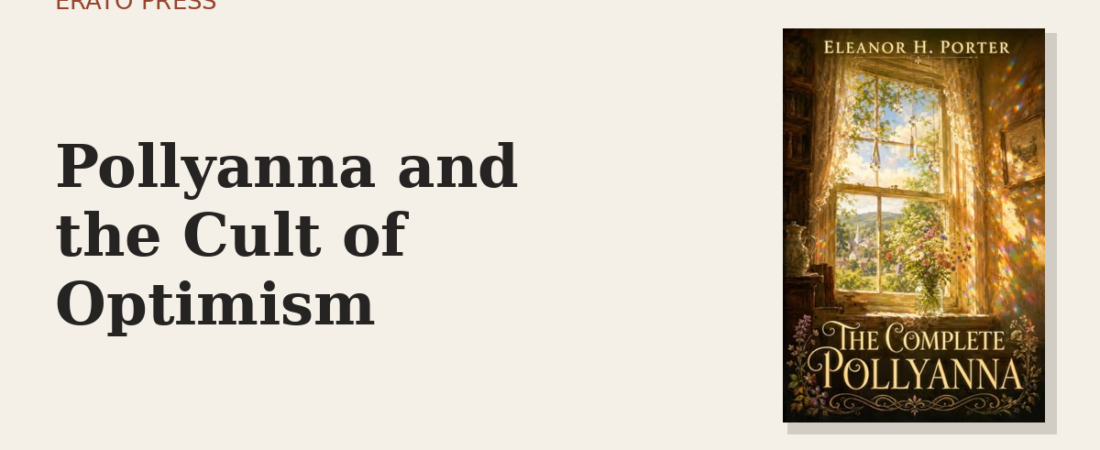
To read Pollyanna without the sneer requires getting back behind a century of misuse to the text itself, and that is what this edition is built to do. The Erato Press Complete Pollyanna gathers both of Eleanor H. Porter’s novels — Pollyanna and Pollyanna Grows Up — with a biographical account of the singer-turned-novelist and a critical essay that takes the Glad Game seriously as the disciplined practice Porter intended. If your only acquaintance with Pollyanna is the slur, the book underneath it will surprise you.
Read the Erato Press edition →
Enjoyed this piece?
Get the next one — our essays on the classics and news of each new Erato Press edition — straight to your inbox.