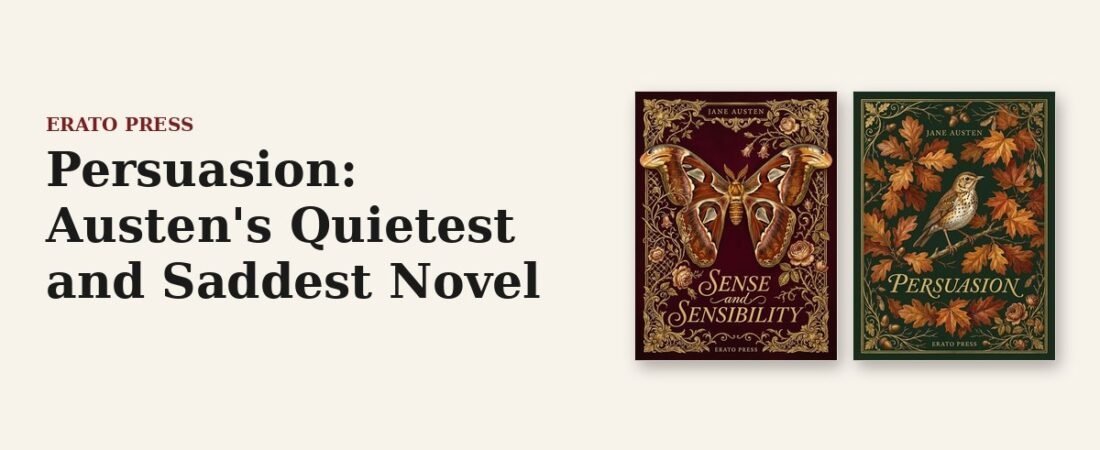
Short answer: Persuasion is Austen’s quietest, saddest, and most emotionally mature novel — the one she wrote last, in failing health, about second chances and the cost of caution. It breaks with every other Austen novel because it is not a story of discovery but of consequence: the heroine has already made her great mistake before the book begins, and the novel asks the question her comedies never do — whether time can be recovered, and loss redeemed.
A different kind of heroine
When we speak of Austen’s novels, we usually mean the arc of discovery: a young woman enters the world, misreads it, suffers, learns, and is rewarded with love and clearer sight. Persuasion breaks that pattern so completely that one wonders whether Austen is still writing the same kind of book at all. Anne Elliot is twenty-seven — old, by the cruel arithmetic of her world — and the novel begins not in ignorance but in regret. Eight years earlier she was persuaded to break her engagement to a young naval officer, Frederick Wentworth, because he was poor and unconnected. He has since grown rich and successful; she has quietly faded, her bloom gone, her value in the marriage market all but spent. Where Elizabeth Bennet is all spark and forward motion, Anne is all interiority — patient, observant, half-resigned. Austen dares to build a love story around a woman the world has already written off.
The novel of the road not taken
What makes Persuasion so moving is its subject: the ache of a choice you cannot unmake. Anne did the prudent thing, the thing she was advised was right, and it cost her the love of her life. The novel sits inside that long regret and refuses to look away from it. And it complicates the very virtue that caused the damage. In the earlier novels prudence is generally a good — the discipline that saves Marianne or chastens Emma. Here Austen turns it over and examines its underside. Lady Russell, who counselled Anne to give Wentworth up, is no villain; she is a good woman whose advice was sound by every reasonable standard. That is exactly the point. The novel’s hardest insight is that prudence divorced from attention to actual feeling — good advice that is not also right advice — can be a form of cowardice dressed as wisdom. Anne should not have ignored her wiser friend; she should have trusted her own heart more than she did. Persuasion asks whether the cautious life is the safe one or the wasted one, and it does not give a comfortable answer.
Consciousness as suffering
Of all Austen’s heroines, Anne is the most thoroughly interior, and the novel makes a discovery about consciousness that the comedies never reach: that intelligence and sensitivity can be sources of pain rather than paths to happiness. Anne sees everything clearly — that her father is vain, that Mr Elliot is dishonest, that Wentworth still feels something beneath his studied coldness — and her clarity brings her nothing but ache, because she has no power to act on it. The novel’s structure deepens the torment by design: it keeps throwing Anne and Wentworth into the same rooms, near each other, unable to speak, each acutely aware of the other and forbidden by circumstance and pride from saying so. Her consciousness becomes a kind of theatre of suffering, always reaching toward what it cannot have. And yet that same consciousness is the novel’s moral center. Anne may have little agency, but she has the authority of truth; she sees rightly when everyone around her sees falsely, and the book grants her the dignity of being right even when being right changes nothing.
The letter, and Austen’s most beautiful writing
The famous climax is the letter Wentworth writes while overhearing Anne argue that women love longest “when existence or when hope is gone.” “You pierce my soul. I am half agony, half hope.” Those words are staggering precisely because they appear in an Austen novel — Austen, the supreme ironist, who almost never lets feeling come straight through without the protection of wit. Here, just once, after a lifetime of perfect restraint, she allows the emotion to arrive unguarded. The letter is the moment when the narrative itself can no longer be contained within the novel’s careful management of surfaces; eight years of suppressed feeling break the form open. And there is a quiet paradox in it that is pure Austen: the most authentic act of communication in all her work occurs not in speech but in writing, composed in haste, offered with full knowledge that it might be refused. It lands like a held breath finally released.
The ending that does not close
Anne and Wentworth will be happy — but Austen withholds the clean, sealed resolution of the earlier books. The final pages dwell on the “tax of quick alarm”: Anne’s awareness that Wentworth’s naval profession carries real danger, that her happiness is now permanently shadowed by the possibility of its loss. The social world that wronged her — Sir Walter’s vanity, the whole apparatus of rank that nearly ruined her life — is not reformed; it simply recedes as Anne moves toward a future among the Navy, Austen’s meritocracy of the deserving. This refusal of complete closure is the heart of the novel’s distinctive maturity. It offers not the innocent happiness of someone who has never suffered but the wiser, provisional happiness of someone who has — happiness held in the full knowledge of how easily it can be taken away.
Why save it for last
Because Persuasion rewards a reader who already knows Austen’s restraint: you feel the warmth precisely because you know how rarely she permits it. Written in the shadow of her own mortality — it was her last completed novel — it carries a weight and an autumnal beauty that none of the comedies quite reach, the sense of an artist with nothing left to prove and everything left to feel. Read the comedies first, beginning with Pride and Prejudice, and come to this one last. For more of her range, pair it with the earlier, sharper Sense and Sensibility, where prudence and feeling first went to war.
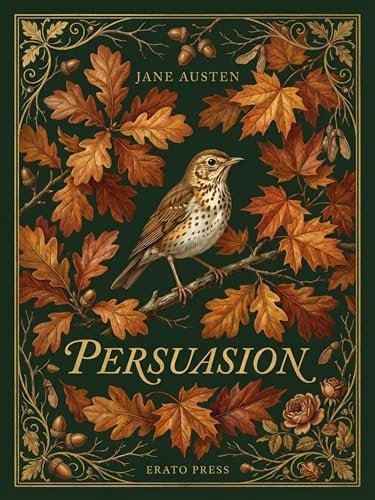
Read the Erato Press Persuasion →
Or read Sense and Sensibility →
Related reading: Where to Start With Jane Austen · Pride and Prejudice: Why It Still Works · The Real Jane Austen: Life Behind the Novels
This article contains affiliate links. As an Amazon Associate, Erato Press earns from qualifying purchases.
Enjoyed this piece?
Get the next one — our essays on the classics and news of each new Erato Press edition — straight to your inbox.