“Better to reign in Hell, than serve in Heav’n.” It is the most quoted line John Milton ever wrote, and very nearly everyone who quotes it has the speaker wrong in their hearts. We remember it as a flourish of magnificent defiance, the war cry of a free spirit who would rather rule his own ruin than kneel in another’s glory. We remember it, that is, as heroism. What we forget is who is speaking and where he stands: Satan, newly fallen, addressing his shattered legions from a lake of fire, having just lost a war against omnipotence and lost it for the worst of reasons. The line is not a triumph. It is the self-justification of a being who has confused defeat with grandeur—and the fact that it sounds so magnificent is the central problem of Paradise Lost, the problem Milton built the poem to pose and that readers have been failing to solve in the most instructive ways for three and a half centuries.

Milton announced his ambition in the opening lines: to “justify the ways of God to men.” The verb is exact. Justify—to make just, to defend the justice of—is the language of the courtroom and of theology’s hardest case, the one philosophers call theodicy: if God is all-good and all-powerful, why is there evil? A blind, defeated, politically disgraced poet in his fifties set himself to answer the oldest objection to faith in the longest and most demanding poem in the English language. Whether he succeeded is debatable. That the attempt produced the most compelling villain in literature is not.
The energy of the early books
The trouble starts immediately, and Milton must have known it would. The first two books of Paradise Lost belong almost entirely to Satan, and they are the most thrilling poetry in the work. We meet him at the nadir of his fortunes, hurled out of Heaven, “rolling in the fiery gulf,” and we watch him do the one thing that compels admiration in any circumstance: refuse to despair. He rallies the fallen angels, raises the great hall of Pandemonium out of the burning marl, presides over a debate among his lieutenants that is a masterclass in political rhetoric, and volunteers, alone, to cross the abyss of Chaos and find the new world God has made. “What though the field be lost? / All is not lost; the unconquerable will, / And study of revenge, immortal hate, / And courage never to submit or yield.” Read in isolation, this is the language of the resistance hero, the unbroken prisoner, the leader who will not let his people give up.
And so the Romantics read it. William Blake delivered the most famous verdict in all Milton criticism: that the poet “was a true Poet and of the Devil’s party without knowing it,” that his genius caught fire whenever Satan spoke and went slack in Heaven. Shelley agreed, finding Milton’s Satan morally superior to Milton’s God, who seemed to him a tyrant insisting on his own worship. The Satanic reading made Satan the secret hero of the poem—a Promethean rebel against cosmic authority, the first and grandest of the Romantic outcasts who would people the next century’s literature. It is a seductive interpretation, and it is, I think, exactly the trap Milton laid.
The trap, and how it springs
Here is the structural genius of the poem. Milton gives Satan all the rhetorical advantages of the early books precisely so that we will fall for him—and then he makes us watch the speaker rot. The reader who thrills to “the unconquerable will” in Book I has been recruited into Satan’s self-image. The reader who keeps reading discovers that the self-image is a lie the character tells to keep from seeing what he has become.
The turning point is Satan’s soliloquy on Mount Niphates at the start of Book IV, and it is one of the great pieces of psychological writing in English. Alone, unobserved, with no legions to perform for, Satan looks at the sun and confesses: “Me miserable! which way shall I fly / Infinite wrath, and infinite despair? / Which way I fly is Hell; my self am Hell.” The defiance was a public posture. Privately he knows he is wrong, knows that God’s service was “no hard” yoke, knows that his rebellion sprang from wounded pride and nothing nobler—and chooses to go on anyway, sealing himself in evil with the terrible words “Evil be thou my Good.” From here the descent is relentless and physical. The magnificent archangel shrinks: he squats “like a toad” at the ear of sleeping Eve, he is degraded into a serpent, and in his moment of supposed triumph after the Fall, returning to Hell to be applauded, he and all his followers are transformed into hissing snakes, their cheers turning to a “dismal universal hiss.” Milton spends the poem disassembling the figure he spent the opening building. The grandeur was real, and it was bait.
What the Satanic reading misses is that admiring Satan is not a flaw in the poem but its subject. The poem is about the seductiveness of evil, about how sin disguises itself as freedom and self-assertion and the courage never to submit. To be taken in by Satan’s rhetoric is to reenact, in the act of reading, the temptation the poem describes. Milton, who had defended regicide and lost, who knew everything there was to know about a glorious cause that curdles into tyranny, understood that the most dangerous evil does not announce itself as evil. It announces itself as liberty.
Free will, and the burden Milton places on us
The theodicy turns, in the end, on a single concept: freedom. Milton’s God, in the much-maligned Book III, offers the poem’s actual answer to the problem of evil, and it is the orthodox one stated with unusual rigor. God made angels and men “sufficient to have stood, though free to fall.” He foreknew the Fall but did not cause it; foreknowledge is not compulsion. To have created beings incapable of disobedience would have been to create automata whose obedience meant nothing—”what praise could they receive? / What pleasure I from such obedience paid, / When will and reason… had served necessity, / Not me.” The price of a creation capable of genuine love is a creation capable of genuine betrayal. Evil is the cost of freedom, and freedom is the only thing that makes goodness worth anything.
One can find this answer adequate or not—it is the same answer Augustine gave, and it satisfies some readers and infuriates others. But notice that the poem does not merely state it; the poem makes you live it. By tempting the reader with Satan and then exposing the temptation, Milton turns the act of reading into an exercise of exactly the faculty his theodicy defends. You are free to be seduced. You are free to see through the seduction. The poem will not compel your verdict any more than God compels Adam’s obedience—which is the deepest sense in which Paradise Lost justifies the ways of God to men: not by argument alone, but by reproducing, in the reader, the freedom that is God’s defense.
This places Milton in a particular line of poets who took readers down into Hell and made them feel its logic from the inside. Dante had done it three centuries earlier, walking his pilgrim through a Hell of exquisite moral architecture; our essay Dante’s Inferno: A Traveler’s Guide to Hell traces how that earlier vision of damnation differs from Milton’s—Dante’s sinners are fixed forever in the shape of their sin, while Milton’s Satan damns himself anew with every line he speaks.
Frequently asked questions
Is Satan the hero of Paradise Lost?
He is the protagonist of the opening books and the most vivid character in the poem, but Milton does not intend him as the hero, and the poem’s structure works against the Romantic reading that makes him one. Satan is given every advantage early so that his moral collapse over the later books will register as a genuine fall. The true heroism Milton endorses is the quiet, domestic, painful kind shown by Adam and Eve at the close—the courage to live on, repentant, in a fallen world.
Do I need to be religious to read it?
No. The theological framework is Christian, but the questions are universal—why suffering exists, whether freedom is worth its cost, how evil makes itself attractive—and the poem rewards a secular reader as fully as a believing one. Milton’s psychology of pride and self-deception owes nothing to doctrine and everything to observation. Many of the poem’s keenest modern admirers have read it as literature rather than scripture.
How hard is the language?
The syntax is Latinate and the sentences are long—Milton bends English word order toward Latin, suspending the verb and folding clause within clause. It rewards reading aloud, where the grammar resolves into the great organ-roll of the verse, and it rewards good annotation, which is precisely what an edition exists to provide. Read at the pace the sentences ask for, the difficulty becomes the pleasure.
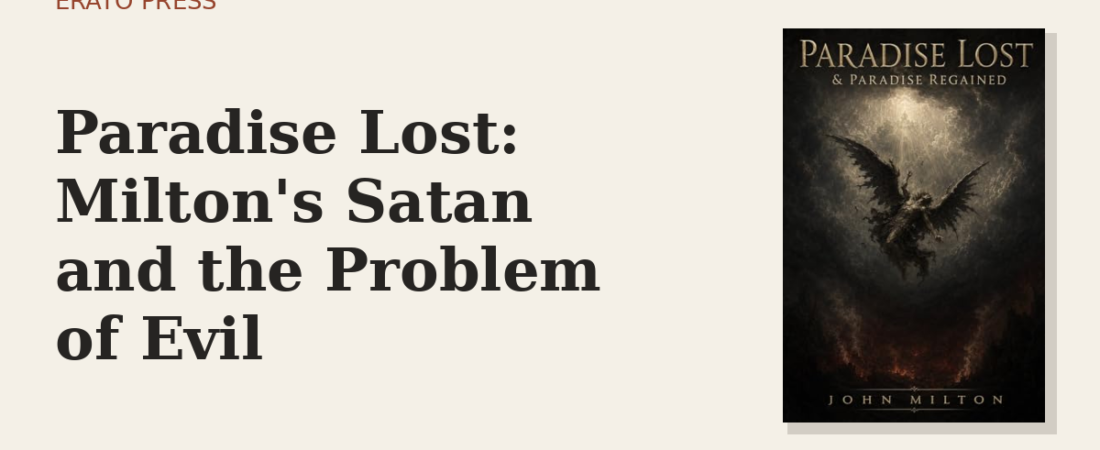
The Erato Press edition presents the full text of Paradise Lost with the annotation a modern reader needs to follow Milton’s classical allusions and unwind his great periodic sentences, and an introduction that takes the measure of Satan, the theodicy, and the long argument over whose side Milton was really on. We have built the edition to keep you free—free to be moved by the fallen archangel, and equipped to see exactly what he is.
Read the Erato Press edition →
Enjoyed this piece?
Get the next one — our essays on the classics and news of each new Erato Press edition — straight to your inbox.