Oscar Wilde spent his career insisting that the mask tells more truth than the face. “Give a man a mask and he will tell you the truth,” he wrote; the artist’s first duty is to a beautiful surface, not a sincere depth. It is one of history’s cruel ironies that the man who built his life on the supremacy of the pose was destroyed in a courtroom for the gap between his public surface and his private life — broken, that is, on exactly the distinction he had spent twenty years arguing did not matter. The story of Wilde is the story of a doctrine of style colliding with a society that had decided, suddenly and viciously, to read his life as a confession.

The shape of his fall is well known: in 1895, at the very summit of his fame, with two hit comedies running simultaneously in the West End, Wilde sued the Marquess of Queensberry for criminal libel, lost, and was himself prosecuted and sentenced to two years’ hard labour for “gross indecency.” He emerged broken in health and bankrupt, exiled himself to France, and died in a Paris hotel in 1900 at forty-six. But the trial is not the whole man, and the temptation to read everything through its lurid lens flattens an artist of genuine and varied accomplishment. My claim here is that Wilde’s wit, his plays, and his catastrophe are a single coherent thing — all of them expressions of his conviction that life should be lived as an art, and all of them, in the end, judged by a public that refused him the very separation of art and life that he preached.
The wit was a philosophy, not a party trick
Wilde’s epigrams are so quotable that they get treated as decoration, witticisms detached from any system. They are not. “We are all in the gutter, but some of us are looking at the stars”; “The only way to get rid of a temptation is to yield to it”; “I can resist everything except temptation” — the paradox is not a verbal tic but a method. The Wildean aphorism works by inverting a piety until the underside, usually truer, faces up. Each one is a small machine for exposing the gap between what respectable society says it believes and what it actually does, and the laughter it produces is the laughter of recognition.
Behind the jokes sat a serious aesthetic creed, developed in his lectures and his criticism, that art owes nothing to morality and answers only to beauty and form. A poem, he held, is “either well written or badly written, that is all”; any insistence that art carry a moral lesson was a “sign of a certain incompleteness of vision.” He praised what he called the calm of Greek statues — a serenity that comes “not from the rejection but from the absorption of passion.” The epigrams are this philosophy in miniature: passion absorbed into form, feeling perfected into phrase. To laugh at a Wilde line is to assent, briefly, to his whole argument about the sovereignty of style.
The comedies are sharper than their sparkle
Wilde’s great social comedies — Lady Windermere’s Fan (1892), A Woman of No Importance, An Ideal Husband, and the dazzling The Importance of Being Earnest (1895) — are usually praised for their glitter and underrated for their teeth. Beneath the badinage, each is an assault on the moral machinery of his audience: the double standard that ruined women for the sins men were forgiven, the cult of respectability that punished the appearance of vice more than the fact of it, the hypocrisy by which society maintained its surfaces. Lady Windermere’s Fan turns the “fallen woman” plot against the very people who would condemn her; An Ideal Husband is, in part, about a public man held hostage by a private secret — a subject Wilde was writing months before it became the plot of his own life.
Earnest is the masterpiece because it dispenses with the sentiment entirely and lets the form itself become the satire. Its characters live by a logic in which the name is more real than the man, the manner more binding than the fact — “the truth is rarely pure and never simple,” and the whole farce of doubled identities and invented invalids is a comedy about people who treat their respectable surface as the only reality that counts. It is the purest dramatization of Wilde’s own creed, staged as delight. That this play and An Ideal Husband were both running in London at the exact moment of his arrest gives the catastrophe an almost unbearable symmetry: the city was laughing at his anatomy of hypocrisy even as it prepared to destroy him with it.
The novel that became the indictment
Before the plays came the scandal of the fiction. The Picture of Dorian Gray, the only novel Wilde wrote, had been attacked on publication as immoral, and at his trials the prosecution read passages aloud as if the book were evidence of the author’s character — converting an aesthetic provocation into a legal exhibit. Wilde had armored the novel with a preface that stated his creed at its baldest: “There is no such thing as a moral or an immoral book. Books are well written, or badly written. That is all.” The court ignored the warning and did precisely what the preface forbade.
The episode is the hinge of his whole story, and readers who want to understand how an argument about beauty curdled into a charge against a man should turn to The Picture of Dorian Gray: Wilde’s Only Novel and Its Scandal, where the collision between art and life is staged within the book itself, in a portrait that bears the moral consequences its owner refuses. Dorian wanted the surface without the cost; the trials made Wilde pay the cost for the surface. The novel had imagined the bargain a decade before its author was forced into a version of it.
The man and the mask
What the trials performed, with terrible efficiency, was the refusal to grant Wilde his own central distinction. He had spent his life arguing that the artist’s life and the artist’s work occupy separate realms, that the pose is its own truth, that one should never confuse the singer with the song. The court collapsed all of it: it read the work as the man, the wit as evidence, the philosophy of surfaces as a cover for the deeds beneath. In De Profundis, the long letter written from Reading Gaol, a different Wilde appears — chastened, wounded, reaching past paradox toward something like sorrow — and even there the old conviction survives, transmuted: that suffering, too, must be made into form, that “where there is sorrow there is holy ground.”
The cruelty of his ending should not be allowed to sentimentalize the achievement that preceded it. Wilde was not merely a martyr; he was a major comic dramatist, a critic of real depth, a fabulist of strange and tender power in his fairy tales, and the most quotable man who ever wrote in English. The trial is part of his story, but it is not its meaning. Its meaning is the work, and the work argues, still, that a perfect surface is not a lie but a kind of truth — the truth a society would rather not hear from a man it has already decided to convict.
Frequently asked questions
What was Wilde actually convicted of?
“Gross indecency” under the 1885 Criminal Law Amendment Act, after his own libel suit against the Marquess of Queensberry collapsed and exposed him to prosecution. He was sentenced to two years’ hard labour, an ordeal that wrecked his health and led to his death three years after release.
Where should a new reader start with Wilde?
The Importance of Being Earnest for the wit at its most perfect, then The Picture of Dorian Gray for the ideas that got him into trouble. De Profundis and The Ballad of Reading Gaol show the darker, post-prison voice and complete the arc from dandy to penitent.
Are the epigrams just clever, or do they mean something?
They mean a great deal. Each paradox is a small instrument for inverting a social piety and exposing the hypocrisy underneath. Wilde’s wit is the popular, portable form of a serious aesthetic philosophy about the supremacy of form over moralizing.
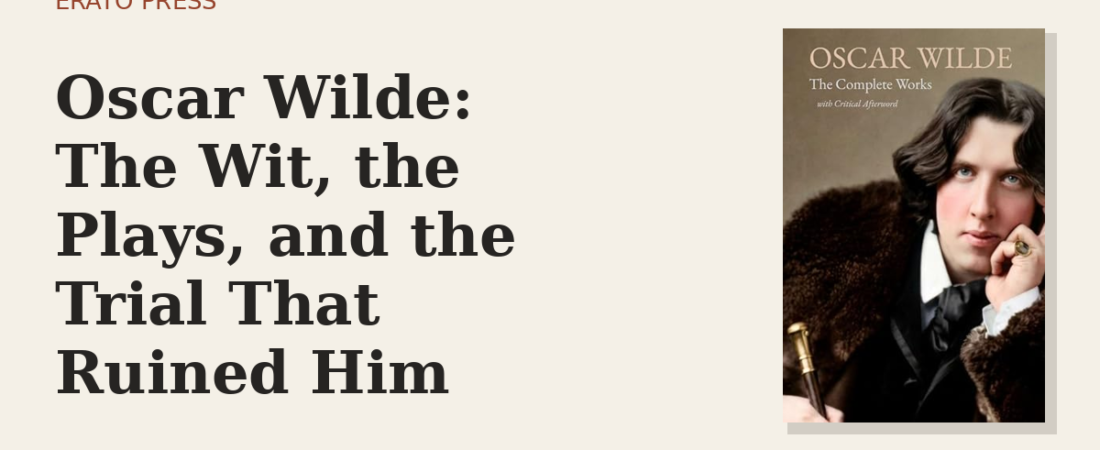
To read Wilde whole — the aphorist, the playwright, the novelist, the prisoner — is to see how completely of a piece he was, and how unjustly his life was used against his art. The Erato Press Complete Works of Oscar Wilde gathers the fiction, drama, poetry, and essays with critical companions that restore the philosophy behind the wit and set the 1895 trials in the context of the doctrine they violated.
Read the Erato Press edition →
Enjoyed this piece?
Get the next one — our essays on the classics and news of each new Erato Press edition — straight to your inbox.