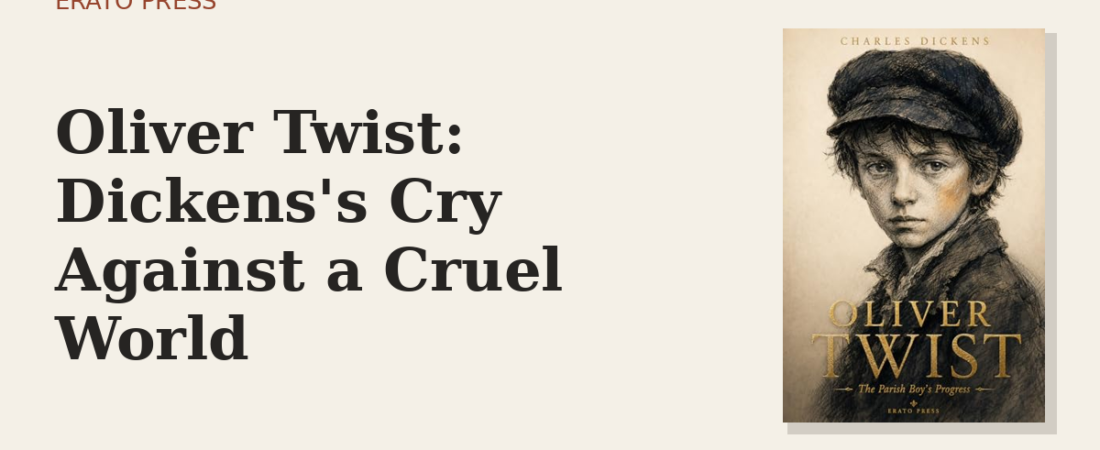
“Please, sir, I want some more.” A starving workhouse boy dares to ask for a second helping of gruel, and the outrage that follows — the horror of the well-fed officials that a pauper child should want more — is the most famous indictment in English fiction of a society’s cruelty to its poor. Oliver Twist (1838), Dickens’s second novel, is the book in which he discovered his great subject and his great weapon: the power of a popular story to shame a nation. It is a melodrama of an innocent orphan caught between the workhouse and the London underworld, and it is also a furious social protest that helped change how the Victorians saw poverty, crime, and childhood.

The scandal of the workhouse
Dickens wrote in the immediate aftermath of the New Poor Law of 1834, which had made relief for the destitute deliberately harsh — the workhouse designed to be so miserable that only the truly desperate would enter it. Into that cruelty he dropped the figure of a child, Oliver, born in the workhouse, orphaned, starved, sold, and beaten, and he dared his comfortable readers to look. The early chapters are savage satire: the fat, sanctimonious officials who preach thrift while children starve, the whole machinery of a charity organized to punish the poor for their poverty. Dickens had found that a single sympathetic child could do what no political pamphlet could — make a whole class of readers feel the human cost of a policy — and he would use that power for the rest of his career.
Fagin’s London
When Oliver escapes to London, he falls into the other great subject of the book: the criminal underworld, drawn with a vividness that scandalized and thrilled Dickens’s readers. Fagin, the old receiver of stolen goods who trains children as pickpockets; the Artful Dodger, the swaggering boy-thief; the brutal housebreaker Bill Sikes and the doomed, loyal Nancy — these are among the most indelible figures Dickens created, a whole shadow-city of the desperate and the damned. Dickens insisted, against critics who wanted crime prettified, on showing this world as it was: the squalor, the fear, the violence that ends in Nancy’s terrible murder and Sikes’s flight and death. He wanted his readers to know that this underworld was made by the same society that ran the workhouse — that cruelty at the top breeds crime at the bottom.
Melodrama with a moral engine
By the standards of his mature work, Oliver Twist is raw — its plot creaks with coincidence, its good characters are saintly and its villains black, its Oliver more symbol than boy. But the rawness is also its force: this is Dickens young and angry, before the subtlety came, wielding melodrama as a moral weapon with tremendous energy. And its central figures — Fagin, the Dodger, Nancy, Sikes — burst through the melodrama into permanent life. The novel established the pattern our guide to Dickens traces through his whole career: entertainment and social conscience fused so completely that readers swallowed the protest with the pleasure.
Why read it now
Because it is the origin of the socially conscious popular novel, and because its rage at a society that starves and criminalizes its poorest children has not expired. It is shorter and more headlong than Dickens’s later masterpieces, gripping as a thriller, and unforgettable in its villains — the book that first showed what a novel could do to the conscience of a nation.
Frequently asked questions
Is Oliver Twist as dark as its reputation?
Parts of it are genuinely grim — the workhouse cruelty, Nancy’s murder — but it is balanced by comedy, adventure, and Dickens’s warmth. It is melodrama with a moral purpose, thrilling as often as it is harrowing.
Was Fagin an antisemitic caricature?
The early portrayal of Fagin drew on ugly stereotypes, and Dickens was criticized for it in his own lifetime; he later softened references and created a sympathetic Jewish character in a subsequent novel in partial response. A thoughtful edition addresses the controversy honestly.
Is it a good first Dickens?
It is short, fast, and famous, which makes it an easy entry — though Great Expectations and David Copperfield show his mature art better. Oliver Twist is the place to meet young, angry Dickens at his most propulsive.
Read the Erato Press edition →
and hear the cry that shamed a century.
Enjoyed this piece?
Get the next one — our essays on the classics and news of each new Erato Press edition — straight to your inbox.