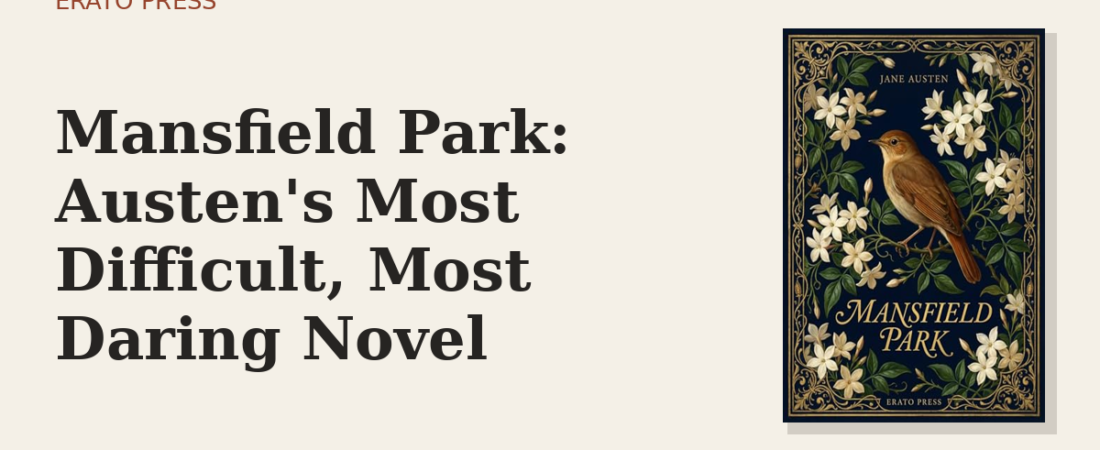
Of all Jane Austen’s novels, Mansfield Park (1814) is the one readers argue about most, because it refuses to do what we want Austen to do. Its heroine, Fanny Price, is not witty and sparkling like Elizabeth Bennet or Emma; she is poor, timid, physically frail, and morally rigid — a girl who watches and judges from the margins and will not bend. The charming, clever characters are the corrupt ones; the dull, unbending girl is right. It is Austen’s most serious and most difficult book, a novel about moral integrity in a world of glamorous compromise, and once a reader stops wishing Fanny were more fun and starts seeing what Austen is doing, it reveals itself as perhaps her most profound.

The poor relation who will not bend
Sent as a child from her poor family to be raised on the charity of her wealthy relatives at Mansfield Park, Fanny grows up an outsider in the great house — loved by no one but her cousin Edmund, reminded constantly of her inferior place, taught to be grateful and small. And from that powerless position she becomes the novel’s one fixed moral point. When the glamorous, worldly Crawfords arrive and the household drifts into flirtation, theatrical vanity, and the beginnings of real corruption, only Fanny sees clearly and refuses to join; when Henry Crawford, charming and unprincipled, decides to marry her, she alone resists the match everyone else thinks she should be grateful for, because she has seen his character and will not trade her integrity for security. Austen dares us to find her priggish — and then vindicates her utterly, as the charming characters destroy themselves and the quiet, unyielding girl is proved right.
The shadow of slavery
And there is a darkness in Mansfield Park that Austen’s other novels do not have. The wealth that makes Mansfield possible comes from Sir Thomas Bertram’s plantation in Antigua — that is, from slave labor — and Austen, quietly but unmistakably, lets that fact shadow the book. When Fanny asks her uncle about the slave trade, the novel tells us, her question is met with “dead silence.” Critics have argued for decades about how much Austen intends by this, but the silence is there, deliberate, at the heart of the great house: the comfort and elegance of English gentility resting on an atrocity no one will discuss. It gives the novel a moral weight, a sense of rot beneath the polish, that makes Fanny’s stubborn integrity feel less like priggishness and more like the only clean thing in a compromised world.
The daring of the unglamorous heroine
What makes Mansfield Park Austen’s most daring experiment is precisely its refusal to charm. She had shown she could write the irresistible heroine; here she deliberately wrote the opposite — the good, dull, powerless girl who is right — and asked whether we could learn to value integrity over wit, substance over sparkle. It is a test of the reader as much as a novel, and it connects to the moral seriousness our guide to Austen argues was always the steel beneath her comedy. Readers who pass the test find in Fanny Price one of the most quietly courageous heroines in fiction.
Why read it now
Because it is the Austen novel for grown-ups — the one that trades charm for depth and asks the hardest question, whether we can admire goodness when it is not entertaining. Slower and darker than her comedies, shadowed by the money behind the manners, it rewards patience with a moral seriousness that has made it, for many careful readers, her richest book.
Frequently asked questions
Why do people find Fanny Price hard to like?
Because Austen deliberately made her the opposite of her sparkling heroines — shy, frail, and morally unbending. The novel dares you to value her integrity over the charm of the corrupt characters around her, and rewards the reader who does.
What is the connection to slavery?
The Bertram family’s wealth derives from a slave plantation in Antigua, and Austen pointedly notes the “dead silence” that meets Fanny’s question about the slave trade. The shadow of that atrocity lies quietly beneath the novel’s elegant world.
Is it a good first Austen?
Probably not — start with Pride and Prejudice or Emma. Mansfield Park is the novel to read once you love Austen and are ready for her most serious, demanding, and rewarding work.
Read the Erato Press edition →
and meet the heroine Austen dared you not to like.
Enjoyed this piece?
Get the next one — our essays on the classics and news of each new Erato Press edition — straight to your inbox.