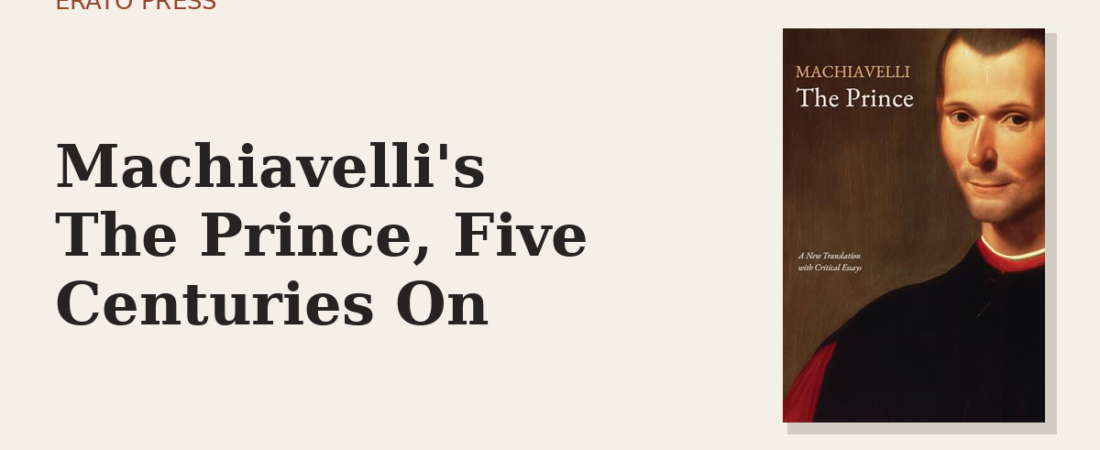
In 1513, a recently tortured and unemployed Florentine bureaucrat sat down in exile on his small farm at Sant’Andrea and wrote a short book he hoped would buy him back into political life. It did not. Il Principe circulated in manuscript, was printed only in 1532, five years after its author’s death, and within a generation had made Niccolò Machiavelli’s name a synonym for evil. The English stage gave us “Old Nick” and the adjective “Machiavellian”; the Catholic Church put the book on its Index. And yet five centuries on, The Prince is still read, still argued over, and still — this is the uncomfortable part — still useful. The scandal of the book is not that it recommends cruelty. It is that it describes power without lying about it.

That is the thesis worth holding onto. Every prior “mirror for princes” — the medieval genre of advice books for rulers — told the prince to be just, pious, merciful, and beloved, because virtue would be rewarded by God and history. Machiavelli looked at the actual Italy around him, a peninsula of mercenary armies, Borgia poisonings, French invasions, and overthrown republics, and concluded that the advice books were not merely useless but dangerous. “Many have imagined republics and principalities that have never been seen or known to exist in truth,” he writes in the pivotal fifteenth chapter, “for there is such a distance between how one lives and how one ought to live that he who lets go of what is done for what ought to be done learns his ruin rather than his preservation.” He proposes, instead, to follow “the effectual truth of the thing” — la verità effettuale — rather than its imagined picture. With that phrase, political science is born.
Virtù against fortuna
The engine of the book is the contest between two words that resist clean translation. Fortuna is not quite “luck”; it is the river of contingency, the flood that destroys when it pleases, the goddess of chance who rules, Machiavelli estimates, half of what happens to us. Virtù is not “virtue” in the moral sense at all. It is closer to the Latin vir, manliness — force, skill, decisiveness, the capacity to seize a moment and bend events to your will. The man of virtù does not pray for good fortune; he builds dikes and embankments in advance so that when the flood comes he is ready. In the notorious final chapters, Machiavelli writes that fortune is a woman who favors the bold and must be mastered — an image that tells us, uncomfortably, exactly as much about his century’s sexual imagination as about his politics.
What makes this more than locker-room philosophy is the precision of the examples. Machiavelli’s hero is not a fantasy but Cesare Borgia, whose rise and ruthless consolidation of the Romagna the author had watched up close as a Florentine envoy. Borgia installed a brutal lieutenant, Remirro de Orco, to pacify the province; then, when the population’s hatred had done its work, had Remirro cut in two and left in the public square one morning “with a piece of wood and a bloody knife beside him.” The people, Machiavelli reports without flinching, were left “satisfied and stupefied.” This is the book’s method in miniature: not approval, not condemnation, but cold attention to what worked and why. The cruelty was, in his chilling term, “well used.”
The argument that will not stop being misread
The single most quoted question in the book is whether it is better to be loved or feared, and the single most common misreading is that Machiavelli says “feared.” He does not, quite. He says that it is best to be both, but since the two rarely coexist and human beings are fickle — “ungrateful, fickle, liars and deceivers” — it is safer to rely on fear, because love is sustained by a bond of obligation that men break whenever it suits them, while fear is sustained by dread of punishment, which never fails. But then comes the qualification everyone forgets: the prince must above all avoid being hated, and the surest way to be hated is to seize the property and the women of his subjects. “Men sooner forget the death of their father than the loss of their patrimony.” Even here, the supposed apostle of tyranny is reasoning about limits, about what a population will and will not tolerate. He is, in his grim way, a realist about consent.
This is why the book refuses to settle into the cartoon villainy assigned to it. Rousseau insisted that The Prince was secretly a republican’s satire, a handbook of tyranny written to expose tyrants to a free people — an argument that founders on the fact that Machiavelli plainly meant the dedication to the Medici sincerely, hoping for a job. Others read it as pure cynicism. The truer reading is harder: Machiavelli loved republics (his longer and greater work, the Discourses on Livy, is a passionate defense of self-government) but believed that a corrupt, divided state could only be rescued, in the short term, by a single ruthless founder. The Prince is emergency medicine, not a theory of the good life. He prescribes the poison because the patient is already dying.
Why it still reads as a manual
Strip away the Renaissance furniture and the structure of the analysis is startlingly modern. Machiavelli separates the question of how to acquire and hold power from the question of whether the holder is good — the same separation that lets a contemporary analyst study how a campaign wins an election without endorsing the candidate. He thinks in terms of incentives, of timing, of the management of reputation, of the difference between appearing virtuous and being virtuous (the prince “need not have” the qualities of mercy and faith, “but he must certainly seem to have them”). Read in a boardroom or a campaign war room today, the advice on managing perception, neutralizing rivals before they consolidate, and never doing a necessary cruelty by halves still lands with a cold click of recognition. This is precisely why Erato pairs the classic with a modern reading in Machiavelli’s The Prince, Five Centuries On, tracing how the same logic surfaces in the politics and corporations of our own moment.
And yet to read it as a how-to is to flatten it. The deeper achievement is intellectual honesty under pressure. Machiavelli wrote from defeat — he had been imprisoned, strung up by the wrists in the strappado, and stripped of the public career that was his whole identity. The book is not the confident swagger of a man with power but the clear, bitter sight of a man who has lost it and is determined, at least, to understand the game that beat him. That is what gives the prose its peculiar electricity: it is the truth told by someone who has nothing left to gain by lying.
The man behind the monster
The Machiavelli of the letters is almost unrecognizable as the demon of legend. In a famous letter to his friend Francesco Vettori, written the same year as The Prince, he describes his days in exile — snaring birds, quarreling at the village inn, reading scraps of Dante and Petrarch — and then, at evening, putting on his finest robes to enter his study and “converse” with the ancient authors, who answer his questions, where “for four hours I feel no boredom, I forget every trouble, I do not dread poverty, I am not frightened by death.” Out of those evenings came the book. It helps, when the word “Machiavellian” rises to the lips, to remember the lonely, ruined, bookish man putting on court dress to talk to the dead.
Frequently asked questions
Is The Prince actually evil?
No more than a surgeon’s textbook is evil for describing where to cut. The book separates the analysis of power from the morality of its use, which feels shocking because we are used to advice that flatters our better instincts. Machiavelli refuses to flatter. Whether the result is wickedness or honesty has been the central argument about the book for five hundred years, and the fact that it cannot be settled is the source of its life.
Should I read The Prince or the Discourses on Livy?
Start with The Prince — it is short, sharp, and the foundation of the legend. But if it leaves you thinking Machiavelli was an enemy of liberty, the Discourses will correct you fast: there he argues that the healthiest states are republics, that political conflict can be productive, and that liberty is worth defending. The two books are two halves of one mind.
Does the advice still apply today?
The specific examples are Renaissance, but the underlying logic — about incentives, perception, timing, and the gap between how power is supposed to work and how it actually works — transfers uncomfortably well to modern politics and business. That portability is exactly why the book has never gone out of print.
The Erato Press edition presents Machiavelli’s incendiary little book in a clear modern translation, with the historical context — Borgia, the Medici, the wars of Italy — that the bare text assumes you already know, so that you can read it as his first readers could not: with the whole game laid out before you.
Read the Erato Press edition →
Enjoyed this piece?
Get the next one — our essays on the classics and news of each new Erato Press edition — straight to your inbox.