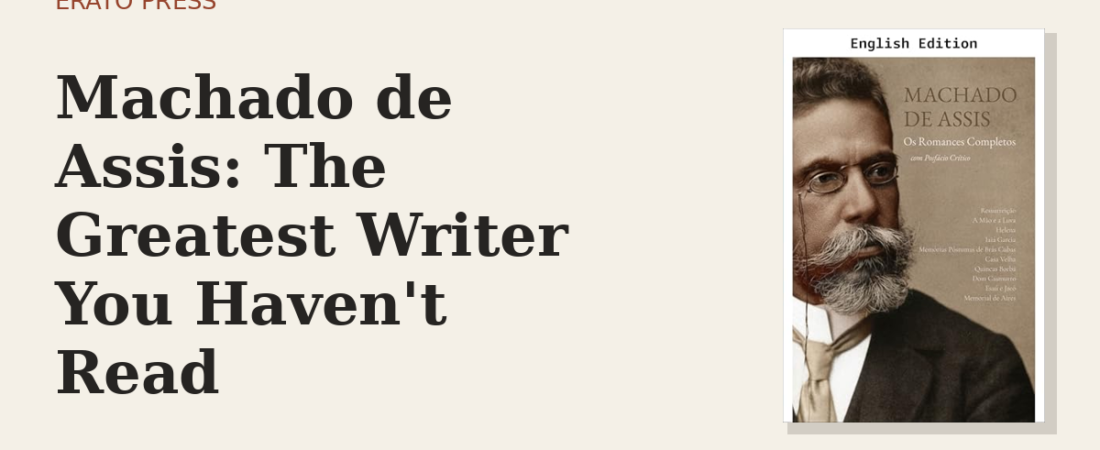
Imagine a novelist who, in the 1880s, in a country most of his future readers could not find on a map, sat down and wrote a book narrated by a dead man, and made the dead man charming, digressive, malicious, and self-aware in a way that would not become fashionable in Europe and North America for another half century. The novelist was Joaquim Maria Machado de Assis, the grandson of freed slaves, born poor and mixed-race in Rio de Janeiro, largely self-taught, an epileptic stammerer who rose to become the founding president of the Brazilian Academy of Letters. He is, by a serious measure, one of the half-dozen greatest novelists of the nineteenth century. And most readers of English have never heard his name.

The thesis here is not modest, because Machado does not require modesty. He was doing things with the novel, an unreliable narrator who knows he is unreliable and dares you to catch him, a structure built from tiny ironic chapters that comment on themselves, a corrosive skepticism about human motive dressed in perfect courtesy, that the rest of world literature would only catch up to in the twentieth century. The reason the Anglophone world is finally discovering him is not that he has gotten better. It is that we have finally gotten ready for him.
A dead man’s memoirs, and the narrator who plays with you
Begin where most new readers should, with The Posthumous Memoirs of Brás Cubas, published in 1881. The conceit announces itself in the dedication, which is offered “to the worm that first gnawed the cold flesh of my corpse.” The narrator is dead, and writing from beyond the grave, which frees him from every consideration that makes living narrators flatter themselves. Brás Cubas has nothing left to gain or protect, so he tells the truth, and the truth is that his life amounted to very little: a failed love affair, a failed political career, a failed philosophy, a comfortable selfishness redeemed by nothing. The book’s final accounting is one of the bleakest and funniest in all literature, a man tallying up his existence and finding, in the negative, a small surplus: he never had children, and so, he concludes, he did not transmit to any creature the legacy of human misery.
What makes this more than a clever frame is the narrator’s relationship with the reader. Brás Cubas interrupts himself, addresses you directly, accuses you of impatience, skips chapters and apologizes, includes a chapter that is nothing but a row of punctuation marks. He is forever winking, forever reminding you that a book is a made thing and he is the maker, and that you should trust nothing he says even as you cannot stop listening. The technique that later readers would label metafiction was, for Machado, simply the honest way to tell a story: with full awareness that telling shapes, distorts, and serves the teller.
Dom Casmurro and the trap of the unreliable narrator
If Brás Cubas dazzles, Dom Casmurro wounds, and it is the book that has made Machado a permanent subject of argument. Its narrator, Bento Santiago, an old and bitter man, sets out to tell the story of his great love for Capitu, the bewitching girl next door whom he married, and of his growing certainty that she betrayed him with his best friend and that the son he raised was not his own. He builds his case across the whole novel, marshaling evidence, interpreting glances, reading guilt into Capitu’s famously “undertow eyes.”
And here is Machado’s masterstroke, the thing that places him decades ahead of his moment: the entire case is delivered by a jealous man, and we have only his word. There is no scene of adultery, no proof, nothing but the increasingly paranoid reconstruction of a narrator who has every reason to deceive himself and us. Generations of early readers took Bento at his word and pitied the betrayed husband. Later readers, trained by a century of unreliable narration, see something far darker: a portrait of how jealousy manufactures its own evidence, how a man can destroy a woman with a story and never know whether the story is true. Machado does not resolve it. He cannot, because the point is that we, like Bento, can never know, and the not-knowing is the tragedy. No nineteenth-century European novelist built a trap this clean.
The irony that hides inside good manners
Reading the late Machado, you feel a particular sensation that is hard to name and impossible to forget: the prose is polished, gentle, almost old-fashioned in its courtesy, and underneath it runs a current of pure acid. He will describe a character’s vanity, cruelty, or self-deception in the kindest tones, with a little philosophical aside, a borrowed proverb, a feigned hesitation, and the effect is more devastating than any direct attack. He loved to turn a proverb inside out. It is not the occasion that makes the thief, one of his narrators corrects; the proverb is wrong; the occasion makes the theft, but the thief was born ready. That single revision is the whole Machadian worldview in miniature: a smiling, unillusioned conviction that human beings are mostly governed by appetite and self-interest, however nobly they dress it up, and that the spectacle is best met with irony rather than rage.
His narrators are obsessed with chance, with the small accidents that determine whole lives, and with the gap between what people say they feel and what they actually do. A banknote pressed into a beggar’s hand might be charity, or vanity, or superstition, or the memory of an old love, and Machado will float all four explanations and refuse to settle, because he knows the human heart does not settle either. This refusal to flatten motive into a single cause is what makes him feel modern. He treats consciousness as the murky, contradictory, self-serving thing it is, and he does it with a lightness that never lets you feel lectured.
The Alienist and the comedy of reason
For a sharp, short introduction to his mind, there is The Alienist, a novella in which a brilliant doctor opens an asylum in a small Brazilian town and sets out to scientifically determine who is sane. His criteria expand, and expand, until he has institutionalized most of the town as mad, then reverses his theory and concludes that the few he left out were the truly insane, and locks them up instead, and finally, with perfect logic, decides that he himself is the only madman and commits himself. It is a parable about the arrogance of reason, the violence of categories, and the ease with which authority dressed as science becomes tyranny, and it is wickedly, economically funny. Machado, who lived through the rise of positivist confidence and watched scientific racism gather force in a country built on slavery, knew exactly how dangerous a clever man with a system could be.
Why the Anglophone world is only now catching up
The simplest answer is language: Machado wrote in Portuguese, the great novels stayed largely untranslated or badly translated for decades, and a writer this dependent on tone and irony loses everything in a clumsy version. But there is a deeper answer. Machado’s techniques, the self-conscious narrator, the withheld resolution, the distrust of the storyteller, the bleak comedy of motive, were simply ahead of what his nineteenth-century audience abroad was equipped to value. The literary world spent the twentieth century inventing, with great fanfare, devices Machado had quietly perfected in Rio decades earlier. Now that those devices are the common language of serious fiction, readers opening him for the first time have the disorienting experience of meeting a contemporary who happens to have died in 1908. The discovery is overdue, and it is accelerating, and it is entirely deserved.
Frequently asked questions
Where should I start with Machado de Assis?
The Posthumous Memoirs of Brás Cubas is the ideal entry, short, dazzling, and immediately addictive in its voice. From there, Dom Casmurro delivers the emotional and interpretive depth charge, and Quincas Borba completes the great trilogy of his maturity. The novella The Alienist is a perfect one-sitting taste of his irony for the impatient.
Did Capitu actually betray Bento in Dom Casmurro?
Machado does not tell you, and that is the genius of the book. The entire accusation comes from a jealous, embittered narrator with no proof, and the novel can be read with equal conviction as the story of a betrayal or as the story of a man destroying an innocent woman with his own suspicion. The uncertainty is not a flaw to be solved; it is the whole devastating point.
Why is he compared to so many later writers?
Because his methods anticipate them. The playful, intrusive narrator recalls the experimental fiction of the twentieth century; the unreliable confession looks forward to a hundred modern novels; the philosophical comedy and the cold eye on human motive have drawn comparisons to writers across the next century. He arrived at these things first, alone, on the far side of the Atlantic, which is what makes the belated recognition so striking.
Machado loses more than most writers to a careless rendering, because everything depends on the exact pitch of his irony, the courtesy that conceals the knife. The Erato Press edition brings his novels into English with that pitch protected and an apparatus that places him in the Rio de Janeiro he never left and the world literature he quietly outran. He is not a curiosity from the margins. He is one of the central figures the center forgot, and the book in your hands is the correction.
Read the Erato Press edition →
Enjoyed this piece?
Get the next one — our essays on the classics and news of each new Erato Press edition — straight to your inbox.