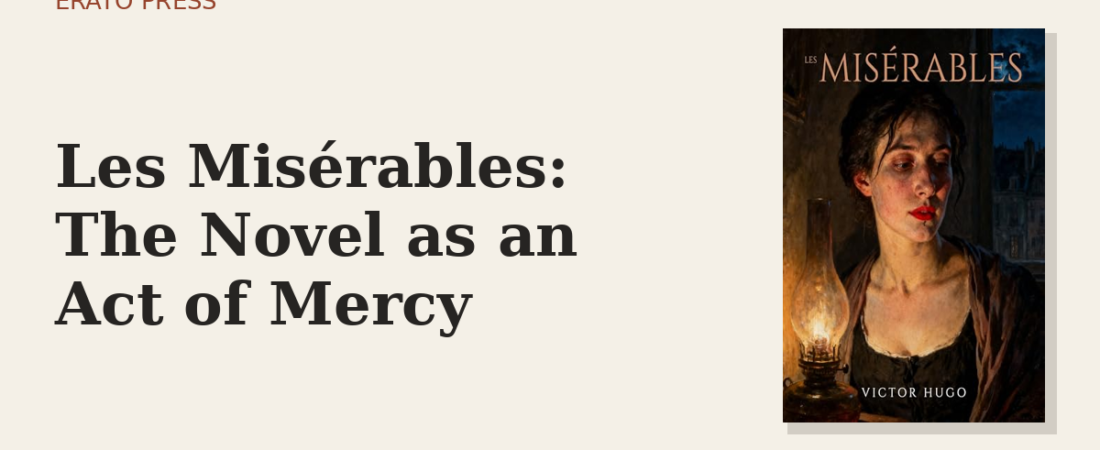
A starving man serves nineteen years in the galleys for stealing a loaf of bread, comes out hardened into a beast, steals silver from the bishop who shelters him, is caught — and is forgiven, the bishop telling the police the silver was a gift and handing him the candlesticks besides. From that one act of undeserved mercy, Victor Hugo built the most expansive and generous novel of the nineteenth century. Les Misérables (1862) is enormous in every sense: enormous in length, in cast, in ambition, in heart. It is the story of Jean Valjean’s lifelong struggle to become good, and it is also a thundering indictment of a society that manufactures the very misery it then punishes — a book that dares to believe a single soul can be redeemed and a whole social order can be shamed into justice.

Valjean and Javert: mercy against law
The novel’s spine is the pursuit of Valjean by the policeman Javert across decades — and it is far more than a manhunt, because the two men embody opposed visions of the moral universe. Javert believes in law, absolutely: a man is what he was, a criminal is a criminal forever, order is everything and mercy is weakness. Valjean, transformed by the bishop’s grace, becomes the living proof that a man can change, that the past need not be destiny, that mercy remaking a soul is more real than any law. Their final confrontation — when Valjean spares Javert’s life and Javert, unable to fit an act of grace into a universe made only of law, is destroyed by it — is one of the great moral climaxes in fiction. Hugo stages the deepest of questions, justice versus mercy, as a chase, and makes it unbearably suspenseful.
The wretched of the earth
The title means “the wretched,” “the miserable ones,” and Hugo’s true subject is the whole underworld of the poor that respectable society preferred not to see: Fantine, driven to prostitution and death to feed her child; her daughter Cosette, worked like a slave by the monstrous Thénardiers; the street urchin Gavroche, singing on the barricade; the students who die for a republic in the failed rising of 1832. Hugo halts his story for long essays on the sewers of Paris, the argot of criminals, the Battle of Waterloo, convent life — digressions that maddened some readers and that are, in truth, the book’s method: he wanted to hold an entire society up to the light, its heights and its depths, and force the comfortable to look at what their order costs. It is the great novel of social conscience, and it changed how a century thought about poverty and punishment.
The romance of redemption
What keeps Les Misérables beloved, a century and a half on, and able to become the world’s most successful musical, is that under the social argument beats an unashamedly romantic heart. Hugo believed in redemption, in sacrifice, in love, in the possibility that human beings might be better than their circumstances — and he was not afraid of feeling. Valjean’s slow sanctification, his fierce paternal love for Cosette, his final lonely death as the young lovers he has protected find happiness, is melodrama in the grand and honorable sense: it aims straight at the heart and hits. In an age of irony, Hugo’s earnest faith in human goodness reads as almost radical.
Why read it now
Because no novel argues more powerfully that mercy is stronger than law and that no one is beyond redemption — and because its portrait of a society that criminalizes poverty and then wonders at its own crime has not dated. It is very long, and Hugo digresses gloriously; give yourself to it, skim the essays if you must, and let the great current of the story carry you. Few books leave a reader more convinced that goodness is possible.
Frequently asked questions
Is Les Misérables worth its length?
For most readers, overwhelmingly yes — the central story is gripping and deeply moving. Hugo’s long digressions on Waterloo, the Paris sewers, and convent life can be skimmed on a first reading without losing the thread; many readers come to love them on a second.
How different is it from the musical?
The musical captures the emotional arc faithfully but compresses a vast novel into a few hours. Hugo’s book gives you the full interior lives, the social panorama, and the philosophical depth the stage can only gesture at — above all the slow, believable transformation of Valjean’s soul.
What is the historical setting?
Post-Napoleonic France, culminating in the failed republican uprising of June 1832 — not the great Revolution of 1789 but a smaller, doomed rising that Hugo uses to dramatize the era’s unfinished hopes. A good edition supplies the light historical context you need.
Read the Erato Press edition →
and follow one soul from the galleys to grace.
Enjoyed this piece?
Get the next one — our essays on the classics and news of each new Erato Press edition — straight to your inbox.