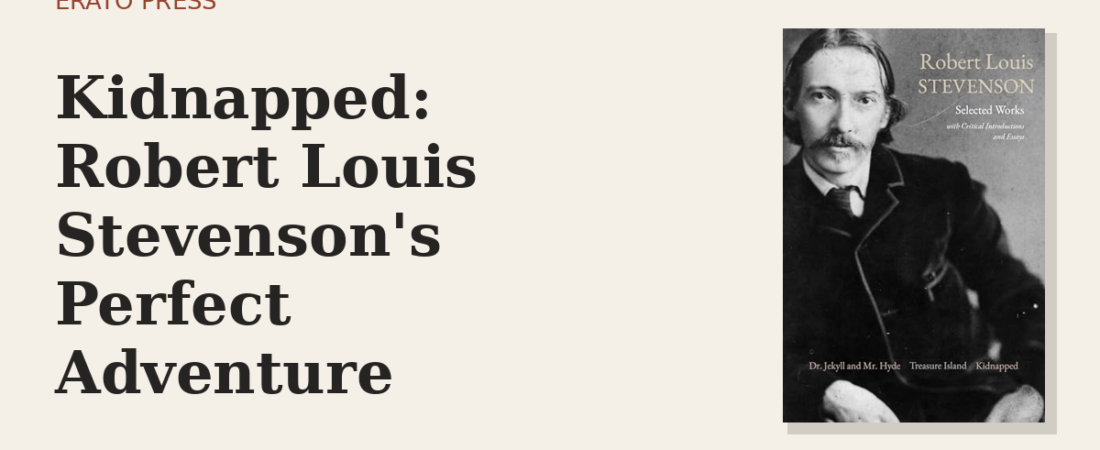
David Balfour, newly orphaned, goes to claim his inheritance from a miserly uncle who promptly has him kidnapped and sold aboard a ship bound for the American plantations. Shipwrecked on the wild Scottish coast, he falls in with Alan Breck Stewart — a dashing, dangerous Jacobite rebel with a price on his head — and the two flee together across the Highlands, pursued by soldiers, through one of the most thrilling and beautifully written chases in adventure fiction. Kidnapped (1886), by the author of Treasure Island, is Robert Louis Stevenson’s most perfect adventure novel — fast, vivid, and irresistible — and, beneath the flight and the fighting, a subtle and moving study of an unlikely friendship across a deep divide.

The chase across the heather
Stevenson was the great master of pace, and Kidnapped is his purest demonstration. Once David and Alan take to the heather, the novel becomes a sustained flight — over mountains and moors, across rivers, through the territory of hostile clans, always a step ahead of the redcoats — rendered with a physical immediacy that puts the reader in the wet heather beside them, exhausted, hunted, alive. The famous “flight in the heather” is a set-piece of pure narrative tension, and the equally famous quarrel between the two friends, when fatigue and difference boil over into bitter words, is a masterstroke of realism amid the romance. Stevenson knew that an adventure is only as good as the human truth inside it, and he grounds every thrill in the felt reality of two tired, frightened, quarreling men.
Two Scotlands, one friendship
The heart of the book is the friendship between David and Alan, and its depth comes from all that divides them. David is a cautious, sober, Protestant Lowlander, loyal to the Hanoverian king; Alan is a reckless, romantic, Catholic Highlander, a Jacobite rebel who would die (and kill) for the exiled Stuart cause. They embody the two Scotlands that had torn the country apart in the risings of 1715 and 1745 — the modern, commercial Lowlands and the old, doomed clan Highlands — and their prickly, deepening affection across that divide is Stevenson’s quiet act of national reconciliation. He loved both Scotlands, and in the bond between his mismatched heroes he dramatized the possibility that opposites might, through shared danger and hard-won respect, come to love each other. It gives a boys’ adventure the weight of history and the warmth of real feeling.
The stylist’s adventure
What sets Stevenson above the run of adventure writers is the sheer quality of his prose — clean, muscular, and beautiful, admired by writers from Henry James to Borges. He proved that a story of pure incident could also be genuine literature, that the adventure novel need not be crude to be exciting. Kidnapped is a book a child can devour for the chase and an adult can savor for the craft, the psychology, and the elegiac love of a vanishing Scotland. It stands with Treasure Island at the summit of the adventure tradition, the work of a master who dignified the form.
Why read it now
Because it is one of the most purely enjoyable novels ever written and one of the best-made — a perfect adventure with a real heart, told in prose that has not aged a day. Whether you are twelve or fifty, the flight across the heather with David and Alan is one of the great pleasures reading has to offer.
Frequently asked questions
Is Kidnapped a children’s book?
It works wonderfully for young readers as a thrilling adventure, but its craft, its historical depth, and its subtle study of friendship reward adults fully. Like the best of Stevenson, it belongs to every age.
Do I need to know Scottish history?
No — Stevenson supplies what you need, though the novel is richer if you know a little about the Jacobite risings and the divide between Highland and Lowland Scotland. A good edition glosses the context lightly.
How does it compare to Treasure Island?
They are Stevenson’s two great adventures; Treasure Island is the more famous pirate tale, Kidnapped the more historically grounded and, many think, the more mature and moving. Readers who love one almost always love the other.
Read the Erato Press edition →
and take to the heather with David and Alan.
Enjoyed this piece?
Get the next one — our essays on the classics and news of each new Erato Press edition — straight to your inbox.