Everyone knows the secret of Strange Case of Dr Jekyll and Mr Hyde before they open it. The title has become a figure of speech, the twist a permanent feature of the cultural furniture: the respectable doctor and the monster are the same man. This is a strange fate for a book that Robert Louis Stevenson built, with great care, as a mystery — a story whose whole architecture depends on the reader not knowing. To read it now is to read a detective novel whose solution has been spoiled for a hundred and forty years. And yet it survives the spoiling, which tells you the secret was never really the point.

Stevenson wrote the novella in 1885, reportedly in a feverish burst, after a nightmare; he is said to have burned a first draft and rewritten it whole. It appeared in 1886 and sold in the tens of thousands within months, helped along by pulpits that took it for a parable of vice and virtue. That sermonic reading is not wrong so much as too small. The book’s enduring argument is harder and more modern: that the self is not a unity to be defended against corruption but a colony of incompatible drives held together by force of will, and that respectability is one of the technologies by which we hold it. Hyde is not an invader. He is a tenant who was always there, and Jekyll’s tragedy is that he wanted to give him his own front door.
The structure is the meaning
The first thing to notice is how late we arrive. The novella does not begin with Jekyll at all; it begins with Mr. Utterson, a dry, decent lawyer, and we spend most of the book inside his bafflement. We meet Hyde first as rumor, then as the perpetrator of a trampling and a murder, then as a key the household will not explain. Only at the very end, in two written documents — Dr. Lanyon’s narrative and Jekyll’s “full statement of the case” — does the explanation arrive, and it arrives as confession, after the deaths, when nothing can be done.
This withholding is doing thematic work, not just suspense. By routing the whole story through outside observers — the lawyer, the relative, the loyal servant — Stevenson keeps the divided self unseen from within for as long as possible. The reader is forced into the position of Victorian society itself: confronted with a man’s monstrous double and unable to name it, sensing the wrongness, sniffing around the edges of a respectable house, declining to ask the question directly. The revelation, when it comes, is not a trick sprung on us but the lifting of a denial we have shared. The form enacts the repression the book is about.
Hyde as the cost of respectability
Jekyll’s own statement is unsparing about why he built the door. He was not a villain but a man of “a profound duplicity of life,” ashamed less of his pleasures than of the gap between them and the public dignity he was determined to maintain. The drug does not create a second man; it separates one. It lets the pleasures walk abroad under another name and another face, so that Jekyll the eminent doctor need never be implicated in what Hyde the free man does. This is the device’s seduction: not transformation but deniability. Hyde is smaller, younger, less developed — because the appetites Jekyll exiled into him were the ones he never let grow up.
What makes the book a Victorian document of the first order is that the shadow is generated by the very rigor of the respectability. A culture that demands a seamless public surface produces, by necessity, a sealed interior where everything the surface forbids accumulates. Stevenson grasped that this is not stable. The interior pressurizes; the seal fails. Late in the book Jekyll discovers he is turning into Hyde without the drug, involuntarily, in his sleep — the suppressed self asserting its claim until the respectable one needs the chemistry merely to stay Jekyll. The hierarchy inverts. The mask, worn long enough, becomes the effort, and the face beneath it becomes the default.
A fable of addiction
Read in another light, the novella is one of the most precise accounts of addiction in English fiction, and it is hard to believe Stevenson — who lived much of his life on prescribed and self-administered drugs for chronic illness — did not know it. The pattern is exact. The first transformations are chosen, thrilling, controlled. Jekyll insists he can stop, and for a stretch he does. Then the dose required climbs; the involuntary episodes begin; the supply of a crucial salt runs out and cannot be replaced, and a contaminant in the original batch turns out to have been the active ingredient all along — meaning the escape was always an accident he can never reproduce. The will that opened the door cannot close it. By the end Jekyll is not choosing Hyde; he is rationing himself against Hyde, and losing.
This is why “Jekyll and Hyde” as a phrase for ordinary two-facedness undersells the book. Stevenson is not describing hypocrisy, which is a stable arrangement. He is describing a compulsion that escalates past the point of control and ends in self-annihilation, because the two selves cannot finally share one body. The last act is a slow suicide conducted by a man trying to outlast his own habit.
The double, and the Gothic’s late great theme
The figure of the double — the Doppelgänger, the second self that shadows and finally destroys the first — had haunted Romantic and Gothic writing for decades before Stevenson. What he added was modernity and economy. His double is not a supernatural twin or a portrait in an attic but a pharmacological accident, a product of laboratory chemistry and middle-class shame, set not in a haunted castle but in foggy, gas-lit, eminently professional London. The horror is domestic and circumstantial, which is precisely what made it portable into the century that followed and into psychoanalysis, where the divided psyche became the founding assumption rather than the shocking discovery.
It belongs, too, to a remarkable cluster of late-Victorian fictions in which the respectable surface of empire and propriety is shown harboring something it cannot acknowledge. Stevenson’s near contemporary worked the same vein from the outside in, and readers drawn to the way Dracula: How Bram Stoker Invented the Modern Vampire stages the foreign predator at the heart of London will recognize, in Hyde, the predator who was already inside the house and wearing the householder’s own skin. The two books are the era’s twin nightmares: the monster that comes from abroad, and the monster that comes from within.
Frequently asked questions
Is it worth reading if I already know the twist?
Yes, and arguably more so. Once the surprise is gone, the craft becomes visible: the deliberate routing through outside observers, the slow inversion of which self is in control, the confession structure that converts a mystery into a tragedy. Knowing the answer lets you watch Stevenson build it.
How long is the book?
It is a novella — readable in a single sitting of two or three hours. Its compression is part of its power; there is no slack in it. That brevity is one reason it has never gone out of print and remains an ideal entry point into the late-Victorian Gothic.
Is Hyde meant to be Jekyll’s evil half?
Not exactly. Jekyll’s own account is subtler: Hyde is the part of him that is purely appetite, untethered from conscience, but Jekyll never claims his respectable self is correspondingly pure good. The disturbing implication is that the “good” Jekyll is the compromise, and Hyde is one of his ingredients, not his opposite.
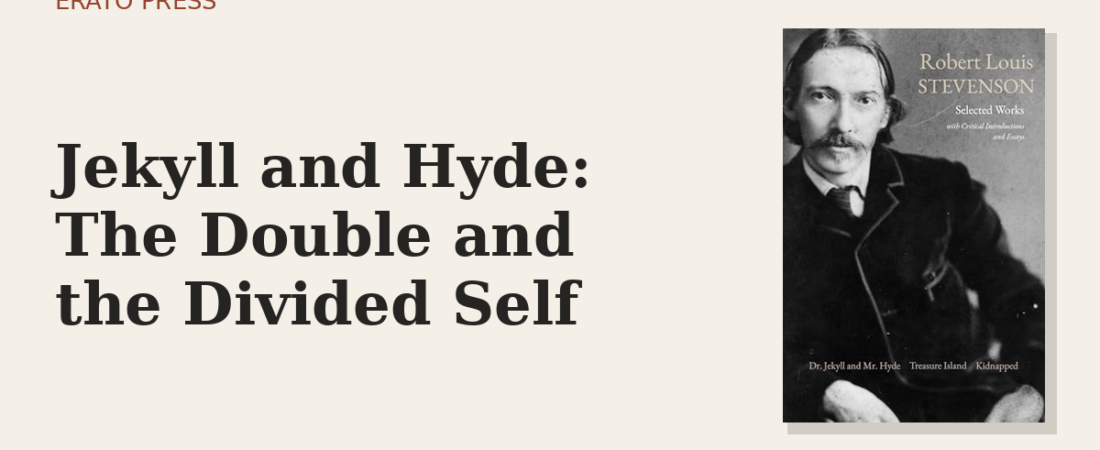
A novella this concentrated rewards an edition that gives it room to breathe and context to land. The Erato Press edition presents Stevenson’s text with critical apparatus that situates the divided self within Victorian respectability, the literature of the double, and the author’s own intimate knowledge of dependency — so that the book can be read as the dark, exact fable it is rather than the spoiled punchline it has become.
Read the Erato Press edition →
Enjoyed this piece?
Get the next one — our essays on the classics and news of each new Erato Press edition — straight to your inbox.