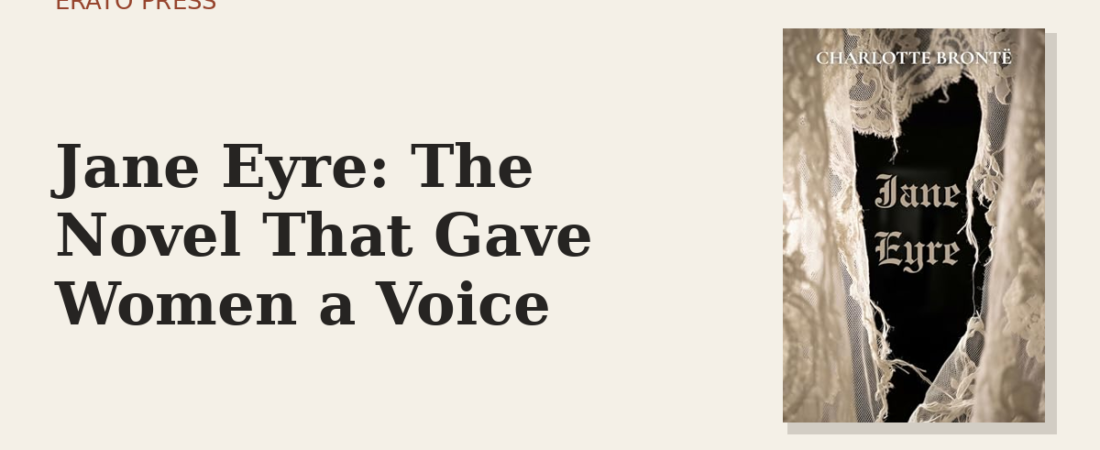
“I am no bird; and no net ensnares me: I am a free human being with an independent will.” When those words came out of the mouth of a small, plain, penniless governess in 1847, they startled England. Jane Eyre gave the English novel something it had never quite had: the voice of a woman who was neither beautiful nor rich nor meek, who insisted on her own worth, her own passion, and her own moral judgment against every power that tried to master her. Charlotte Brontë’s masterpiece is a gothic romance, a coming-of-age story, and a quiet revolution — the first great novel to let an ordinary woman claim, in her own fierce first-person voice, the full dignity of a soul.
“Reader, I married him” — but on her terms
The story is famous: the orphaned Jane, abused by relatives and a cruel charity school, becomes governess at Thornfield Hall, falls in love with its brooding master Mr Rochester, and discovers on their wedding day the madwoman locked in his attic — his living wife. What makes it revolutionary is not the gothic machinery but Jane’s response. She loves Rochester with all the passion in her, and she leaves him, because to stay as his mistress would be to surrender the self-respect that is the core of her being. She will not be any man’s kept woman, not even the man she loves. Only when circumstance has made them equals — he humbled, she independent — does she return, on her own terms, to speak the most famous line in the book: “Reader, I married him.” Not “he married me.” She is the subject of her own life.
Passion and conscience
Brontë’s achievement was to give a woman a full inner life of desire and will at a time when female characters were mostly required to be angels or warnings. Jane burns — with anger at injustice, with longing for love, with a hunger for a wider life (“women feel just as men feel,” she declares, in a passage that rang like a manifesto). And yet she governs that fire by an iron conscience; the whole drama of the novel is the tension between her passion and her integrity, and her refusal to sacrifice either. It is this combination — a heroine who is both intensely feeling and morally unbreakable — that made generations of readers, especially women, feel that a novel had finally spoken for them. The Brontë sisters between them remade the English novel; our guide to where to start with the Brontës sets Charlotte’s fierce moral romance beside her sister Emily’s wilder vision.
The madwoman in the attic
And then there is Bertha Mason, Rochester’s mad first wife, locked away upstairs — one of the most haunting figures in fiction and, to later readers, one of the most troubling. She is the dark double of Jane, the woman of passion unchecked by reason, the colonial secret in the English house, the fury that respectable Victorian womanhood had to cage. Feminist critics made her the emblem of everything the age forced women to suppress, and the novel is richer and stranger for her — a gothic shadow that will not stay in its attic, complicating every easy reading of the love story. Jane Eyre contains its own critique, and that depth is part of why it has never stopped being argued over.
Why read it now
Because it is the great novel of a woman insisting on her own soul — passionate, moral, and free — and because Jane’s refusal to be owned, to trade her integrity even for love, remains one of the most bracing declarations of selfhood in literature. Gripping as a gothic romance, deep as a study of conscience, it is the book that taught the novel to speak in a woman’s undefeated voice.
Frequently asked questions
Is Jane Eyre a romance or something more?
Both. It has one of the great love stories, but its true subject is Jane’s integrity — her insistence on self-respect and moral independence even against her own passion. That is what lifts it above romance into a landmark of the novel.
How is it different from Wuthering Heights?
Charlotte’s novel is a moral, first-person story of a heroine who governs her passion by conscience; Emily’s is an amoral, elemental tragedy of passion unbound. The sisters’ masterpieces are fascinating opposites — see our essay on Wuthering Heights.
Who is the madwoman in the attic?
Bertha Mason, Rochester’s secret first wife, kept locked away — a figure later critics read as the emblem of female rage and repression the Victorian age forced women to hide. She gives the novel its gothic power and its enduring depth.
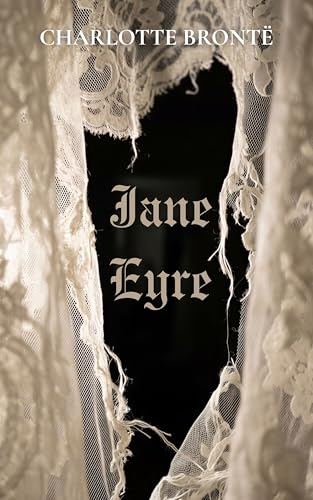
Read the Erato Press edition →
and hear the voice that would not be caged.
Enjoyed this piece?
Get the next one — our essays on the classics and news of each new Erato Press edition — straight to your inbox.