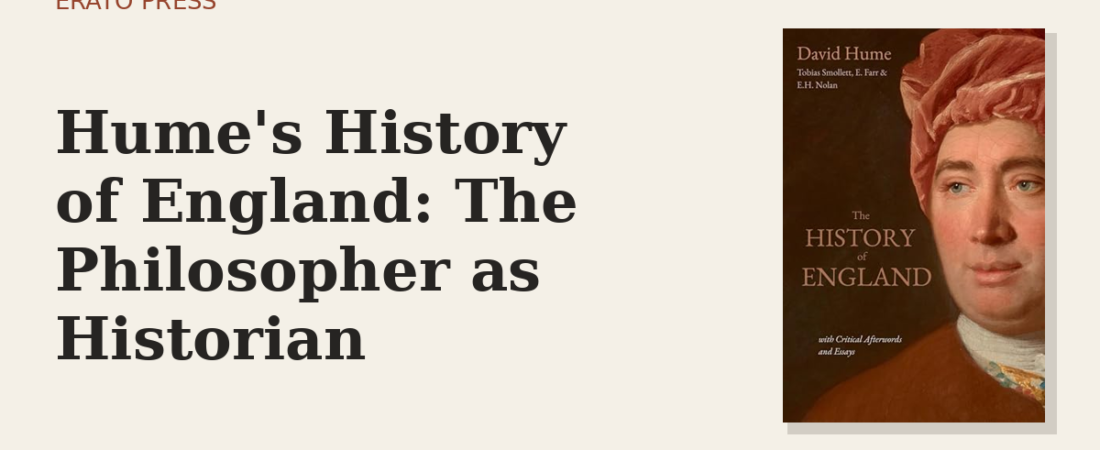
Today we remember David Hume as perhaps the greatest philosopher ever to write in English — the cool, devastating skeptic who dismantled our confidence in causation, miracles, and the self. But in his own lifetime, Hume was famous across Europe for something else: he was the historian of England, author of a monumental History of England that was for decades the standard account, a bestseller that made him rich and celebrated when his philosophy had brought him mostly suspicion. Written with the same calm, skeptical, humane intelligence that animates his philosophy, and in prose of wonderful clarity, it is one of the great works of Enlightenment history — the philosopher turning his cool gaze on the passions and follies of the English past.

History without the myths
Hume’s aim was to write history free of the partisan myths — Whig and Tory, Protestant and Catholic — that had turned England’s past into a battlefield of propaganda. He tried to judge kings and rebels, martyrs and tyrants, with a philosophical detachment that infuriated all sides: too sympathetic to the Stuart kings for the Whigs, too skeptical of religious enthusiasm for the pious. His famous coolness toward the fanaticisms of the past — his refusal to take either the Puritans’ or the royalists’ self-justifications at face value — was a genuine innovation, an attempt to apply reason and evidence to history as he had applied them to philosophy. He wanted to understand the past, not to enlist it, and the result is a history of unusual balance and psychological penetration.
The Enlightenment mind at work
What makes the History a pleasure, beyond its narrative sweep from the ancient Britons to the Revolution of 1688, is the constant presence of Hume’s mind — worldly, ironic, endlessly curious about human motivation, quick to note the gap between what people profess and what they do. He treats religious zeal as a historian of human nature rather than a believer, and his skepticism gives his account of England’s wars of faith a clarity the partisans could never achieve. It is the same intelligence that revolutionized philosophy, here turned to the concrete drama of history, and it makes even familiar events feel freshly examined. Hume the historian and Hume the philosopher are one person, and the History is Enlightenment thought in its most accessible and enjoyable form.
The forgotten bestseller
For a century, Hume’s was the history of England that educated people read — outselling his philosophy many times over, translated across Europe, the foundation of how a generation understood the national past. That it has been overshadowed by his philosophical fame is one of the ironies of reputation; the book that made him famous is now the one fewest read. But it remains a magnificent achievement, a companion to the great Enlightenment histories like Gibbon’s Decline and Fall — indeed Gibbon revered Hume — and a chance to meet one of history’s greatest minds in an unfamiliar and delightful role.
Why read it now
Because it lets you encounter the supreme British philosopher as his own age knew him — as a superb, readable, skeptical historian — and because his effort to write the past without partisan myth, to judge human folly with reason rather than passion, is a model our own tribal age could learn from. Clear, wise, and quietly brilliant, it is Enlightenment history at its most humane.
Frequently asked questions
Was Hume really more famous as a historian than a philosopher?
In his lifetime, yes. His History of England was a European bestseller that brought him wealth and fame, while his now-celebrated philosophy was met largely with suspicion. The reversal of reputations came later.
Is it biased?
Hume tried hard to write without Whig or Tory partisanship, which led all sides to accuse him of favoring their opponents — a sign of his relative balance. His skepticism toward religious enthusiasm is his most distinctive slant.
Do I need to read the whole thing?
No — like other great multi-volume histories, it can be read in parts. Any substantial section conveys Hume’s clarity, irony, and psychological insight.
Read the Erato Press edition →
and meet the great philosopher in his other, forgotten greatness.
Enjoyed this piece?
Get the next one — our essays on the classics and news of each new Erato Press edition — straight to your inbox.