Short answer: Heathcliff is neither a romantic hero nor a simple villain — he is something more unsettling: a wronged child who becomes a monster, a victim who turns into a victimizer, and a figure the novel deliberately refuses to let us either love or condemn cleanly. He is one of literature’s great moral problems, and that irresolution is exactly why he is unforgettable.

The case for the victim
Heathcliff begins as an object of cruelty. A dark-skinned orphan picked up on the streets of Liverpool, he is brought into the Earnshaw household and, after his protector dies, systematically degraded — beaten, denied education, reduced to a servant, and robbed of the woman he loves by a world that has decided he is beneath her. Much of what he becomes is the predictable product of what is done to him. Emily Brontë makes us understand his rage from the inside; it has roots we cannot dismiss. And the deepest wound is one he never even hears in full. Hidden in the shadows, Heathcliff catches only the first half of Catherine’s confession to Nelly — the part where she says it would degrade her to marry him — and leaves before she reaches the rest, the part where she says “I am Heathcliff.” The tragedy of the novel is born from this interrupted listening, a word that never reaches its destination. He spends the next twenty years acting on half a sentence.
The case against the monster
And yet what he does with that rage is monstrous. He does not seek justice; he engineers a decades-long revenge that deliberately destroys innocents — the next generation of children, who did him no wrong. He marries Edgar’s sister Isabella only to torment her; he ruins Hindley through drink and gambling until he can seize his property; he reduces Hareton, his enemy’s son, to exactly the illiterate brutality that was once forced on him, reproducing his own degradation in another body. His vengeance is cold, patient, and long outlives any wound he suffered — it reaches past death, when he bribes the sexton to open his coffin against Catherine’s so their remains may mingle in the earth. Sympathy for the victim cannot survive contact with the abuser he becomes.
The stranger from nowhere
Part of what keeps Heathcliff irreducible is a silence the novel needs in order to function. He has no surname, no past, no known origin. He is found on the streets of Liverpool, described as “dark” in a way modern critics have read as potentially racial, and then the question is dropped — mentioned and immediately abandoned. Where does Heathcliff come from? The text does not know and does not wish to know. The gap is not an oversight; it is constitutive. If we knew where he came from, he would cease to be the absolute stranger the narrative requires. He must come from nowhere in order to embody what lies outside every order — social, moral, natural. You cannot finally judge a man who has been deliberately denied the history that would let you place him.
The body that only suffers
Notice, too, how Heathcliff exists in the prose. He barely speaks in the ordinary sense; he snarls, foams, gnashes, clutches, strikes. Learning of Catherine’s death, he beats his head against a tree until it bleeds, and when Nelly tells him she is at peace, he answers with a prayer that is also a curse: “May she wake in torment! … Be with me always — take any form — drive me mad! Only do not leave me in this abyss, where I cannot find you!” In this novel the body appears only when it suffers or when it dies, and Heathcliff is its purest instance: love and damnation are indistinguishable in him, and the desire for eternal union is the same desire as the desire for annihilation.
Why Brontë won’t resolve it
The genius of the character is that Brontë holds both truths in suspension and refuses to release us. Heathcliff is not a lesson about how abuse creates abusers, nor a Byronic fantasy of dangerous love, though he flirts with both. He is kept deliberately in the gap between explanation and excuse, so that we can neither absolve nor simply condemn him. He forces the reader to live with moral irresolution — to feel pity and horror at once and find no way to reconcile them.
“Something worse”
Perhaps the truest answer is that Heathcliff is a study in what happens when a love too absolute for the world is denied: it does not fade, it turns. Robbed of Catherine, he has nothing left but the will to make others suffer as he suffers. And in the end he does not even die at a climax — he fades. In the final chapters his presence in the text drops by half; the novel abandons him before he abandons life. He stops eating not out of despair but from a kind of ecstatic expectation, hallucinating Catherine in every shadow and cloud and human face: “I am within sight of my heaven — I have my eyes on it: hardly three feet to sever me!” His death, with its open eyes that refuse to close and its mocking half-smile, is less an event than a dissolution already complete. And here Brontë delivers her cruelest irony. As Heathcliff fades, Hareton — the nephew he brutalized — rises into the center of the book, and it is Hareton who weeps over the body of the man who degraded him. The most monstrous creature in the novel receives, at the last, the only expression of genuine grief. He is neither hero nor villain but a soul consumed — the most frightening thing in a frightening book.
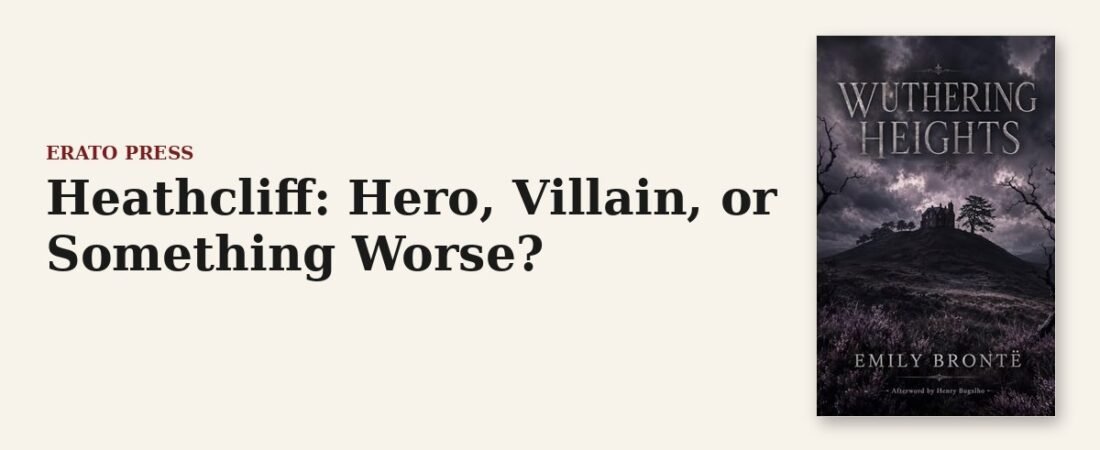
Meet Heathcliff in the Erato Press Wuthering Heights →
Related reading: The Brontë Sisters: Where to Start · Wuthering Heights: Love, Violence, and Dissolution · The Life of Charlotte Brontë
This article draws on the original afterword “Dissolution as Destiny,” written for the Erato Press edition. This article contains affiliate links; as an Amazon Associate, Erato Press earns from qualifying purchases.
Enjoyed this piece?
Get the next one — our essays on the classics and news of each new Erato Press edition — straight to your inbox.