The stepsisters in the Grimms’ Cinderella do not merely fail to fit the slipper. They take a knife to themselves. The mother hands the first one a blade and tells her to cut off her toe—”when you are queen, you will no longer have to go on foot.” The second hacks off a slice of her heel. Each climbs into the carriage beside the deceived prince, and each time two pigeons perched in the hazel tree over the dead mother’s grave call out the truth: look, look, there’s blood in the shoe. At the wedding, the same pigeons fly down and peck out the sisters’ eyes, one at the approach and one at the departure, so that they are left blind for the rest of their days “as a punishment for their wickedness and falsehood.” There is no fairy godmother in this story, no pumpkin, no singing mice. There is a grave, a hazel branch the girl waters with her tears, and birds that mete out justice with their beaks.

This is the version Jacob and Wilhelm Grimm printed in 1812, and it is closer to what Europe had been telling itself for centuries than anything you saw as a child. The familiar tales are not softened folklore. They are folklore that has been put through two centuries of laundering—first by the Grimms themselves, then by Andrew Lang and the Victorian anthologists, and finally and most thoroughly by the Walt Disney Studios, which turned a corpus of peasant cruelty into the house style of American childhood. To read the originals is to recover a body of stories that knew, far better than their adaptations, what they were about.
Even the Grimms cleaned house
The first surprise is that the sanitizing began with the collectors. We picture the brothers as faithful scribes taking dictation from toothless village grandmothers, but the reality of their method—and of the seven editions they issued between 1812 and 1857—is a story of relentless revision. Their sources were often educated young women of their own bourgeois Kassel circle, some of them of French Huguenot descent, who already knew Charles Perrault. And with each edition Wilhelm in particular polished, expanded, and moralized, smoothing the prose toward the “book German” of a respectable nursery.
The most telling edits concern sex and mothers. In the 1812 Rapunzel, the girl innocently asks the enchantress why her clothes have grown so tight around her waist—a pregnancy the prince’s nightly visits have plainly produced. By 1857 the line is gone, replaced by a slip of the tongue in which Rapunzel merely mentions the prince by accident. More systematically, the cruel mothers of the early editions become stepmothers in the later ones. The murderous figure in Snow White is the heroine’s own mother in 1812; only later does she mutate into the stepmother who has anchored herself in the popular imagination. The Grimms could publish a mother who orders a huntsman to bring back her child’s lungs and liver so she can eat them, salted—but only, it seems, once that mother had been demoted to a second wife. The biological mother had to be protected; the household tyrant could keep her appetite.
The catalogue of mutilation
Strip away the adaptations and what remains is startlingly bodily. Snow White’s queen, in the original, is made to dance to death at the wedding in a pair of iron shoes heated red-hot over coals. The wolf and the seven kids ends with the goat slitting the sleeping wolf’s belly open with scissors, sewing it full of stones, and watching him drown in the well when he stoops to drink. In The Goose Girl, the false bride pronounces her own sentence without knowing it: a usurper, the king says, deserves to be stripped naked, put into a barrel studded inside with sharp nails, and dragged through the streets by two white horses until she is dead—and so she is. These are not lapses or excesses. They are the form. The fairy tale, in its older shape, is a machine for converting wickedness into a precisely calibrated physical punishment, and the satisfaction it offers is the satisfaction of exact retribution: the eye for the eye, the dance for the poison, the barrel for the lie.
What the Disney process erased was not only the gore but the moral logic the gore expressed. A Cinderella with a fairy godmother is a story about luck and a pretty face. A Cinderella who plants a tree on her mother’s grave, waters it with grief, and is answered by birds is a story about the dead protecting the living and about labor rewarded—a far stranger and older proposition. Sanitization does not merely remove blood. It removes the reason the blood was there.
A nation assembled out of stories
To understand why two serious philologists spent their lives on nursery tales, you have to see the political weather of the early nineteenth century. When the Grimms began collecting, the German-speaking lands were a scatter of principalities recently overrun by Napoleon. “Germany” was a language and a hope, not a state. The brothers belonged to the generation of Romantic nationalists for whom the Volk—the common people—were the carriers of an authentic national spirit that French rationalism and aristocratic French manners had nearly snuffed out. Folk tales, in this view, were not entertainment but evidence: relics of a deep Germanic past, the literature of a nation that had never been allowed to become one.
This is the irony beneath the brothers’ scholarship. They presented the Kinder- und Hausmärchen as pure German oral tradition while quietly absorbing tales of French literary origin and editing the rest toward a respectable national ideal. The project was philological and patriotic at once—the same impulse that drove Jacob to the monumental Deutsche Grammatik and the great German dictionary drove both brothers to the tales. They were trying to give a future country a usable past. That the past they assembled was partly invented, partly imported, and heavily revised does not make it less powerful; the most influential national mythologies usually are. The stories worked their way so deeply into the culture that they became the thing they claimed already to be.
The American answer to this hunger came a century later and from a very different soil. When L. Frank Baum set out to write what he called “a modernized fairy tale, in which the wonderment and joy are retained and the heartaches and nightmares are left out,” he was reacting against precisely the Grimm tradition—and producing something only a young, optimistic republic could have imagined. The contrast illuminates both. You can read our companion essay on The Wizard of Oz: America’s Own Fairy Tale to see what a fairy tale looks like when a culture deliberately drains it of cruelty from the start, rather than scrubbing the cruelty out afterward.
Frequently asked questions
Are the Grimms’ tales suitable for children?
Many of them, in the original, were not written with the modern child in mind at all—the early editions carried scholarly notes and were aimed as much at adults and antiquarians as at the nursery. That said, generations of children have read the unbowdlerized versions without harm, and child psychologists from Bruno Bettelheim onward have argued that the tales’ frankness about cruelty, abandonment, and death is exactly what makes them useful: they give a name and a shape to fears children already have. The point is not to shock but to read with awareness of what these stories were and are.
Did the Grimms write these stories?
No—they collected and, crucially, edited them. The tales descend from oral and earlier literary traditions across Europe; many have analogues in Perrault’s French collection of 1697 and in Italian sources older still. The Grimms’ achievement was to gather, arrange, and shape this material into a single national corpus, and Wilhelm’s rewriting across the editions gradually gave the tales the polished narrative voice we now think of as theirs.
Which translation should I read?
It matters more than for almost any other book, because so many English versions are themselves bowdlerized—softened a second time on top of the Grimms’ own softening. A faithful translation preserves the bluntness of the punishments and the strangeness of the moral world. Avoid retellings marketed as “complete” that have quietly trimmed the iron shoes and the pecked-out eyes.
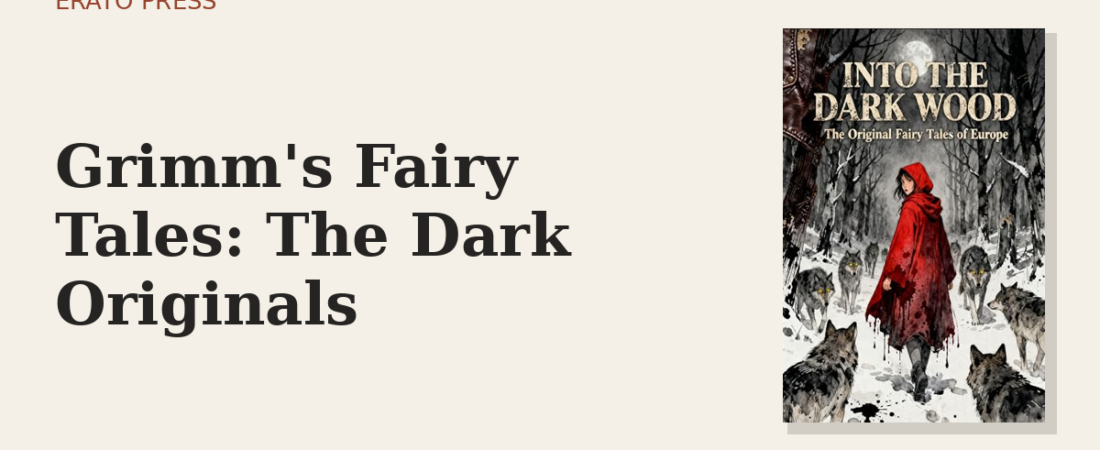
The Erato Press edition restores the tales in their unsoftened force and frames them with an introduction on the brothers’ method, their nationalist project, and the long history of editing that separates what you remember from what they actually printed. We have kept the blood in the shoe—and explained why it belongs there.
Read the Erato Press edition →
Enjoyed this piece?
Get the next one — our essays on the classics and news of each new Erato Press edition — straight to your inbox.