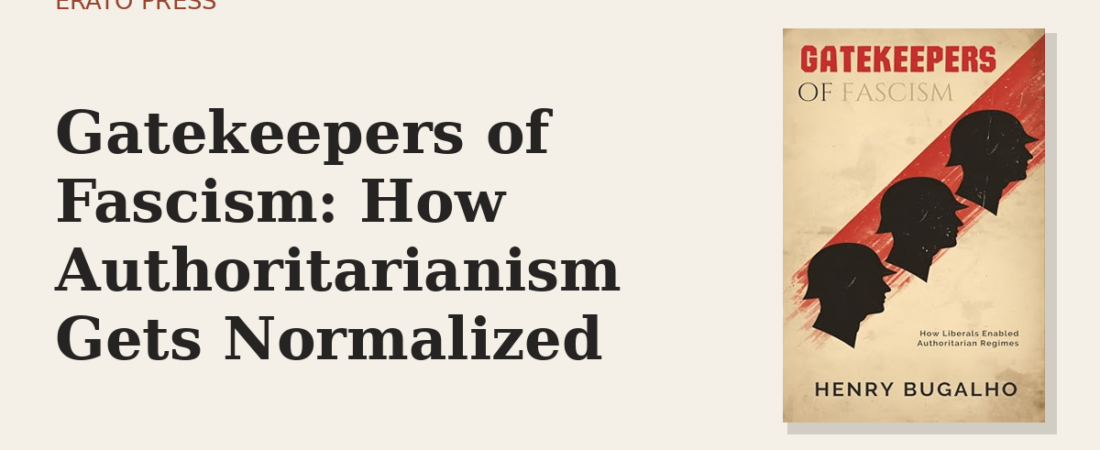
Authoritarian regimes are not, in the modern era, usually built by authoritarians. They are built by the people who were supposed to stop them. This is the uncomfortable thesis at the center of the essays collected here: that the decisive actors in the collapse of a constitutional order are rarely the would-be strongmen themselves — who are, after all, a permanent feature of any political landscape — but the respectable, moderate, institution-tending figures who hold the gates and, at the crucial moment, decide to open them. The story of how democracies fall is, far more often than we like to admit, the story of a failure of gatekeeping.

The point bears stating carefully, because it is easy to mistake for a slogan. The argument is not that centrists are secretly fascists, nor that every compromise is a betrayal. It is something more precise and more disturbing: that liberal and conservative establishments possess, in normal times, an effective veto over who is allowed into serious politics — and that this veto, the quiet machinery of exclusion that keeps demagogues at the margins, is the actual load-bearing structure of a democracy. When it holds, the extremist remains a crank. When it fails, the crank becomes a chancellor. The history that matters is the history of those failures.
What a gatekeeper actually does
Every functioning democracy runs on a set of unwritten understandings that no constitution can encode. Mainstream parties agree, tacitly, not to form coalitions with anti-system movements. Editors decline to treat conspiracy as news. Business leaders refuse to fund candidates who threaten the rule of law. Judges, prosecutors and civil servants apply the rules to the powerful as to the weak. None of this is mandated; all of it is convention; and convention is precisely the thing a determined antagonist sets out to erode. The gatekeepers are the people positioned to enforce these understandings — and the moment they begin to calculate that the extremist might be useful, or merely unstoppable, the gate is already half open.
The classic mechanism is not persecution but accommodation. The respectable conservative tells himself he can harness the radical’s energy and discard the radical afterward. The liberal tells herself that the proper response to an anti-democratic movement is more openness, more debate, more procedural fairness — that to exclude is to become what one opposes. Both reassure themselves with the same comforting word: normal. Surely this is just the ordinary churn of politics; surely the institutions will hold; surely the man is not as bad as he sounds. Normalization is not a single decision but a thousand small ones, each defensible in isolation, that together carry a society across a line it never consciously chose to cross.
The lessons of the twentieth century, read honestly
The instructive cases are well known and worth recalling with their specifics intact, because the specifics are where the lesson lives. The men who handed Germany to Hitler in January 1933 were not Nazis. They were conservative aristocrats and industrialists and a senile field marshal who believed they could install him as a figurehead and govern through him — “we have hired him,” one of them is supposed to have said, and within months it was clear who had hired whom. Italy’s liberal establishment spent two years treating Mussolini’s squads as a regrettable but manageable nuisance, and a king who could have called out the army instead invited the man to form a government. In each case the fatal move was made by people who thought of themselves as the responsible center, the grown-ups in the room, the bulwark — and who reasoned their way, step by procedural step, into opening the door.
The essays insist on this historical specificity rather than the easy analogy, and the insistence is a discipline. It is tempting to flatten every authoritarian episode into a single morality tale, to make every demagogue a Hitler and every compromise a Munich. That flattening is itself a kind of evasion, because it makes the danger look unmistakable — jackboots, torchlight, an obvious villain — when the real danger is precisely that it does not look like that at the time. To the people living through 1922 or 1933, the slide felt like ordinary, even tedious, political maneuvering. The lesson of the cases is not that we should watch for monsters. It is that we should watch the gatekeepers, and the language of reasonableness they use to justify each accommodation.
The grammar of normalization
If there is a single contribution these essays make, it is to anatomize the rhetoric by which the abnormal is made to seem ordinary — and to do it with a restraint that refuses cheap partisan point-scoring. The mechanisms are not the property of any one faction; they are tools, available to whoever finds them useful, and the discipline of the argument is its refusal to pretend otherwise. The dehumanizing language that prepares a population to accept the unacceptable is one such tool, examined at length in Manufacturing an Enemy: How Propaganda Dehumanizes — the slow rhetorical work of redefining a portion of one’s fellow citizens as a contamination to be removed rather than an opposition to be argued with.
Normalization has a grammar, and once you can read it you cannot unsee it. There is the rhetoric of both-sidesism, which treats an attack on the constitutional order as one more position to be weighed against its critics. There is the rhetoric of inevitability, which counsels accommodation on the grounds that resistance is futile and one had better secure a seat at the table. There is the rhetoric of whataboutism, which neutralizes every alarm by pointing to some hypocrisy on the other side. And there is the most seductive of all, the rhetoric of institutional faith — the serene conviction that the courts, the press, the permanent bureaucracy will surely hold, which is precisely the conviction that persuades the gatekeepers they need not personally do anything. Institutions do not defend themselves. They are defended, or surrendered, by people.
Why this is a book about the present, without naming it
The restraint of these essays — their refusal to collapse into the partisanship of any particular national moment — is not timidity. It is method. An argument about the structural conditions of democratic collapse is more useful, and more durable, if it does not hitch itself to the headline of the week; the reader is trusted to draw the lines to the present, and trusted to do so across the political spectrum, because the failure modes described here have no fixed party. The point is not to indict a side. The point is to describe a vulnerability that every constitutional order shares, and to locate the responsibility where it actually sits: not only with the would-be autocrat, who is doing what such men have always done, but with the custodians of the institutions he means to capture, who alone have the power to stop him and who, again and again in the historical record, have chosen not to.
Political violence, when it comes, is downstream of this failure rather than its cause — the symptom that appears once the gates have already been left open. Readers who want to trace how that violence has surfaced and resurfaced within a single democracy’s history, rather than only in the European catastrophes, will find that recurrence examined in Political Violence in America: A Long, Recurring Shadow. The two arguments belong together: one describes the door, the other describes what walks through it once the door is open.
Frequently asked questions
Isn’t “gatekeeping” just another word for elite control of politics?
It is elite control, and the essays do not pretend otherwise — but the argument is that some forms of exclusion are the immune system of a democracy rather than a defect of it. The refusal of mainstream actors to legitimize anti-constitutional movements is not the same as suppressing dissent; it is the maintenance of the boundary that separates ordinary political conflict from an assault on the rules of the game.
Is this a partisan book?
Deliberately not. The mechanisms it describes — accommodation, normalization, institutional complacency — have served authoritarian movements of the left and the right alike, and the essays keep their focus on the structure of the failure rather than on assigning it to one camp. The reader is left to apply the analysis wherever it fits.
What can an ordinary reader actually do with this?
Learn to recognize the grammar of normalization when it appears, and to be suspicious of the language of reasonableness that asks you to treat an attack on the system as one more debatable opinion. The first defense against the failure of gatekeeping is the refusal to be reassured.
Erato Press has gathered these essays in a single volume, edited and annotated to set each argument in its historical frame and to draw out the connections among them. For readers who want to understand how authoritarianism gets in — not through the front gate, but through the people holding it — it is the edition to have.
Read the Erato Press edition →
Enjoyed this piece?
Get the next one — our essays on the classics and news of each new Erato Press edition — straight to your inbox.