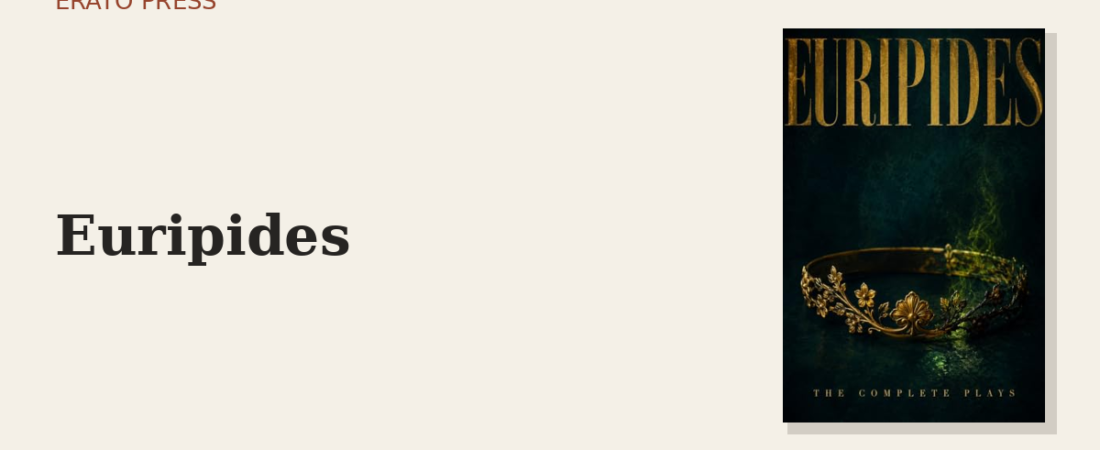

With this edition, the three great tragedians of Athens are complete on one shelf — Aeschylus who invented tragedy, Sophocles who perfected it, and now Euripides, who broke it open. He was the youngest of the three, the least honoured in his lifetime, and the most like us.
Where his predecessors wrote of gods and kings, Euripides dragged tragedy down to the human. His characters are not heroes but people under unbearable pressure: Medea, the abandoned wife who murders her own children to punish the husband who left her; the women of a burning Troy, handed out as spoils; Pentheus, torn apart by his own mother in the ecstasy of The Bacchae. He put real, wounded, unheroic people on the stage, and gave voice to the ones tragedy had ignored — women, slaves, the mad, the defeated.
His contemporaries found him disturbing. He questioned the gods, exposed the cruelty beneath heroic myth, and refused easy comfort. Aristophanes mocked him; the prizes went to safer men. But it was Euripides the future would follow. Every play since that finds tragedy in ordinary suffering, every drama that sides with the victim rather than the victor, is his descendant.
This edition gathers all nineteen surviving plays — Medea, The Bacchae, Hippolytus, Electra, and more — in one annotated critical volume. It completes the Erato editions of the Greek stage, the foundation on which all Western drama stands.
Read The Complete Plays of Euripides →
Enjoyed this piece?
Get the next one — our essays on the classics and news of each new Erato Press edition — straight to your inbox.